
T-Promotion Thickness Variation Visualization for Automobiles



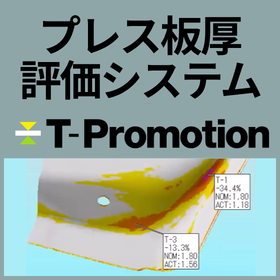
Evaluate the reduction in thickness of press-formed products using 3D data to support lightweight design.
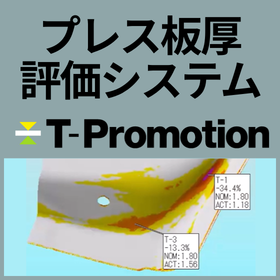
In the automotive industry, weight reduction is essential for improving fuel efficiency and performance. Thickness management of press-formed parts is a crucial factor in lightweight design. Inadequate or excessive thickness can affect the strength and durability of parts, potentially hindering the achievement of design goals. T-Promotion visualizes the reduction of thickness in press-formed products using 3D data, enabling a reduction in the man-hours required for thickness measurement and ensuring quality management without measurement omissions. 【Usage Scenarios】 - Lightweight design of press-formed parts - Quality improvement through thickness management - Confirmation of neck and crack occurrence - Identification of processes leading to thickness reduction - Evaluation of formability 【Benefits of Implementation】 - Support for identifying issues during the design phase through thickness evaluation with 3D data - Increased efficiency in thickness measurement and improved quality management - Enhanced fuel efficiency through optimization of lightweight design - Early detection and countermeasures for forming defects - Cost reduction and increased productivity
basic information
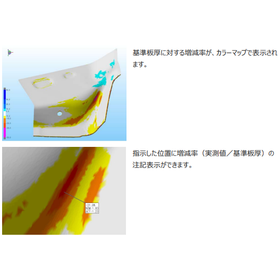
**Features** - Visualization of thickness variation rates using 3D data - Elimination of thickness measurement omissions - Detection of necking and cracking areas - Thickness evaluation between processes - Evaluation of formability based on press conditions **Our Strengths** We provide a supportive service specialized in the manufacturing industry, with a strong focus on 3D shape processing technology. We carefully understand our customers' challenges and offer optimal solutions through on-site analysis and reliable technical expertise.
Price range
Delivery Time
Applications/Examples of results
It is mainly used in the automotive industry's press die manufacturing, prototyping, and mass production processes. • Detection of defects during die tryout: By 3D scanning the panel immediately after press forming, it identifies "areas of reduced thickness (necks)" before cracks or wrinkles occur. This contributes to understanding the behavior of actual dies that could not be predicted by CAE analysis. • Mass production startup and regular quality management: By conducting overall scans using non-contact measurement devices instead of traditional sampling measurements, it shortens measurement time while expanding the inspection range to the entire area. This achieves a shift from "measuring only areas of concern" to "overall assurance." • Evaluation of tailored blank (TWB) materials: Even for panels made from materials with varying thicknesses, they can be uniformly evaluated and managed based on the rate of increase or decrease.
catalog(1)
Download All Catalogs
Recommended products


Distributors

Since our establishment in 1984, we have consistently faced the diverse challenges encountered in the manufacturing industry. By combining our customers' extensive know-how with our strength in three-dimensional shape processing technology, we provide solutions that are truly beneficial to manufacturing sites. The pillars of our business are "contract development," which leverages our flexible responsiveness, and "packaged products," which reflect the needs of the field. In both areas, we aim to carefully understand our customers' challenges and utilize our analytical skills from a field perspective along with our solid technical capabilities to deliver valuable products and services.