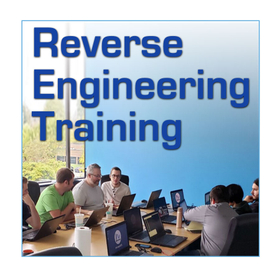
Vehicle Reverse Engineering Training


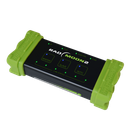
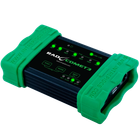
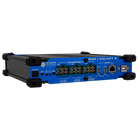
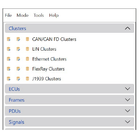
Read the CAN log of the actual vehicle in a "physical value" state. Systematically learn how to create DBC files with VehicleSpy.
[Target Audience] - Individuals with basic knowledge of CAN who conduct measurements/logging on actual vehicles or benches - Engineers involved in the analysis of vehicles or ECUs for which specification documents (DBC files) do not exist - Those who want to estimate "what each ID means" in vehicle CAN logs and reach physical value monitoring - Those who want to master the reverse engineering support functions in VehicleSpy [Overview] In this seminar, participants will learn a series of analysis techniques to visualize "raw data" obtained from the vehicle CAN bus as physical values. Participants will identify which ID is sent from which ECU, estimate bit assignments, and calculate scaling—practically learning these three analysis steps using the reverse engineering support functions in VehicleSpy. By the end of the seminar, participants will acquire the skills to create a DBC file as a final deliverable.
basic information
[Agenda of the Seminar Content] 1. Introduction - Training targets and objectives - Prerequisite knowledge and materials needed for reverse engineering (service manuals, diagnostic tools, etc.) 2. Overview and Procedures of Reverse Engineering - Estimation of ID levels: Identifying which ECU is sending which ID - Estimation of bit assignments: Identifying signal positions - Estimation of scaling: Deriving conversion formulas from raw values to physical values 3. Reverse Engineering Functions of Vehicle Spy - Reverse Engineering View: Utilizing a dedicated analysis view - Highlighting Function: Visualization and suppression of data change points - Integration with Rx Messages Table: Automatic addition of received IDs and DBC export - Template Mode: Assisting ID identification using known patterns - Support for scaling analysis: Setting data points using graph display and reflecting them in the database
Price range
Delivery Time
Applications/Examples of results
[Application Examples of Seminar Content] - Identification of ECU: Confirmation of transmission ID stop by connector removal - Analysis of wheel speed sensors: Correlation confirmation between speed changes during actual driving and CAN data (bit assignment estimation) - Analysis of body system signals: Identification of signal changes due to door/window opening and closing, and light ON/OFF operations - Analysis of actuators and vehicle status: Tracking data fluctuations associated with shift operations and temperature changes
Recommended products
Distributors
In 1994, Intrepid Control Systems was established in the suburbs of Detroit, Michigan, and since then, we have been delivering the latest development tools that support various in-vehicle communication standards to customers around the world. We provide development tools for CAN/CANFD, LIN, Automotive Ethernet, BroadR-Reach, FlexRay, MOST, Keyword2000, ISO14229, ISO9141, UART, J1939, J1850, GMLAN, I2C, SPI, and more. Our customers range from large corporations included in the Fortune 100, major OEMs, to individuals. In addition to a global network of distributors, we have branches in the USA, Japan, China, India, Germany, the UK, and South Korea, where we offer direct sales and technical support. We also actively host seminars in the automotive industry, participate in exhibitions, and contribute in areas such as technical papers.