
Cracks and insufficient hardness after heat treatment | Explanation of processing, causes, and countermeasures by representative steel types.




Are you puzzled by cracks and deformations occurring after heat treatment? We will explain the considerations for troubleshooting by checking the type of steel treatment and the heating and cooling conditions.
In heat treatment of steel materials, even when the same treatment is applied, the hardness and degree of deformation obtained can vary depending on the type of steel and the dimensions and shapes of the components. To prevent insufficient hardness or cracking after treatment, it is important to confirm the material properties along with the heating and cooling conditions. 【Recommended for these concerns】 - Insufficient hardness after heat treatment - Cracking or deformation after quenching - Wanting to know the differences in treatment for each type of steel <What you can learn from the article> - Representative types of steel and the concept of heat treatment - Main factors causing insufficient hardness and cracking - Points to check for deformation, decarburization, and temper brittleness In the second part, we will organize points to confirm in heat treatment using examples such as S45C and SCM440 for machine structural steel, and SKD11 for tool steel. In large components, even if the surface is hardened, the necessary hardness may not be achieved internally. For tool steel, attention is also needed for retained austenite and decarburization during high-temperature heating. The cause of issues is not always singular. Please use this as a reference when investigating the causes by cross-referencing the type of steel, component shape, treatment records, and hardness measurement results. Inquiries about steel selection are welcome.
basic information
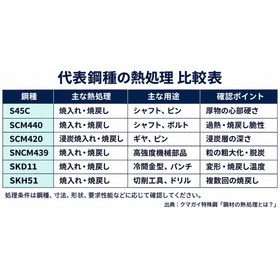
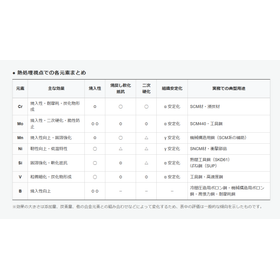
The heat treatment conditions vary depending on the composition of the steel type, hardenability, dimensions of the parts, and the required hardness. We have organized the treatments for representative steel types and points to check when considering potential issues. - Carbon steels such as S45C: Quenching is performed using water cooling. While hardness is achieved through cooling, care must be taken to avoid cracking and deformation due to rapid cooling. - Alloy steels for mechanical structures such as SCM440: Oil cooling is commonly used for quenching. For large components, it is important to confirm that the required hardness is achieved not only on the surface but also in the core. - Tool steels such as SKD11: There may be an increase in residual austenite after quenching, which should be considered in relation to dimensions and performance. Sub-zero treatment or multiple tempering may be considered as needed. - High-speed steels such as SKH51: Secondary hardening is utilized through tempering. It is necessary to confirm the conditions according to the steel type, including multiple tempering. - SACM645, SKD61, etc.: Nitriding is an option for surface hardening. To obtain the necessary properties not only on the surface but also internally, the heat treatment conditions prior to nitriding should also be confirmed. - Common issues: If problems such as insufficient hardness, quench cracking, deformation, or decarburization occur, it is important to check the steel type as well as the part shape and heating/cooling conditions.
Price range
Delivery Time
Applications/Examples of results
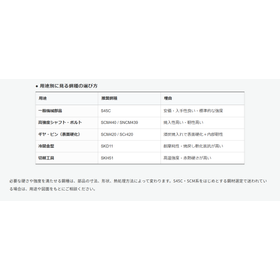
In mechanical structural components such as shafts and bolts, quenching and tempering are considered to achieve strength and toughness. If a thick shaft has surface hardness but insufficient internal strength, the hardenability of the steel type and the cooling conditions relative to the component dimensions are checked. If cracks occur at corners or steps after quenching, stress concentration due to rapid cooling or the influence of shape may be considered. Reviewing the cooling method suitable for the steel type, the shape of the corners, and the heating conditions is the starting point for countermeasures. If deformation occurs in thin sections or asymmetric shapes, variations in cooling or the condition of the jigs should also be checked. In tools and molds using materials like SKD11, residual austenite may be related to dimensional changes after processing. If fine cracks are observed on the surface of molds made from SKD61 during use, in addition to repeated heating and cooling, the state of tempering and residual stress should be checked. Insufficient hardness, decarburization, and cracking cannot be definitively attributed to causes based solely on symptoms. Please gather information on the steel type, shape, heat treatment chart, measurement results, and usage conditions, and contact our representative.
Line up(5)
| Model number | overview |
|---|---|
| S45C (carbon steel for machine structures) | Quenching by water cooling is used. While hardness is obtained through cooling, care must be taken to avoid cracking and deformation due to rapid cooling. |
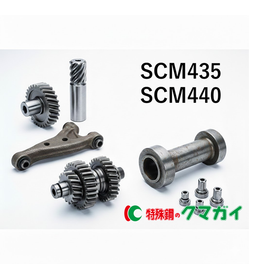
| SCM440 (Cr-Mo steel) | Quenching by oil cooling is common. For large components, it is checked whether the required hardness is achieved not only on the surface but also in the core. |
| Tool steels such as SKD11 | After quenching, there may be an increase in residual austenite, which should be considered in terms of dimensions and performance. Sub-zero treatment or multiple tempering processes may be considered as needed. |
| High-speed steel such as SKH51 | We will utilize secondary hardening through tempering. It is necessary to confirm the conditions according to the steel type, including multiple tempering processes. |
| SACM645, SKD61, etc. | Nitriding to harden the surface is an option. In order to obtain the necessary properties not only on the surface but also internally, we will also check the heat treatment conditions before nitriding. |
catalog(1)
Download All Catalogs
Recommended products






Distributors
**Expanding Our Global Steel Business!** We support both **CIF and EX Works (EXW)** terms. **Delivering Japanese Specialty Steel to the World.** Since our establishment in 1913, we have been a specialized trading company of special steel for nearly a century, listening to the needs of many customers and building an ideal relationship between customers and steel manufacturers as a conductor of steel distribution. As a trading company with various processing equipment, including cutting machines and laser cutting machines, we also contribute to reducing our customers' capital investment. Please feel free to contact us if you have any requests.