
Sintered alternatives for sliding parts and mechanism parts: irregular wire + precision cut near-net shape parts.


Proposing the reduction of subsequent processes and improvement of mass production by leveraging strength, surface properties, and continuous production through plastic processing.
We propose a method transition to "shaped wire + precision cutting" for mechanical and sliding components manufactured using the sintering process. This is a near-net-shape method that forms a cross-sectional shape close to the final component through plastic processing such as drawing and rolling, and cuts it to the required length with high precision. ■ Improvement of Strength and Toughness By using shaped wire through plastic processing, we aim to enhance the strength and toughness by replacing sintered components. We also recommend this for components where strength improvement is being considered. ■ Surface Properties Suitable for Sliding Parts A smooth surface can be formed through drawing and rolling. We can consider applying this to parts where contact and sliding affect functionality, such as cams, latches, splines, wedges, and guides. ■ Reduction of Processes through Precision Cutting Our unique precision cutting technology suppresses burrs and deformation during cutting. Depending on the shape, it may be possible to use the parts as they are without additional processing. This leads to a reduction in subsequent processes such as cutting, barreling, polishing, and chamfering. ■ Mass Production Capability through Continuous Production By continuously forming and precisely cutting shaped wire from coil material, we can accommodate parts in large quantities. We also propose combining additional processes such as cold forging, pressing, cutting, rolling, and tapping as needed.
basic information
For details, please refer to the download. It includes information on the applicable accuracy and hardness handling standards.
Price range
Delivery Time
Applications/Examples of results
■Sliding and Mechanism Parts Cams, latches, splines, wedges, guide blocks, etc. Parts that require contact and sliding functions with counterpart components. ■Rotating and Transmission Parts Gears, shafts, keys, etc. Parts with irregularities, grooves, and R shapes. ■Locking Mechanism Parts Claw parts, engagement (fitting) parts, stoppers, etc. Mechanism parts used for engagement and positioning of components. ■Other Irregular Parts Weights, spacers, pins, irregular blanks, blanks for forging, etc. Parts that can be shaped through cutting or parts that combine additional processing.
catalog(2)
Download All Catalogs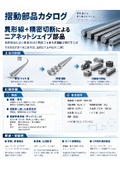

Recommended products


Distributors

Since its establishment in 1947, we have been manufacturing and selling steel wire products through drawing and rolling processes, and now we offer integrated production from cold-formed components to metal parts produced by pressing, shearing, and machining. In particular, we excel in the production of deformed coil wire with irregular cross-sections, and our strength lies in our ability to consistently produce unique deformed metal parts utilizing these irregular wires. Compared to powder sintering and precision casting methods used for manufacturing deformed parts, our deformed metal parts produced entirely through plastic processing at Namitei possess excellent toughness, strength, and smooth surface characteristics, making them widely adopted in sliding components and thin-walled deformed parts. To leverage the cost advantages of continuous processing, we propose specifications that mix functional applications and processing characteristics to meet our customers' needs.