
news list
latest news
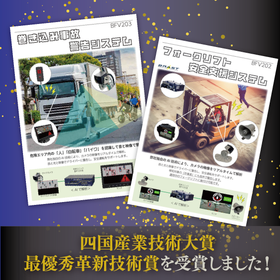
The blog has been updated! Awarded the Grand Prize for Innovative Technology at the Shikoku Industrial Technology Awards!!
On the blog, we introduce the daily activities of Pal Giken. This time, we will share the details of the "Shikoku Industrial Technology Award" ceremony. Please visit the website below.
31~36 item / All 36 items
-

Image Intrusion Unit (BSV11) with customizable settings to match the conditions of the area to be monitored.
The "Image Intrusion Monitoring Unit (BSV11)" is a product that analyzes images from analog and IP cameras in real-time to detect intruders. The BSV11 allows for the setting of eight detection areas, each with its own conditions for determining an intruder. ◆ Pre-area... Up to four can be set. An alarm is triggered when an intruder exits the detection area and meets the judgment conditions. ◆ Normal area... Up to four can be set. An alarm is triggered when an intruder enters the detection area and meets the judgment conditions. If only one condition can be set to determine an intruder, adjusting the judgment condition to account for the difficulty of detecting in the background can lead to excessive detection in the foreground. In such cases, utilizing these eight detection areas allows for setting judgment conditions specific to the background and foreground. Additionally, if there are large movements of vegetation or similar objects within the image, setting that area as a pre-area allows for the detection of only intruders that exit the area, while the stationary vegetation remains undetected. This also helps reduce false alarms.
-

Normal detection is possible even in heavy snowfall areas! "Snow Accumulation Prevention Cover (PSP-SCV)" and "Snow Accumulation Prevention Reflector (PRF-300SP)"
This time, we would like to introduce the "Snow Accumulation Prevention Cover (PSP-SCV)" and the "Snow Accumulation Prevention Reflector (PRF-300SP)." When snow accumulates on the surface of a microwave sensor, it may not be able to detect properly depending on the amount of snow. To prepare for such situations, we have the "Snow Accumulation Prevention Cover (PSP-SCV)" available. *Applicable sensors: BSS01, BSS20, BLS01, BFS01 By attaching this to the sensor, you can prevent snow accumulation on the sensor body. Additionally, when installing the microwave intrusion detection sensor (BSS01) facing the reflector, we also have the "Snow Accumulation Prevention Reflector (PRF-300SP)" designed to prevent snow accumulation on the reflector. By using these products together, normal detection is possible even in heavy snowfall areas.
-

Microwave Proximity Sensor (BSS300) that detects people entering a detection area of 0.5m to 20m.
This sensor, as its name suggests, monitors the surrounding area and detects individuals who enter a detection zone of 0.5m to 20m. Other features include: ● Wide-angle monitoring of close-range areas It monitors with a beam width of approximately 52° horizontally and 45° vertically. ● High separation resolution of 20cm. This means it can distinguish between two closely approaching points or lines, detecting changes of 20cm. (Our conventional sensors detect at 2m.) As a result, even when emitting radio waves towards the ground, it can differentiate between the ground and intruders for monitoring. ● Strong against changes in the surrounding environment, such as weather, due to the characteristics of microwaves. Unlike conventional passive sensors used for close-range outdoor monitoring, it is not affected by temperature or weather changes. (Passive sensors detect people by receiving infrared radiation emitted from the human body.) Examples of installation for close-range sensors include: ● Pole monitoring ● Gate intrusion monitoring ● Building entrance intrusion monitoring, among others. Particularly in pole monitoring, it can complement the blind spots that occur at the feet of other intrusion monitoring sensors by monitoring from above towards the ground, allowing for a more seamless detection area to be established.
-

Beam reflection detection method and beam interruption detection method, two detection methods of microwave.
At Pal Giken, we are developing various sensors that use "microwaves," and this time we will explain how they detect intrusions. ◆◆ Two Detection Methods ◆◆ Our microwave sensors support two detection methods. 1) Beam Reflection Detection Method A single sensor is installed, and the transmitted wave output from it defines the detection area. The detection range depends on the antenna angle of the sensor, but the sensor alone covers a wide distance. When a target intercepts the transmitted wave from the sensor, it is received as a reflected wave and detected as an "intrusion." 2) Beam Interruption Method This method configures the detection area by positioning the sensor and reflector opposite each other. The transmitted wave output from the sensor hits the reflector and is received as a reflected wave. There are also products that configure the detection area using a transmitter and receiver. In this case, the transmitted wave output from the transmitter is received by the receiver. In both cases, the levels that serve as the basis for transmission and reception are monitored, and if the wave is interrupted due to an intrusion, causing the level to fall below a threshold, it is detected as an "intrusion."
-

What is a microwave?
Microwaves are a type of radio wave and a form of electromagnetic wave. Electromagnetic waves propagate as repeating waves, and the number of repetitions per second is called frequency (measured in hertz, Hz). The length from the peak of one wave to the peak of the next is called wavelength. The name of electromagnetic waves changes according to their frequency, and their applications also vary based on their characteristics. In our company, we refer to radio waves with frequencies ranging from 3 GHz to 30 GHz (wavelengths from 10 cm to 1 cm) as "microwaves," and we use 24 GHz band radio waves in our microwave sensors. ◆◆ Features of Microwaves ◆◆ The features of microwaves include: - High directivity - Resistance to weather changes such as rain, fog, and snowfall - Ability to penetrate materials like resin, making them unaffected by obstacles These features, combined with our unique algorithms (signal processing technology), enable long-distance detection even in harsh environments. Additionally, our sensors can be used without a license. They can be used both indoors and outdoors in Japan, allowing for installation in various situations.
-

The "Multi-Span Sensor" enables detection over a wider area without gaps (blind spots) thanks to its multi-link functionality.
At Pal Giken, we are developing various sensors that use "microwaves." Even when we refer to "microwave sensors," there are many different purposes and applications, each with its own characteristics. We would like everyone to know about these features! Therefore, today we would like to introduce our products. The product we are introducing this time is the "Microwave Multi-Span Sensor (BSS200-P1)." The multi-span sensor can receive microwaves sent from one unit with multiple units. (Up to three units can be used.) Compared to installing several standard one-to-one transmitters and receivers, there are no gaps (blind spots) in the radio waves. This multi-link function allows for detection over a wider area.