
Machine Learning Force Fields for Organic and Inorganic Systems [Materials Provided]


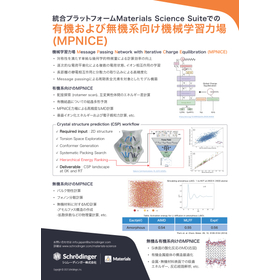
A message-passing machine learning force field with DFT-level accuracy accelerates organic, inorganic, and hybrid material simulations with high precision.
Machine learning force fields, also known as "machine learning interatomic potentials," have emerged as an important tool for achieving cost-effective atomic-level simulations of diverse chemical systems, often achieving accuracy comparable to density functional theory (DFT) at significantly lower computational costs. Recent advancements in message-passing networks have overcome the challenge faced by traditional MLFFs of being limited in the types of elements they can accommodate. Furthermore, the introduction of atomic charges and electrostatic interactions using charge equilibration methods allows for precise reproduction of multiple charge states, ionic systems, and electronic response characteristics, achieving even higher accuracy by explicitly considering long-range interactions. Our MLFF architecture, "MPNICE," incorporates explicit electrostatics for accurate charge representation. We also provide a set of pre-trained models trained on materials covering the entire periodic table (89 elements). MPNICE emphasizes high throughput performance, enabling long-duration and large-scale atomic-level simulations that were difficult to achieve with traditional methods while maintaining high accuracy.
basic information
MPNICE (Message Passing Network with Iterative Charge Equilibration) - A message-passing machine learning force field (MLFF) architecture that achieves calculations an order of magnitude faster than models of equivalent accuracy while incorporating atomic partial charges and long-range interactions. - It is utilized as a general-purpose model for organic materials, inorganic materials, and organic-inorganic hybrid materials to meet the needs of the industry. *For more details, please feel free to contact us.*
Price information
For more details, please feel free to contact us.
Delivery Time
Applications/Examples of results
For more details, please feel free to contact us.
Related Videos
catalog(5)
Download All Catalogs




Recommended products




Distributors

Schrödinger Co., Ltd. is the Japanese subsidiary of Schrödinger Inc., headquartered in New York, USA. Schrödinger has a history of about 30 years in developing software that integrates advanced technologies in chemistry and computer science, primarily in the fields of materials science and life sciences, providing advanced solutions for drug discovery, biologics, and materials research and development.