
Improvement of design efficiency in battery system development: Battery model / BMS model


Model-Based Development Solution Model Library
Are you facing challenges with "Battery Control and State Estimation" in embedded, automotive, and robotics systems? ● Unable to accurately estimate the state of the battery (SOC) ● Concerns about control accuracy and safety due to the effects of temperature and degradation ● Development reliant on actual machine testing, leading to time and cost in verification ● No practical battery model available for embedded environments ▼ Leave it to our battery model / BMS model! ―― Features ――――――――――――――――――――――― ◆ High-precision SOC estimation using a battery model that reflects actual machine characteristics ◆ A model that considers temperature and degradation, contributing to improved safety and control performance ◆ Implementable as a BMS model that operates in embedded and automotive ECU environments ――――――――――――――――――――――――――――― This is a battery model / BMS model solution for embedded devices. In the fields of automotive equipment, industrial equipment, and robotics, it enables battery state estimation, degradation assessment, and control algorithm verification through simulation and on actual embedded devices.
basic information
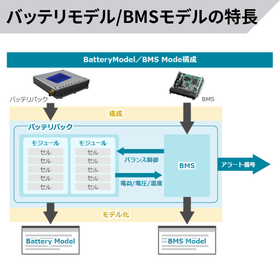
■Features of Battery Model / BMS Model Our battery model / BMS model is created in Simulink, allowing for easy integration of different characteristics for each battery. <Battery Simulink Model> - Simulation results can be verified at the cell, module, and battery pack levels - User-defined cell characteristics can be implemented - Configuration such as the number of cells in a module and the number of modules in a battery pack can be changed as desired <BMS Simulink Model> - Monitors battery voltage and temperature, outputting alert signals for overcharging/discharging, high/low temperature, and high/low voltage - Controls permission/forbiddance of charging and discharging - Calculates SOC (State Of Charge) from the battery's charge amount ■Effects of Introducing Battery Model / BMS Model - No need for actual batteries - Improved development efficiency - Cost reduction - Independent of battery type - Enhanced safety
Price information
Please feel free to contact us with any questions or for a quote. Our products and services are sold to businesses, organizations, and corporations.
Delivery Time
Applications/Examples of results
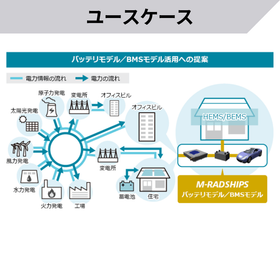
■Battery Model / BMS Model Utilization Process < Battery Model > Can be used in the specification review and design process for the development of BMS (Battery Management System) and more. < Battery Model + BMS Model > Can be used in the specification review and design process for the development of battery application systems (such as smart grids, EV/HEV-related systems, etc.). < The above models and M-RADSHIPS > Can be used in the verification process for simulations that require real-time processing. ■Use Case (Smart Grid) We provide an environment for simulating solar power storage batteries and batteries for EVs/HEVs for HEMS/BEMS, which are located on the user side of the smart grid and correspond to the end of the power transmission network.
catalog(1)
Download All Catalogs
Recommended products
Distributors

We will provide optimal solutions that contribute to our customers' businesses through our "extensive experience and achievements accumulated over many years" and "high technical capabilities" in the fields of embedded and LSI design.