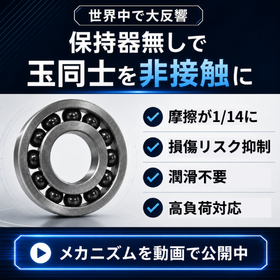
Bearing 'ADB' that reduces friction by up to 1/14.
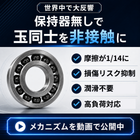
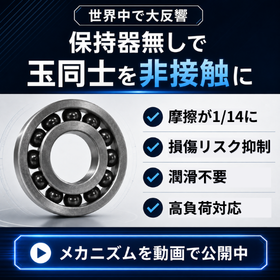
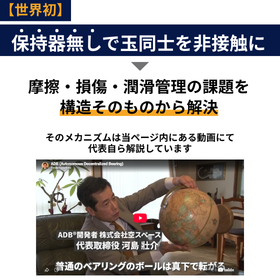
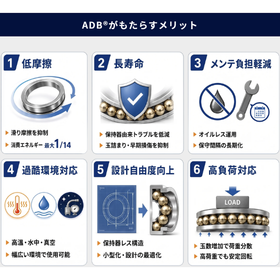
A huge response worldwide! Non-contact between balls without a holder = fundamentally solving the challenges of friction, damage, and lubrication management.
<Structure and Challenges of Conventional Bearings> Bearings typically have a component called a "retainer." The retainer is designed to prevent the balls from coming into contact with each other and is an important part for maintaining the position of the balls. However, the balls and the retainer are always in contact. Friction occurs at the contact points, which is a major factor that hinders the smooth rotation of the bearing. On the other hand, it is not simply a matter of eliminating the retainer. Without the retainer, the balls would come into contact with each other. This contact would also generate friction, similarly hindering smooth rotation as in the case with a retainer. <Ideal State Without Retainer or Ball Contact> The ideal situation is one where there is no retainer and the balls do not come into contact with each other. If there is no contact between the balls and the retainer, as well as between the balls themselves, friction can be minimized, allowing for smooth rotation. This ideal has been realized in the 'ADB' developed by our company. ADB is a groundbreaking bearing that prevents contact between the balls without using a retainer. ▼For more details, visit (Handling Company: Coo Space Co., Ltd. Official Website) https://coo-space.com/
basic information
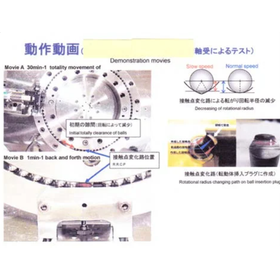
<Structure and Mechanism of ADB> The mechanism of ADB is very simple. There are small "indentations" where the outer ring's balls make contact. In a standard bearing, the balls roll directly underneath the shaft, but in ADB, the indentations on the outer ring cause the balls to roll slightly off to the side from directly underneath. As a result, even though the balls make a complete rotation, the distance they travel is shorter. This causes the balls to slightly decelerate when passing through the indentations and then accelerate again after passing through. Meanwhile, behind the accelerated balls, the following balls are still decelerating, creating small gaps between the balls. ADB utilizes this principle to naturally separate the balls without the need for a retainer.
Price information
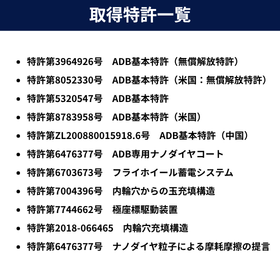
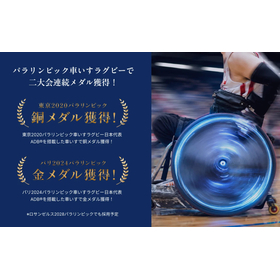
- In the manufacturing sector, an unprecedented 1.68 million views and 1,380 comments recorded on YouTube (as of August 2026) - Kawasaki Entrepreneur Audition: Awarded the Entrepreneur Prize - Invention Award: Received the Invention Encouragement Prize - Nikkei Monozukuri: Featured in an 8-page special article - Tokyo 2020 Paralympics: Adopted for the wheelchair of the Japan national wheelchair rugby team (won a bronze medal) - Paris 2024 Paralympics: Adopted for the wheelchair of the Japan national wheelchair rugby team (won a gold medal) - Scheduled to be adopted for the Los Angeles 2028 Paralympics as well - Various patents obtained (Japan, USA, China)
Delivery Time
Model number/Brand name
Handling company: Kuuspace Co., Ltd.
Applications/Examples of results
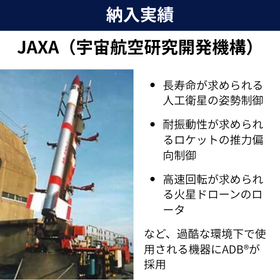
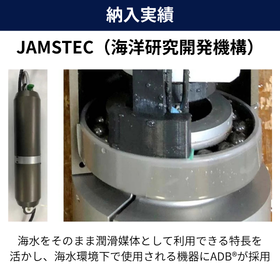
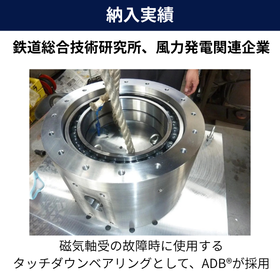
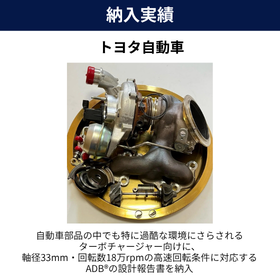
<Aerospace Field> ■Delivery Record: JAXA ADB has been adopted for equipment used in harsh environments, such as attitude control for artificial satellites requiring long life, thrust vector control for rockets requiring vibration resistance, and rotors for Mars drones requiring high-speed rotation. <Marine Research Field> ■Delivery Record: JAMSTEC Leveraging the feature of being able to use seawater directly as a lubricant, ADB has been adopted for equipment used in seawater environments. <Machine Tools, Robotics, and Canning Field> ■Delivery Record: OSG, DMG Mori Seiki Thanks to ADB's ability to rotate with low torque, it has contributed to achieving high speeds of 30,000 rpm, approximately 2.5 times faster than conventional methods. It is also used for improving the efficiency of robotic movements and reducing takt time. <Energy Field> ■Delivery Record: Railway Technical Research Institute, Wind Power Generation Companies ADB has been adopted as a touchdown bearing used in the event of magnetic bearing failure. <Automotive and Engine Field> ■Delivery Record: Toyota Motor Corporation, among others A design report for ADB capable of handling high-speed rotation conditions of 180,000 rpm with a shaft diameter of 33 mm was delivered for turbochargers, which are particularly exposed to harsh environments among automotive parts.
Related Videos
catalog(2)
Download All Catalogs
News about this product(5)
-
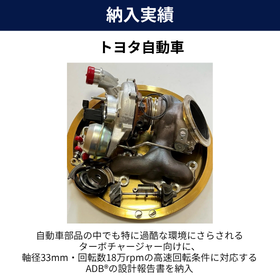
[Case Study] Introduction of Implementation Examples in the Automotive and Engine Fields (Clients: Toyota Motor Corporation, LiquidPiston, etc.)
<Introduction of Case Studies> ADB has been evaluated and adopted in environments where traditional bearings are prone to challenges, such as vacuum, water, rust, high temperatures, high-speed rotation, and micro-vibration. Here, we introduce actual delivery cases. ■Delivery Achievements: Toyota Motor Corporation, LiquidPiston, and others We delivered a design report for ADB that meets the high-speed rotation conditions of 180,000 rpm with a shaft diameter of 33 mm, specifically for turbochargers that are exposed to particularly harsh environments among automotive parts. Additionally, we have confirmed the use of smaller diameter products (see photo).
-
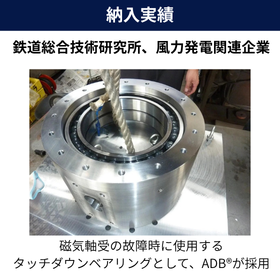
[Case Study] Introduction of Implementation Cases in the Energy Sector (Clients: Railway Technical Research Institute, Wind Power Related Companies)
<Introduction of Case Studies> ADB has been evaluated and adopted in environments where traditional bearings tend to face challenges, such as vacuum, water, rust, high temperatures, high-speed rotation, and micro-vibrations. Here, we introduce actual delivery cases. ■ Delivery Achievements: Railway Technical Research Institute, Wind Power Related Companies Due to the unavailability of the initially planned product for use as a touchdown bearing during magnetic bearing failure, ADB was urgently adopted. Through evaluation in actual machines, the stable support performance of ADB was confirmed, and there have been voices suggesting that "for radial support, ADB may be more suitable than magnetic bearings." Currently, it is being proposed as "flywheel energy storage."
-
[Case Study] Implementation examples in the fields of machine tools, robots, and can manufacturing (Clients: OSG, DMG Mori Seiki)
<Introduction of Case Studies> ADB has been evaluated and adopted in environments where conventional bearings tend to face challenges, such as vacuum, water, rust, high temperatures, high-speed rotation, and micro-vibrations. Here, we introduce actual delivery cases. ■Delivery Achievements: OSG, DMG Mori Seiki ADB has been adopted for the C-axis of machine tools. One of the critical factors influencing machining capability in machine tools is the high-speed rotation of the spindle. ADB has contributed to achieving a high speed of 30,000 rpm, approximately 2.5 times faster than conventional bearings, due to its low torque characteristics. Additionally, the low torque performance of ADB is also effective in improving the operational efficiency of robots and is utilized in applications aimed at reducing takt time.
-
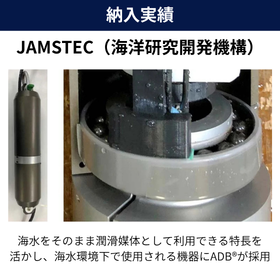
[Case Study] Introduction of a Case in the Marine Research Field (Client: JAMSTEC (Japan Agency for Marine-Earth Science and Technology))
<Introduction of Case Studies> ADB has been evaluated and adopted in environments where traditional bearings tend to face challenges, such as vacuum, water, rust, high temperatures, high-speed rotation, and micro-vibration. Here, we introduce actual delivery cases. ■Delivery Record: JAMSTEC (Japan Agency for Marine-Earth Science and Technology) Leveraging the feature of being able to use seawater directly as a lubricant, ADB has been adopted in equipment used in seawater environments. Traditionally, seals to prevent seawater intrusion and ballast pumps for lubrication and cooling were often necessary, but ADB can utilize seawater itself for lubrication, allowing for the simplification of these mechanisms. As a result, in addition to simplifying the structure, we have successfully reduced torque to about 1/100 of the conventional level.
-
[Case Study] Implementation Case in the Aerospace Field (Client: JAXA (Japan Aerospace Exploration Agency))
<Introduction of Case Studies> ADB has been evaluated and adopted in environments where traditional bearings tend to face challenges, such as vacuum, water, rust, high temperatures, high-speed rotation, and micro-vibrations. Here, we introduce actual delivery cases. ■ Delivery Record: JAXA (Japan Aerospace Exploration Agency) ADB has been adopted for equipment used in harsh environments, such as attitude control for artificial satellites requiring long life, thrust vector control for rockets requiring vibration resistance, and rotors for Mars drones requiring high-speed rotation. In particular, in a vacuum environment, the regeneration of coatings on metal surfaces is difficult, and the generated wear particles can accumulate inside the bearing in a sticky manner, potentially causing failures. ADB helps to extend the lifespan and enhance the reliability of bearings in vacuum environments by suppressing the generation of wear particles due to its structure that prevents contact between the balls.
Recommended products
Distributors
Our company, as a member of Japanese society, aims to contribute to the evolution of society by delivering truly valuable products and services to the world through the skill of sales writing. We believe it is our responsibility to possess the skill to accurately and dramatically communicate "the value that the product or service holds." As a result, we believe this will lay the foundation for a hopeful and prosperous society where everyone can live not according to someone else's values, but according to their own values and in their own way.