
What are drainage standards? Differences between uniform drainage standards and additional standards [Basic Knowledge]
National uniform drainage standards and additional standards set by prefectures. This explains the differences between harmful substances and living environment items, as well as the conditions under which the standards apply.
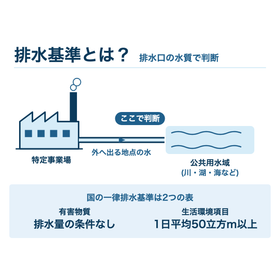
The drainage standards, based on the Water Pollution Prevention Act, set the allowable limits for the pollution of water discharged from factories and business establishments into public water bodies such as rivers, lakes, and seas, as specified by the Ministry of the Environment's ordinance (which establishes the drainage standards). Compliance is determined at the discharge points of specific facilities. It is important to note that the focus is on the water quality at the point of discharge rather than the water used in each process within the factory. ■ Are there two categories of standards? 1. Harmful substances: Cadmium, lead, hexavalent chromium, trichloroethylene, etc. 2. Living environment items: pH, BOD, COD, SS, oil content, copper, zinc, coliform bacteria count, nitrogen, phosphorus, etc. The table of harmful substances includes items that are specified as "not detectable," such as alkyl mercury compounds. This standard set by the government is generally referred to as the uniform drainage standard, and on the Ministry of the Environment's page, it is labeled as the general drainage standard. ■ Which facilities are subject to this? The targets are factories and business establishments (specific facilities) that have installed facilities defined by law. According to national standards, the table for living environment items applies to facilities with an average daily discharge of 50 cubic meters or more, while there are no such discharge volume conditions for the table of harmful substances. Please feel free to consult with us first.
basic information
■ Does the value change depending on whether it's a river or the sea? In the same ministerial ordinance, there are items where the values and scope of application differ depending on the discharge destination. 1. Boron: 10 mg/L outside marine areas, 230 mg/L in marine areas 2. Fluorine: 8 mg/L outside marine areas, 15 mg/L in marine areas 3. Ammonia, etc.: The value obtained by multiplying ammonia nitrogen by 0.4, with a total of 100 mg/L for nitrous nitrogen and nitrate nitrogen 4. Nitrogen and phosphorus: Applicable only when discharging into lakes and marine areas designated by the Minister of the Environment and the water bodies flowing into them ■ Maximum value and daily average For BOD and SS, both maximum values and daily averages are specified. The daily average reflects the average pollution level of the discharged water over one day. ■ Recent amendments? The standard for hexavalent chromium compounds will be revised to 0.2 mg/L from April 2024, with a provisional discharge standard of 0.5 mg/L applicable to the electroplating industry for three years. Additionally, from April 2025, the coliform group count will be changed to E. coli count, with a permissible limit set at a daily average of 800 CFU/mL. Since standard values may be reviewed, it's important to check the latest ministerial ordinance. The supplementary provisions of the ordinance may establish provisional standards limited to specific industries.
Price range
Delivery Time
Applications/Examples of results
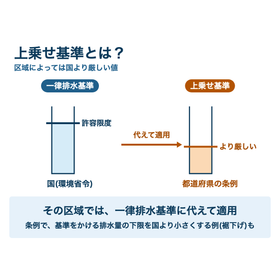
■What are the additional standards? Under the Water Pollution Prevention Act, prefectures can establish stricter wastewater standards through ordinances for areas recognized as insufficient in protecting human health and preserving living environments based solely on national standards. These are the additional standards, which are applied in place of uniform wastewater standards in those areas. ■The extent of the addition is determined by government ordinance The government ordinance stipulates that the additional standards must be necessary and sufficient to maintain water quality environmental standards. ■Are areas with less than 50 cubic meters also subject? Some prefectures have set the lower limit for the application of standards to a volume smaller than that of the national standard through ordinances. This is referred to as "lowering the threshold." Additionally, the law does not prevent local governments from establishing regulations through ordinances for items not included in national standards or for facilities other than specified business establishments. ■How does total load regulation differ? In designated areas of Tokyo Bay, Ise Bay, and the Seto Inland Sea, total load regulation standards for pollution load are applied in addition to concentration standards. ■Inspection of wastewater treatment facilities and rental of measurement devices Tori offers consultation services for the inspection of wastewater treatment facilities and the rental of COD, total nitrogen, and total phosphorus measurement devices. Please feel free to contact us for more information.
catalog(2)
Download All Catalogs

Recommended products
Distributors

Since our founding, we have continued to provide flexible services with the motto of accurately supplying a diverse range of products that respond to changes in the times and the diversification of consumer needs, tailored to various applications and requirements. With the corporate slogan "Chemical Engineering Partner," we, as a group of experts in chemical technology, actively discover ideas to solve our customers' problems from advanced technologies both domestically and internationally, and propose them.