
What is the standard activated sludge method? Differences from the long-term aeration method [Basic Knowledge]
The starting point of various methods of the activated sludge process, the standard activated sludge method. We will compare what the modified methods have changed and the differences in retention time and load.
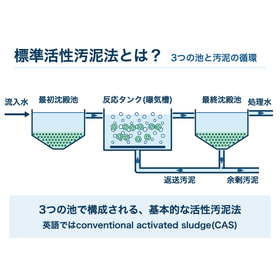
The standard activated sludge method is a basic activated sludge process consisting of an initial sedimentation tank, a reaction tank (aeration tank), and a final sedimentation tank. It is sometimes referred to simply as the "standard method." ■ Does "standard" mean a specification? There are indications that the flow of treatment alone does not fully define the standard method. In this context, some interpret "standard" as referring to the original method from which many variations have emerged. ■ The English name is CAS In English, it is commonly translated as conventional activated sludge (abbreviated as CAS), which has a connotation close to "traditional." ■ How widely is it used in wastewater treatment plants? There are over 600 installations of this method in domestic wastewater treatment plants, making it the second most common method after the oxidation ditch method. When limited to treatment plants with a capacity exceeding 10,000 cubic meters per day, the share rises to about 70%, indicating that larger treatment plants tend to choose the standard method. Additionally, creating anaerobic conditions upstream of the reaction tank is widely implemented as a measure against filamentous bulking. Please feel free to consult with us.
basic information
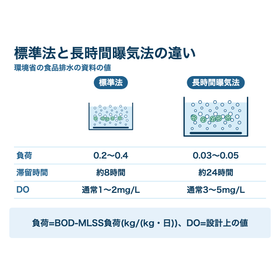
■What did the modified methods change? Tracing the lineage of the activated sludge method, the modified methods that emerged from the standard method can be organized as follows: 1. Load conditions: Long-time aeration method, etc. 2. Method of aeration: Tapered aeration method, etc. 3. Flow type: Oxidation ditch method, etc. 4. Method of inflow: Step aeration method, batch-type activated sludge method 5. Method of solid-liquid separation: Membrane bioreactor (MBR) ■Characteristics of plug flow and complete mixing In terms of flow type, plug flow has the characteristic of suppressing bulking, while complete mixing has the characteristic of alleviating sudden load fluctuations. ■How do they differ when compared numerically? The representative values for the standard method and long-time aeration method are as follows: 1. BOD-MLSS load: 0.2–0.4 and 0.03–0.05 kg/(kg·day) 2. Retention time in aeration tank: Approximately 8 hours and approximately 24 hours 3. Design DO: Typically 1–2 and 3–5 mg/L As the load is significantly reduced, the tank capacity increases, and the retention time of the water also becomes longer.
Price range
Delivery Time
Applications/Examples of results
■What is the strength of the long-term aeration method? It can reduce the amount of excess sludge by decomposing it through endogenous respiration at low loads. It is suitable for small-scale wastewater treatment, is resilient to load fluctuations, and is relatively easy to operate. ■What are the weaknesses of the long-term aeration method? On the other hand, the sludge has poor cohesiveness, and depending on the conditions, the quality of the treated water may be inferior to standard methods. It also requires high construction costs and a large installation area. There are constraints that make it difficult to adopt unless the regulations for discharge points are not strict. ■How to use standard methods in factories with large fluctuations? In wastewater with significant fluctuations, such as dairy wastewater, it is desirable to equalize the quality and quantity of the wastewater in a balancing tank before sending it to the aeration tank. There are also examples where measures have been taken to reduce excess sludge through aerobic digestion. ■Efforts to equalize DO at each stage! In aeration tanks with a push flow, there are examples of preventing bulking by using tapered aeration to maintain a constant DO at each stage. ■Consultation on DO meters and aeration devices At Torii, we offer consultations on the maintenance of DO meters and the renewal of aeration devices. Please feel free to reach out to us.
catalog(3)
Download All Catalogs
Recommended products

Distributors

Since our founding, we have continued to provide flexible services with the motto of accurately supplying a diverse range of products that respond to changes in the times and the diversification of consumer needs, tailored to various applications and requirements. With the corporate slogan "Chemical Engineering Partner," we, as a group of experts in chemical technology, actively discover ideas to solve our customers' problems from advanced technologies both domestically and internationally, and propose them.