
What is pool water quality testing? Sampling methods and test items [Basic knowledge]
The standards and the frequency of inspections differ between school pools and public pools. I will explain the locations for water sampling, the preparation of bottles, and the inspection items.
The water in pools is disinfected with chlorine to accommodate many people entering at the same time, and specific items are regularly tested. However, the standards followed differ depending on the type of pool. ■ Are the standards the same for school and public pools? School swimming pools are managed according to the "School Environmental Health Standards" set by the Ministry of Education, Culture, Sports, Science and Technology based on the School Health and Safety Act. For other swimming pools, the Ministry of Health, Labour and Welfare has provided "Hygiene Standards for Swimming Pools" for local governments, which they use as a reference to establish their own regulations. These hygiene standards for swimming pools do not apply to school pools. ■ What are the main testing items and standard values? The main water quality values are common to both standards. 1. Free residual chlorine: 0.4 mg/L or more (1.0 mg/L or less is desirable) 2. pH value: 5.8 or more and 8.6 or less 3. E. coli: Not detectable 4. General bacteria: 200 colonies or fewer per 1 mL 5. Potassium permanganate consumption: 12 mg/L or less 6. Turbidity: 2 degrees or less 7. Total trihalomethanes: 0.2 mg/L or less is desirable Please feel free to consult with us first.
basic information
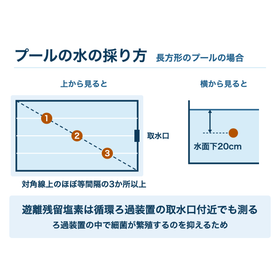
■Where to collect water? According to two national standards, for rectangular pools, the principle is to collect water from three or more points that are almost evenly spaced along the diagonal, at a depth of 20 cm below the water surface. Free residual chlorine is also measured near the intake of the circulation filtration system. Checking the concentration near the intake is to prevent bacteria from proliferating inside the filtration system. ■What is in the bottle for testing bacteria? Samples for E. coli and general bacteria are collected in sterilized bottles that have been pre-filled with sodium thiosulfate to neutralize residual chlorine. After collection, testing should be conducted promptly, and if it cannot be done immediately, the samples should be stored in a cool, dark place and tested within 12 hours of collection. ■Differences in the frequency of testing between schools and the general public 1. Schools: The main water quality parameters are tested once every 30 days within the cumulative usage days. Free residual chlorine is checked at least once before use and once every hour during use as part of daily inspections. 2. General public: Parameters such as pH and bacteria are tested at least once a month. Free residual chlorine is tested at least once every morning and at least twice in the afternoon. ■Timing for measuring total trihalomethanes Total trihalomethanes are measured at least once a year during warmer periods for general pools, and at least once during an appropriate time within the usage period for schools.
Price range
Delivery Time
Applications/Examples of results
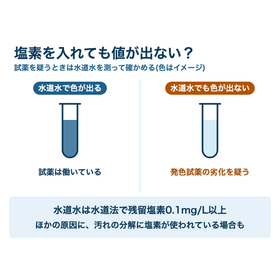
■Why is there no reading even when chlorine is added? The reasons for not detecting free residual chlorine even after adding chlorine agents include the possibility that chlorine is being used to break down contaminants, degradation of the color reagent in the measuring device, or contamination of the colorimetric tube. When in doubt about the reagent, you can verify by measuring tap water. This is because tap water is maintained at a residual chlorine level of 0.1 mg/L or higher according to the Water Supply Act. ■What problems arise if the pH is off? When the pH shifts towards acidity, the disinfection effect is enhanced, but it can lead to concrete deterioration, pipe corrosion, and decreased purification ability. If it shifts towards alkalinity, the disinfection effect decreases. It is necessary to monitor not only the amount of chlorine but also the pH. ■Handling of chlorine According to general pool standards, swimming should be temporarily halted if free residual chlorine falls below 0.4 mg/L, and chlorine agents should be added to bring it back to 0.4 mg/L or higher before resuming. At Torii, we handle easily transportable sodium hypochlorite, solid chlorine agents, pH adjusters, and other chemicals used for pool water quality management. Please feel free to consult us first.
catalog(3)
Download All Catalogs

Recommended products

Distributors

Since our founding, we have continued to provide flexible services with the motto of accurately supplying a diverse range of products that respond to changes in the times and the diversification of consumer needs, tailored to various applications and requirements. With the corporate slogan "Chemical Engineering Partner," we, as a group of experts in chemical technology, actively discover ideas to solve our customers' problems from advanced technologies both domestically and internationally, and propose them.