
Textbook on Equipment Monitoring: An Introduction to IoT, Remote Monitoring, and Anomaly Notification


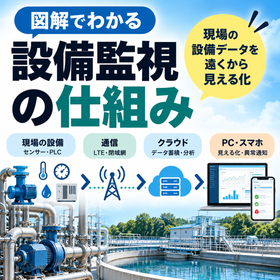
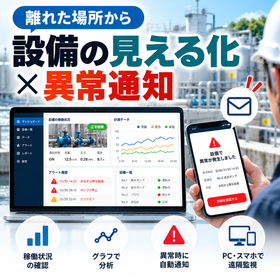
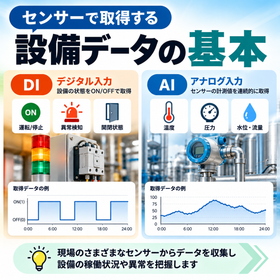
Understand the basics of equipment monitoring through illustrations! Free technical materials on IoT and remote monitoring.
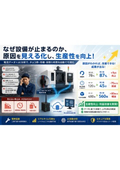
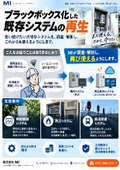
This is a free technical document for facility management and maintenance personnel considering the introduction of equipment monitoring and remote monitoring. It explains the roles of sensors, PLCs, communication devices, and the cloud, as well as data acquisition through DI and AI, LTE communication, abnormal notifications, and visualization of equipment, with accompanying illustrations. [Main Contents of This Document] ■ Basic structure of equipment monitoring systems ■ Basics of DI, AI, sensors, and PLCs ■ Concepts of LTE and closed networks ■ Visualization and abnormal notifications via the cloud ■ Points for cost estimation and preliminary checks ■ Examples of monitoring configurations for water treatment facilities and social infrastructure A total of 24 pages. Please use it to assist in the IoT conversion of existing equipment and the consideration of monitoring system updates.
basic information
【Document Specifications】 Document Title: Textbook on Equipment Monitoring Subtitle: Basics of Visualization, Abnormality Notification, and Remote Management on Site Format: PDF / Total 24 Pages Publisher: MI Corporation Cost: Free 【Contents】 - Basic Knowledge of Equipment Monitoring and Remote Monitoring - Data Acquisition using DI/AI, Sensors, and PLCs - Basics of LTE Communication and Closed Networks - Mechanism of Cloud Monitoring and Abnormality Notification - Implementation Costs and Design Checkpoints - Examples of Equipment Monitoring System Configurations *This document is a technical explanatory material. Specifications for individual devices and implementation costs may vary depending on the target equipment and system configuration.
Price information
Downloading technical materials is free of charge. The cost of implementing the monitoring system varies depending on the monitoring targets, equipment configuration, communication methods, and development scope.
Delivery Time
Model number/Brand name
Textbook on Equipment Monitoring | MI Corporation
Applications/Examples of results
【Purpose】 ■ Remote monitoring of factory equipment operation status and abnormalities ■ Visualization of pump and water treatment equipment operating conditions and measurement values ■ IoT implementation of equipment using existing PLCs and sensors ■ Notifications via email or other means in case of equipment abnormalities ■ Centralized management of equipment installed at remote locations ■ Update of communication methods for existing monitoring systems 【Target Audience】 Equipment management and maintenance personnel, manufacturing engineers, production engineers, factory DX promotion personnel, system design and development personnel 【Case Studies】 Includes anonymous monitoring configuration examples based on factory equipment and social infrastructure equipment.
catalog(5)
Download All Catalogs
Recommended products










Distributors

Our company handles devices and equipment centered around IoT/M2M technology. By enabling devices and equipment connected to a network to exchange information with each other through the network, it is possible to directly collect and control data from the devices and equipment without human intervention. This significantly contributes to improving operational efficiency, environmental protection, and reducing labor costs.