
[Case Study] [Selection Guide] Custom Guide for "Lids" for Stainless Steel Containers


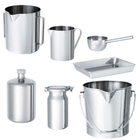


Shall we process not only the container but also the lid to make it easier to use for connecting to devices and for the input of raw materials, etc.?
Stainless steel containers can be used for various purposes by customizing them, not only for storing raw materials but also for incorporating them as machine parts into equipment, connecting containers to facilities, and using them for feeding raw materials, among other applications. When customizing, we can also process the lids in addition to the containers. Here, we have summarized examples of custom-made lids for our stainless steel containers, the basic types of lids, and various lid processing options. At our company, we design and manufacture the optimal "lid" tailored to your specifications, usage environment, and applications, starting from just one piece, to ensure that our customers can use stainless steel containers comfortably.
basic information
Contents ○ Basic lids ○ Custom lid case studies ○ Split lid processing ○ Nozzle processing ○ Short tube/hole processing ○ Lids for pressure vessels ○ Material changes/surface treatment ○ Q&A about "lids" ○ Inquiries and estimation methods for production
Price range
Delivery Time
Applications/Examples of results
Not only the container but also the lid will be processed to make it easier to use.
catalog(8)
Download All Catalogs


News about this product(11)
-

We have pre-released a case study of our delivery to a pharmaceutical manufacturer on Facebook.
At Nitto Metal Industry, we are previewing custom-made case studies on Facebook every month. In this 33rd installment, we are introducing a custom-made product adopted by a pharmaceutical manufacturer: a "water tank for purified water supply" equipped with a stainless steel ball tap. Please take a look. For more details, visit here: https://www.facebook.com/nittokinzoku/
-

[Experimental Case] An experimental case of a stainless steel container has been registered.
We have summarized three experiments conducted so far. 1. Pumping Gyoza Filling Nitto Metal Industry Co., Ltd. offers rental of demonstration machines. This time, we received a request from a food user to create a container for pumping gyoza filling, and we decided to conduct a pumping experiment using our demonstration machine. 2. Jacket Container Pressure Failure Experiment Sometimes, customers mistakenly apply pressure to jacket containers meant for normal pressure, resulting in container failure. Such failures can lead to serious accidents, including injuries to operators and splattering of the liquid inside. We conducted an experiment to determine how dangerous it is when pressure is applied to a jacket container. 3. Transferring High Viscosity Liquids Without Spillage "Do anti-drip beakers prevent any liquid from dripping?" High viscosity liquids take a long time to clean up when spilled. For hazardous liquids, it is even more critical to prevent drips. In this experiment, we used our anti-drip beaker to transfer a high viscosity liquid. Can we successfully transfer a high viscosity liquid without spilling it around?
-

[Explanation Document] How to resolve "clogged powder!" has been registered.
Why does powder get clogged? We will explain basic terms related to powder and introduce methods to resolve powder clogs from the perspective of the containers used to hold the powder! "Powder clogging" is a common issue when discharging powder from containers. It can lead to variations in product quality due to prolonged discharge times or complete stoppages. But why does the powder flow poorly (get clogged) in the first place? Here, we summarize the causes of powder clogging and the specifications of containers and peripheral equipment to resolve these issues.
-

[Explanatory Material] What is the cleaning method to make stainless steel containers last longer? has been registered.
I have summarized the important cleaning methods to prolong the life of stainless steel containers. It is essential to clean the container after use. However, incorrect cleaning methods can cause scratches or lead to rust. Here, I will introduce the important cleaning methods to ensure the longevity of stainless steel containers.
-

[Explanatory Material] What is Helur? has been registered.
The "Hygienic Fitting," which is essential for containers and piping, is easy to clean without the need for tools. We have summarized its mechanism and related products. When flowing or introducing water and raw materials into stainless steel containers or equipment, you likely connect pipes and valves to the containers or equipment. When making these connections, threaded fittings such as sockets and nipples, as well as "fittings" like flanges and hygienic fittings, are used. Here, we will introduce the "Hygienic Fitting," which is used in processes that require a more sanitary environment, along with its applications, types, and related products.
Recommended products


Distributors

Our company, which started in 1957 with the aim of manufacturing stainless steel products and containers for home use, has since expanded into the production and sale of stainless steel tanks for industrial fields such as pharmaceuticals, chemicals, and food. Currently, we design, manufacture, and sell small to medium-sized stainless steel tank units across various industries. Moving forward, as a manufacturer of stainless steel containers and mixers (stirring devices), we will continue to challenge ourselves with sincerity, enthusiasm, and creativity to deliver "one-of-a-kind" products and services to our customers, advancing step by step into the future.