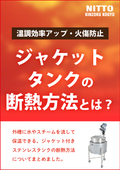
What is the insulation method for stainless steel tanks with jackets?
I have summarized the insulation method for a jacketed stainless steel tank that can maintain temperature by circulating water or steam in the outer jacket.
Using a stainless steel tank with a jacket (outer shell), when hot water or steam is circulated inside the jacket, the surface of the tank also becomes high in temperature. This can lead to an increase in the working environment temperature due to heat radiation from the tank, or if the room temperature is low, it may take a long time for the tank temperature to rise. Additionally, there is a risk of burns if someone accidentally touches the high-temperature tank. Here, we will introduce methods for insulating the jacketed tank.
basic information
Content ○ Purpose of insulation ○ Insulation methods ○ Also serves as a measure against condensation ○ Related products and case studies
Price range
Delivery Time
Applications/Examples of results
For those using stainless steel containers, we introduce the optimal insulation method for improving temperature control efficiency and preventing burns with jacketed stainless steel tanks.
catalog(5)
Download All Catalogs
News about this product(1)
-

Do you know what "pressure vessels" are used for?
The Nitto Metal Industry website has been updated with a new technical column. In addition to stainless steel containers for normal pressure, our company manufactures small capacity pressure vessels, primarily ranging from 1L to 200L, used in factories and laboratories. These are what you might call "industrial pressure vessels," so they are rarely seen in everyday life, and it can be difficult to understand their purpose just by looking at the products. In this column, we will explain the specific purposes for which pressure vessels are used, based on examples of products we have manufactured in the past. <Contents> 1. Used for storage / pumping 2. Used for stirring / mixing / dissolving (+ pumping) 3. Used for filtration / filling 4. Other uses Summary For more details, visit: https://www.nitto-kinzoku.jp/archives/48307/ Technical column on stainless steel containers: https://www.nitto-kinzoku.jp/tecnical-list/ This is a technical column on stainless steel containers explained by a leading manufacturer that supplies "high-quality stainless steel containers" to the pharmaceutical industry.
-

[Explanation Material] What is "Tank No. 20"? has been registered.
I will provide a brief overview of Tank No. 20. Tank No. 20 refers to a tank used for the temporary storage and retention of hazardous materials. It is named as such because it is defined in Article 9, Paragraph 1, Item 20 of the Fire Service Act's "Ordinance on the Regulation of Hazardous Materials." Here, we will clearly explain the uses and judgment methods of Tank No. 20. Nitto Metal Industry is capable of manufacturing stainless steel Tank No. 20 and containers for the transportation of hazardous materials. Please feel free to contact us with details about the contents and capacity.
-

[Explanation Material] We have registered an explanation of the difficult-to-understand pressure vessel!
"What is a pressure vessel?" This is a simple summary about containers designed to handle pressure. In our company's stainless steel containers, we have not only storage and discharge containers but also a product called a pressure vessel. As the name suggests, a pressure vessel is a container designed to handle "pressure." Some people might associate it with familiar items like a pressure cooker. Here, we will explain this somewhat unclear concept of pressure vessels (pressure containers) in an easy-to-understand manner.
-

[Technical Column] What is the difference between Type I and Type II pressure vessels?
Pressure vessels are subject to regulations due to the dangers associated with applying pressure, which are determined by the magnitude and conditions of the pressure. If the strength is insufficient, there is a possibility of causing serious accidents, so detailed regulations regarding structure are established under the Labor Safety and Health Act and the Boiler and Pressure Vessel Safety Regulations. Vessels are classified based on their size and the magnitude of the pressure they handle, and some vessels may require certification. For more details, please visit our website. https://www.nitto-kinzoku.co.jp/archives/technic/pressure_tank02/ Stainless Steel Vessel Manufacturer Nitto Metal Industry Co., Ltd. https://www.nitto-kinzoku.co.jp/
-

【Technical Information】We will explain the difficult-to-understand pressure vessels!
Nitto Metal Industry's stainless steel containers include not only storage containers and discharge containers but also a product called pressure vessels. As the name suggests, pressure vessels are designed to handle "pressure." Some may associate them with familiar items like pressure cookers. This time, we have summarized the somewhat unclear pressure vessels in an easy-to-understand manner. For detailed technical information, please visit our website. https://www.nitto-kinzoku.co.jp/archives/technic/pressure_tank01/
-

The explanation document on the insulation method for stainless steel tanks with jackets has been registered.
This document summarizes the insulation method for a stainless steel tank with a jacket that can maintain temperature by circulating water or steam in the outer tank. By using a stainless steel tank with a jacket and circulating hot water or steam inside the jacket, the surface of the tank also becomes high temperature. Heat radiation from the tank can raise the temperature of the working environment, and if the room temperature is low, it may take a long time for the tank temperature to increase. Additionally, there is a risk of burns if someone accidentally touches the high-temperature tank. This document introduces the insulation method for jacketed tanks.
Recommended products
Distributors
Our company, which started in 1957 with the aim of manufacturing stainless steel products and containers for home use, has since expanded into the production and sale of stainless steel tanks for industrial fields such as pharmaceuticals, chemicals, and food. Currently, we design, manufacture, and sell small to medium-sized stainless steel tank units across various industries. Moving forward, as a manufacturer of stainless steel containers and mixers (stirring devices), we will continue to challenge ourselves with sincerity, enthusiasm, and creativity to deliver "one-of-a-kind" products and services to our customers, advancing step by step into the future.