











Data Infrastructure Construction
Data Infrastructure Construction
We leverage platforms like Databricks and Snowflake to build robust data infrastructure that enables data-driven decision-making.
1~21 item / All 21 items
-
Limits of Manual Operations: Complexity of Data Structures and Maintenance Burden
[Free Provision of Explanatory Materials] Transition to automatic updates using external tools in response to the vast amount of data.
last updated
-
Resolution of User vs. Administrator Conflict: A Management System that Meets Both Parties' Needs
Bridging the gap between the field that wants to analyze freely and the information system that wants centralized management.
last updated
-
Rapid evolution of data infrastructure through agile development.
[Free Presentation of Explanatory Materials] Repeated improvements in a short cycle, responding promptly to changes in needs.
last updated
-
The Importance of Data Modeling: Guidelines to Prevent Inconsistencies in Advance
Not just ending with mere "accumulation." Building a foundation for advanced utilization directly linked to business.
last updated
-
Benefits of using ETL tools: Data integration and reduction of operational burden.
Free presentation of explanatory materials: Integrating data from multiple systems with different formats consistently.
last updated
-
Metadata Management: The Core of Information that Unleashes the True Value of Data Utilization
Organize 'data about data' to ensure reliability and correctness of interpretation.
last updated
-
Differentiating between business metadata and technical metadata.
[Free Presentation of Explanatory Materials] Clearly define the purpose and structure. Support the consistency between systems with technology.
last updated
-
Selection of Metadata Management Tools: From Databricks to AWS
[Free explanatory materials] Prevent the obsolescence of manual management and automatically eliminate information silos.
last updated
-
Semantic Layer: Preventing discrepancies in data definitions between departments.
No need for specialized SQL. Building an environment where you can directly access data using business terminology.
last updated
-
Establishment of Data Governance Basic Policy: The Foundation for Safe AI Implementation
From access control to log management. Design guidelines to minimize information leakage risks.
last updated
-
Conditions for the next-generation data infrastructure: real-time capability and semantic connectivity.
[Free Presentation of Explanatory Materials] Enables interactive collaboration with AI, achieving high-accuracy output.
last updated
-
The first step of AI transformation: Inventory of existing data infrastructure and understanding the current situation.
[Free explanatory materials] The source of competitiveness lies not in the number of AI implementations, but in the "quality of data."
last updated
-
Data infrastructure construction: Databricks × Fivetran partnership
[Free Presentation of Explanatory Materials] Professionals Support the Latest Data Lakehouse Design and Implementation
last updated
-
Example: Introduction of Azure Databricks in the manufacturing industry
[Free Distribution of Explanatory Materials] Automating Failure Prediction and Condition-Based Maintenance Using IoT Data
last updated
-
Data utilization consultation desk: Leading to solutions for challenges in manufacturing industry DX.
[Free explanatory materials] From inventorying existing data to AI implementation, feel free to consult with us first.
last updated
-
Example: IT strategy that reduced data preparation time by 80% (free materials provided)
Eliminating data silos with Databricks implementation, achieving self-service utilization for over 300 people.
last updated
-
[Case Study] Avoiding tens of millions of yen in losses from unexpected shutdowns | Chemical Plant
"Although there are sensors, they cannot be used" and "Neither PoC nor approval can be obtained." To those in charge of plant maintenance: We are revealing all the procedures that have avoided losses of tens of millions of yen annually due to unexpected shutdowns.
last updated
-
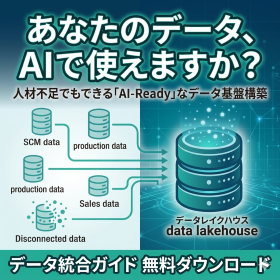
Modern AI Data Utilizing Databricks and Fivetran
Don't just accumulate data! A data stack that enables real-time processing. Free explanatory materials available.
last updated
-
[Real Estate Industry Case] Building an AI Data Platform for Extracting High-Quality Properties Using GCP
Reduced procurement man-hours by 80%! Successfully standardized a previously individualized process. Free explanatory materials available.
last updated
-
Checking for Data Silos through NTP's Support for DX in Manufacturing
We visualize data and processes divided by department and organize your company's information structure. Free explanatory materials are currently available.
last updated
-
Achieving labor reduction and productivity improvement! Basic knowledge of AMR introduction.
A thorough comparison table explaining the differences between AGVs and AMRs! We are currently offering a free resource on the basic knowledge of introducing AMRs to solve challenges in manufacturing and logistics.
last updated