AI control product for industrial furnaces "Eco Furnace"
Introduction of an AI control product that achieves energy savings and CO2 reduction in industrial furnaces.
In recent years, the environment surrounding industrial furnaces has changed significantly. Rising energy prices, societal demands for decarbonization, a shortage of skilled personnel, and the limitations of existing control methods in equipment operation are all pressing issues. In many manufacturing sites, the need for "more efficient and more stable operations" and "reducing CO₂ emissions and fuel costs" has never been higher. To address these challenges faced by users, we introduce Proxima Technology's AI control solution, "EcoFurnace." With our proprietary AI "Smart MPC," we achieve up to a 25% reduction in fuel, electricity, and CO₂ emissions, improve control accuracy, reduce fluctuations by up to 80%, and shorten startup time by up to 60%. It also automatically optimizes responses to disturbances and equipment degradation, which were difficult to manage with existing PID control. Installation is straightforward; simply connect the PLC, LAN, and PC, and you can start using it as soon as the same day by configuring it through a browser. The Grafana-based dashboard visualizes operational status, significantly reducing the adjustment burden on-site. Please feel free to contact us for document requests or demo presentations.
basic information
CPU: Cortex A76 (4 cores) RAM: 8GB Storage: 32GB
Price range
Delivery Time
Applications/Examples of results
Temperature control of glass melting furnaces, hydrogen burner furnaces, rotary kilns, etc., leading to energy savings and CO2 reduction.
Related Videos
catalog(1)
Download All Catalogs
News about this product(4)
-
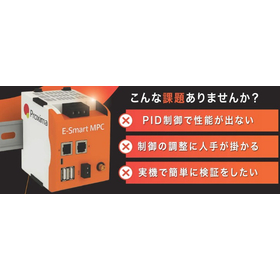
The unique control AI product "E-Smart MPC," which easily implements model predictive control from within the control panel, has been updated to be even more user-friendly with a rich GUI!
We are pleased to announce a significant update to the user interface (GUI) features of our proprietary optimal control AI, "Smart MPC," in its embedded product version, "E-Smart MPC." With this update, you can complete everything from initial setup to operation using only the GUI, meaning no programming is required (no-code), allowing for a smooth user experience! For more details, please watch the video in the "Related Links"! *Related Links Video: How to Use: Setup and Control Demonstration in just under 2 minutes.
-
[Tokyo Big Sight 12/3~5] Smart Factory Japan 2025 Exhibition | Achieving 5-15% Energy Savings with AI Control
We will showcase "Smart MPC," which realizes control optimization in manufacturing sites. ■ Event Overview Date: December 3 (Wed) - December 5 (Fri), 2025, 10:00 AM - 5:00 PM Venue: Tokyo Big Sight, South Hall 14 Exhibition: Smart Factory Japan 2025 ■ Features of Smart MPC Achieves AI control without specialized knowledge through model predictive control and machine learning - Energy-saving effect: 5~15% reduction - Implementation period: as short as 3 days (data collection and operation start) - Temperature accuracy: ±0.2℃ (PID ratio ±0.5℃ → ±0.2℃) - Automatic adjustment: Adapts to aging deterioration through online learning ■ Solving these challenges ✓ Time-consuming PID parameter adjustments ✓ Difficulty in complex multivariable control ✓ Unstable control quality due to a lack of skilled personnel ✓ Desire to balance energy savings and quality A team of 36 engineers, including 20 with PhDs, will solve manufacturing site challenges using advanced mathematical optimization techniques. We will present live demonstrations and case studies at the venue. Please visit our booth.
-
[My Dome Osaka 12/17~12/18] Startup Japan 2025 in Osaka Exhibition | Achieving 5-15% Energy Savings with AI Control
We would like to introduce "Smart MPC," which realizes control optimization in manufacturing sites. ■ Event Overview Date: December 17 (Wed) - 18 (Fri), 2025, 10:00-17:00 Venue: My Dome Osaka M16-12 Exhibition: Startup Japan 2025 in Osaka ■ Features of Smart MPC Achieves AI control without specialized knowledge through Model Predictive Control × Machine Learning - Energy-saving effect: 5-15% reduction - Implementation period: as short as 3 days (data collection operation start) - Temperature accuracy: ±0.2℃ (PID ratio ±0.5℃ → ±0.2℃) - Automatic adjustment: Adapts to aging deterioration through online learning ■ Solving these challenges ✓ Time-consuming PID parameter adjustments ✓ Difficulty in complex multivariable control ✓ Inconsistent control quality due to lack of skilled personnel ✓ Desire to balance energy savings and quality A team of 36 engineers, including 20 with PhDs, will solve manufacturing site challenges using advanced mathematical optimization techniques. We will introduce case studies and tailored implementation methods at the venue. Please visit our booth.
-
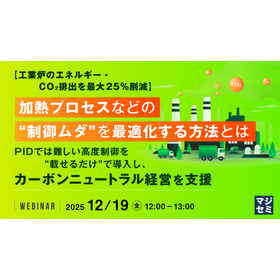
Reducing energy and CO₂ emissions from industrial furnaces by up to 25%: How to optimize 'control waste' in heating processes and support carbon-neutral management by simply implementing advanced control that is difficult with PID.
Industrial furnaces are a major source of CO₂ emissions, accounting for about 15% of domestic emissions. Energy conservation and decarbonization have become unavoidable challenges for the manufacturing industry in terms of both cost reduction and environmental management. **Issues** Controlling industrial furnaces is complex. It requires precise adjustments of multiple heat sources during the heating, holding, and cooling processes, where even slight delays or deviations can lead to overheating and temperature inconsistencies. Traditional PID control struggles to flexibly respond to these complex thermodynamic changes and disturbances, resulting in accumulated structural energy losses due to "overreaction" and "delayed response." **Solution** In this seminar, we will introduce "Smart MPC," a model predictive control that combines machine learning and optimization technology. By utilizing past operational data, it achieves high-precision predictive control without the need for specialized tuning. The embedded controller "E-Smart MPC" allows for easy implementation with direct mounting to control panels and GUI operation. **Implementation Results** CO₂ and fuel reduction (up to 25%), improved control accuracy (up to 80%), and reduced setup time (up to 60%). **Target Audience** Production engineers, equipment managers, and site managers who want to promote energy conservation and decarbonization in thermal control equipment such as industrial furnaces and dryers.
Recommended products
Distributors
Proxima Technology harnesses the power of mathematics, specifically through mathematical algorithms such as machine learning, optimization, control, and 3D data analysis, to implement solutions in society. We provide AI products that contribute to the operations of everyone, particularly those in the manufacturing industry. The manufacturing environment is one where complex variables intertwine, requiring the maintenance of optimal production processes. We achieve autonomous optimization of production equipment by utilizing real-time data analysis and suitable control algorithms powered by AI.