news list
1~5 item / All 5 items
-
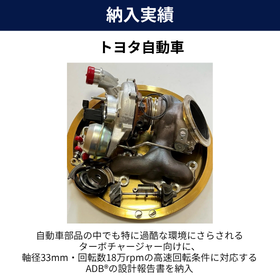
[Case Study] Introduction of Implementation Examples in the Automotive and Engine Fields (Clients: Toyota Motor Corporation, LiquidPiston, etc.)
<Introduction of Case Studies> ADB has been evaluated and adopted in environments where traditional bearings are prone to challenges, such as vacuum, water, rust, high temperatures, high-speed rotation, and micro-vibration. Here, we introduce actual delivery cases. ■Delivery Achievements: Toyota Motor Corporation, LiquidPiston, and others We delivered a design report for ADB that meets the high-speed rotation conditions of 180,000 rpm with a shaft diameter of 33 mm, specifically for turbochargers that are exposed to particularly harsh environments among automotive parts. Additionally, we have confirmed the use of smaller diameter products (see photo).
-
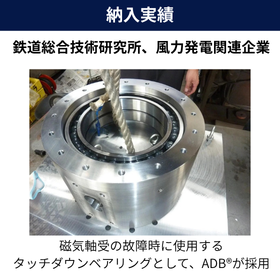
[Case Study] Introduction of Implementation Cases in the Energy Sector (Clients: Railway Technical Research Institute, Wind Power Related Companies)
<Introduction of Case Studies> ADB has been evaluated and adopted in environments where traditional bearings tend to face challenges, such as vacuum, water, rust, high temperatures, high-speed rotation, and micro-vibrations. Here, we introduce actual delivery cases. ■ Delivery Achievements: Railway Technical Research Institute, Wind Power Related Companies Due to the unavailability of the initially planned product for use as a touchdown bearing during magnetic bearing failure, ADB was urgently adopted. Through evaluation in actual machines, the stable support performance of ADB was confirmed, and there have been voices suggesting that "for radial support, ADB may be more suitable than magnetic bearings." Currently, it is being proposed as "flywheel energy storage."
-
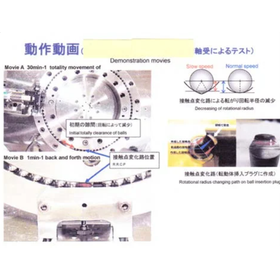
[Case Study] Implementation examples in the fields of machine tools, robots, and can manufacturing (Clients: OSG, DMG Mori Seiki)
<Introduction of Case Studies> ADB has been evaluated and adopted in environments where conventional bearings tend to face challenges, such as vacuum, water, rust, high temperatures, high-speed rotation, and micro-vibrations. Here, we introduce actual delivery cases. ■Delivery Achievements: OSG, DMG Mori Seiki ADB has been adopted for the C-axis of machine tools. One of the critical factors influencing machining capability in machine tools is the high-speed rotation of the spindle. ADB has contributed to achieving a high speed of 30,000 rpm, approximately 2.5 times faster than conventional bearings, due to its low torque characteristics. Additionally, the low torque performance of ADB is also effective in improving the operational efficiency of robots and is utilized in applications aimed at reducing takt time.
-
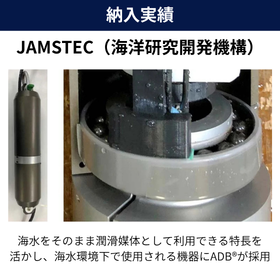
[Case Study] Introduction of a Case in the Marine Research Field (Client: JAMSTEC (Japan Agency for Marine-Earth Science and Technology))
<Introduction of Case Studies> ADB has been evaluated and adopted in environments where traditional bearings tend to face challenges, such as vacuum, water, rust, high temperatures, high-speed rotation, and micro-vibration. Here, we introduce actual delivery cases. ■Delivery Record: JAMSTEC (Japan Agency for Marine-Earth Science and Technology) Leveraging the feature of being able to use seawater directly as a lubricant, ADB has been adopted in equipment used in seawater environments. Traditionally, seals to prevent seawater intrusion and ballast pumps for lubrication and cooling were often necessary, but ADB can utilize seawater itself for lubrication, allowing for the simplification of these mechanisms. As a result, in addition to simplifying the structure, we have successfully reduced torque to about 1/100 of the conventional level.
-
[Case Study] Implementation Case in the Aerospace Field (Client: JAXA (Japan Aerospace Exploration Agency))
<Introduction of Case Studies> ADB has been evaluated and adopted in environments where traditional bearings tend to face challenges, such as vacuum, water, rust, high temperatures, high-speed rotation, and micro-vibrations. Here, we introduce actual delivery cases. ■ Delivery Record: JAXA (Japan Aerospace Exploration Agency) ADB has been adopted for equipment used in harsh environments, such as attitude control for artificial satellites requiring long life, thrust vector control for rockets requiring vibration resistance, and rotors for Mars drones requiring high-speed rotation. In particular, in a vacuum environment, the regeneration of coatings on metal surfaces is difficult, and the generated wear particles can accumulate inside the bearing in a sticky manner, potentially causing failures. ADB helps to extend the lifespan and enhance the reliability of bearings in vacuum environments by suppressing the generation of wear particles due to its structure that prevents contact between the balls.