
The process of creating "cold water" from "heat."



Reusing "unused" heat! We will explain the specific process of generating "cold water" from "heat."
First, a low-temperature, low-pressure gas-liquid mixed refrigerant (water and water vapor) enters the evaporator. Inside the evaporator, the pressure is almost at a vacuum state, so the boiling point of water at 100°C is reduced to about 7-10°C. By absorbing heat from relatively warm water in the chilled water piping, the refrigerant (water) boils and turns into water vapor. The water vapor is drawn into the absorber, similar to the suction side of the compressor in a vapor compression refrigeration cycle. The water vapor is absorbed by the absorbent liquid "lithium bromide" and is pumped into the regenerator. In the regenerator, the mixture of refrigerant and absorbent liquid is heated and separated back into the original water vapor and absorbent liquid. The absorbent liquid returns to the absorber, while the water vapor is sent to the condenser. There are methods for adding heat in the regenerator, such as combustion using fuels like gas or oil, or using steam or hot water. The refrigerant, which has returned to water after losing heat in the condenser, is depressurized in the expansion device and flows back to the evaporator, repeating the cycle.
basic information
For details on each item, please refer to the information below.
Price range
Delivery Time
Applications/Examples of results
For specific products, please check the website below or refer to the separate catalog page. http://solar.yazaki-group.com/
Detailed information
-

● Water is evaporated to create cold water. In a container (evaporator) with pressure close to a vacuum, when water is flowed through a heat transfer pipe that is in contact with the evaporating liquid, the heat from the flowing water is absorbed due to the latent heat of vaporization, resulting in a lower temperature (cold water) than the water that entered the pipe. When water is dripped onto the pipe in a vacuum, the water on the surface absorbs heat from the water inside the pipe and evaporates, thus producing cold water.
-

●The evaporated water vapor is collected. The water vapor (refrigerant) that evaporates in the evaporator is absorbed by the absorbent liquid in the absorber. The absorbent liquid (lithium bromide solution) that easily absorbs water vapor absorbs the incoming water vapor (refrigerant), causing the concentration of the absorbent liquid to become diluted.
-

● We create water vapor and a concentrated solution. The water vapor is absorbed by the absorber, and the diluted absorbent solution is sent to the regenerator. Using the principle of cooking in a pot, by heating the diluted solution, we evaporate the moisture (refrigerant) and return it to a high-concentration lithium bromide solution (absorbent solution that easily absorbs water vapor).
-

●Steam is cooled to create water. The water vapor (refrigerant) evaporated in the regenerator is sent to the condenser. When the water vapor (refrigerant) comes into contact with the pipes carrying cooling water, it condenses back into water (liquefaction). The resulting water (refrigerant) is sent back to the initial evaporator.
catalog(8)
Download All Catalogs


News about this product(3)
-

Creating an environment that thrives even in extreme heat: Introducing the results of closed-type greenhouse demonstrations and summer cooling methods - Exhibiting at the 14th Agricultural WEEK (commonly known as J-AGRI)
Yazaki Energy System will be exhibiting at the "14th Agricultural WEEK (commonly known as J-AGRI)" held at Makuhari Messe. In response to challenges surrounding agriculture, such as record heat and soaring energy prices, our company proposes an agricultural system that utilizes surplus solar heat and waste heat from factories during the summer to support stable cultivation throughout the year, from winter heating to summer cooling. ■ Exhibition Details (Booth Number: 25-47) <Closed-type Agricultural House> Results from the second season and initiatives for the third season <Localized Cooling in Solar-Powered Agricultural Houses> Mechanism of substrate cooling, comparison of energy consumption with spatial cooling, growth conditions this summer <Cooling and Heating with Solar Heat> Examples of crown heating and house cooling, utilization of surplus heat in summer <Cooling of Crops and Workers with Well Water> Exhibition of a prototype well water cooler and proposals for the use of cooling jackets When you visit, please be sure to stop by our booth.
-

Introduction of the technology that supports our products.
On the page below, we are sharing the technologies that support our company. We are also engaged in various other initiatives, so if you have any questions about technical matters or our business, such as "Can you do this?" or "What about this?", please feel free to contact us. (Related page) https://pr.mono.ipros.com/yazaki-energysystem/product/category/68094/
-
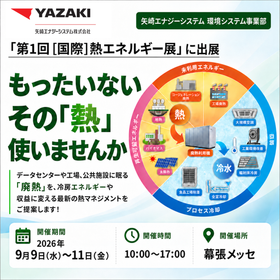
"Creating cold water from waste heat" Exhibited at the 1st [International] Thermal Energy Exhibition
What a waste! Why not make use of that "heat"? We propose the latest heat management that transforms the "waste heat" lying dormant in data centers, factories, and public facilities into cooling energy and revenue! In our booth, we will clearly showcase the actual system in three sections: "Waste Heat Source ➔ Heat Exchanger (Absorption Type) ➔ Utilization Destination." Come and see the story of how the waste heat from your facility can be transformed into something valuable! 【Core Technology】 Our compact and lightweight "Hot Water Absorption Chiller" directly converts low to medium temperature waste water (waste heat) at 70-95°C into cooling energy. This dramatically reduces the power consumption of air conditioning during operation, simultaneously improving the energy efficiency of the facility (such as PUE) and lowering manufacturing costs. 【System Proposal】 As heat coordinators, we provide multifaceted system proposals. We cover a wide variety of heat sources, including waste heat from gas engines in data centers, wastewater from compressors and boilers in factories, warm wastewater from cleaning plants and power stations, as well as geothermal and solar heat. We will build an optimal heat circulation model that connects these sources to office air conditioning, precision air conditioning in clean rooms, regional heat supply, and next-generation agriculture in greenhouses (house cooling packages).
Recommended products


Distributors

From the development and manufacturing to the sales of living environment equipment, we quickly respond to customer needs. Yazaki Energy System focuses on power cables, general cables, communication cables, gas equipment represented by gas meters, environmental system equipment such as air conditioning and solar thermal systems, and instrumentation equipment like taxi meters. We conduct the development, manufacturing, and sales of living environment equipment within the Yazaki Group in a consistent manner, providing products and services tailored to customer needs. As the energy society evolves, we see this as an opportunity to offer products and services that optimally utilize diverse energy sources, aiming to contribute to our customers and society as a 'comprehensive producer of all energy.' Moving forward, we will continue to challenge ourselves to deliver joy and inspiration to everyone, based on our commitment to being a company that exists with the world and is needed by society.