
OCT-equipped heating observation imaging furnace internal structure visualization system


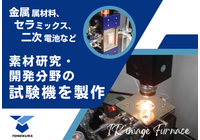
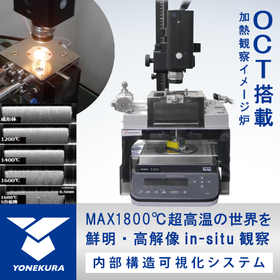


Contributed to research on changes in the internal structure of ceramics! Direct observation of changes in internal structure at high temperatures.
The "OCT-equipped heating observation imaging furnace," which can directly observe changes in internal structures at high temperatures, has contributed to the study of changes in the internal structure of ceramics. It is a compact observation device that utilizes a focused heating method and is equipped with OCT (Optical Coherence Tomography) for internal observation. ◆ Key Points ◆ - Internal structure observation at high temperatures In-situ observation up to MAX 1800℃ - Understanding weight and thermal changes Clarifying the relationship between internal changes and temperature/weight changes - Excellent operability and controllability Data acquisition combining weight changes with temperature OCT is a technology that uses infrared laser light to visualize the interior of materials. It can be applied to materials such as ceramics and resins that allow infrared light to pass through. For more details, please refer to the catalog or contact us.
basic information
【Specifications】 ■ Model Number Heating Observation Image Furnace with Electronic Balance "IR-TPTG" ■ Heating Furnace Temperature Range: RT~1200℃ Heating Rate: MAX 30℃/sec Heating Method: Infrared Dual Elliptical Focusing Heating Furnace Body Cooling: Cold Water (Tap Water or Chiller) Power Supply Capacity: Single Phase 200V 10A Sample Holder: 20×20 mm Ceramic Plate ■ Electronic Balance Resolution: MIN 0.001g Maximum Weighing Capacity: 620g ■ Observation System OCT Device Microscope, etc.: Please inquire *Specifications are subject to change without notice.
Price information
Please contact us.
Delivery Time
Model number/Brand name
OCT-equipped heating observation imaging furnace
Applications/Examples of results
1) Observation of Internal Structure at High Temperatures (In-situ observation up to 1800℃) This is an internal observation device equipped with OCT (Optical Coherence Tomography) designed in a compact manner using a concentrated heating method. Using this device, a research group from Yokohama National University and Kanagawa Prefectural Institute of Industrial Technology successfully observed the internal structural changes of ceramics during sintering at high temperatures for the first time in the world. 2) Understanding Weight and Thermal Changes (Clarifying the relationship between internal changes and temperature/weight changes) A heating observation furnace equipped with an electronic balance acquires data on the temperature and weight changes of samples during sintering. By comparing OCT images, it is possible to clarify the relationship between internal changes and temperature/weight changes. 3) Excellent Operability and Controllability (Data acquisition combining weight changes with temperature) The thermal device has a vacuum chamber structure, achieving a vacuum level of 10^-3 PA, and is compatible with inert gas and reducing atmospheres. It allows for rapid heating and cooling up to 1800℃ at a rate of 1500℃/SEC. With excellent temperature control, programming within ±1℃ is possible.
Related Videos
catalog(2)
Download All Catalogs

News about this product(4)
-

"OCT-equipped heating observation imaging furnace" contributes to global research! Direct observation of internal structural changes at high temperatures.
The "OCT-equipped heating observation furnace" is a compact design that utilizes a focused heating method and is an internal observation device equipped with OCT (Optical Coherence Tomography). Using this device, a research group from Yokohama National University and the Kanagawa Institute of Industrial Science and Technology successfully observed the internal structural changes of ceramics during sintering at high temperatures for the first time in the world. For more details, please refer to the catalog. If you have any questions or inquiries, please feel free to contact us.
-

\Weight change and thermal change can be understood/On-site observation of internal structural changes《OCT-equipped heating observation imaging furnace》
The "OCT-equipped Heating Observation Furnace" is a compact design that utilizes a focused heating method and is an internal observation device equipped with OCT (Optical Coherence Tomography). Using this device, a research group from Yokohama National University and the Kanagawa Institute of Industrial Science and Technology successfully observed the internal structural changes of ceramics during sintering at high temperatures for the first time in the world. Please utilize it for research and development of materials such as ceramics and resins. For more details, please refer to the catalog. If you have any questions or inquiries, please feel free to contact us.
-

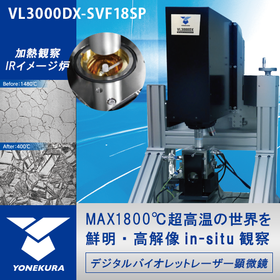
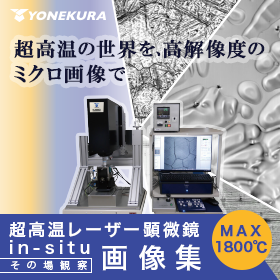
The product page for the high-temperature observation laser microscope system "VL3000DX-SVF18SP" is now available! Observe in-situ at a maximum temperature of 1800°C with high resolution! Please utilize it for research on the microstructural behavior of materials such as steel, non-ferrous metals, ceramics, and secondary batteries under high temperatures, as well as for material development.
The representative heating observation IR imaging furnace of Mikyo Manufacturing has been equipped with a digital violet laser microscope. This enables clear microscopic observation in ultra-high temperature environments of up to 1800°C. For more details, please refer to the catalog. If you have any questions or inquiries, please feel free to contact us.
-

We have published the catalog for the OCT-equipped heating observation imaging furnace!
Contributing to the world's first research! We have released a catalog for the "OCT-equipped heated observation imaging furnace," which allows for direct observation of internal structural changes at high temperatures! This is a compact design utilizing a focused heating method, equipped with OCT (Optical Coherence Tomography) for internal observation. Please utilize it for research and development of materials such as ceramics and resins. For more details, please refer to the catalog. If you have any questions or inquiries, please feel free to contact us.
Recommended products







Distributors

Mikyo Manufacturing provides a consistent production system that develops, designs, manufactures, and supports testing machines and measurement devices tailored to the objectives and applications of customers in fields such as material research and development, as well as in accordance with material testing standards and methods. The testing machines that respond to requests from various major manufacturers and research institutions are mostly customized products. When measuring the durability of new materials, they are completely made-to-order. We also pay attention to the "usability," which varies depending on the installation location and users, and we adjust the testing machines to ensure they are optimal for each customer.