
61. Shopify B2B EC Construction

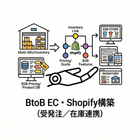


B2B e-commerce doesn't end with "creating a cart." We build Shopify B2B that encompasses order placement, pricing, and transaction conditions, all functioning on-site.
A typical failure in B2B e-commerce is "the e-commerce site is created, but the order management does not function." In B2B, there are always on-site requirements such as corporate pricing, quantity-based pricing, quotes, credit payments, transaction conditions, approval flows, and inventory integration. If you create only the appearance without designing these elements, you will ultimately revert to using email and Excel, and the e-commerce platform will become unused. In this service, we will build a B2B e-commerce system that can withstand operations by "designing the necessary functions and operations for B2B transactions first" based on Shopify. Furthermore, we will launch it with a sustainable structure, keeping in mind future expansions (inventory, core systems, CRM integration, multilingual support, and international transactions). ■ Service Offerings (3 Points) 1. B2B Requirement Definition (organizing transaction conditions, pricing, order management, and operational flows) 2. Shopify B2B Construction (store design, products/customers, payment/shipping, permissions) 3. Integration/Operational Design (inventory, core systems, quote operations, management screen operations) Deliverables: Complete Shopify B2B e-commerce package (requirement definition, design, construction, initial operation guide) *Please provide the current order management flow (email/phone/Excel, etc.). We will create a blueprint for B2B e-commerce.
basic information
■Provided Content B2B EC Requirements Definition (Most Important) - Customer Classification (Existing Clients/New Clients/Agents/Overseas, etc.) - Pricing Structure (Corporate Pricing, Quantity-based Pricing, Contract Unit Price, Discounts) - Order Method (Immediate Order/Quotation → Approval → Order) - Payment (Deferred Payment, Invoice, Card, Prepayment) - Transaction Conditions (Minimum Lot, Delivery Time, Shipping Conditions, Closing Date) - Authority (Purchasing Staff/Approvers, Management of Multiple Staff) Shopify B2B Construction (Design → Implementation) - Basic Store Design (Categories, Search, Product Display) - Product/Customer Data Design (SKU, Variations, Customer Linkage) - B2B Function Settings (Company Accounts, Price Lists, Payment Conditions, etc.) - Checkout Design (B2B Input, Notes, Shipping) Order and Delivery Operation Design (“Working on the Ground”) - How to Receive Quotation Requests/Response Templates - Order Processing, Shipping, Billing Flow - Inquiry Pathway (Designing Conditions to Hand Over to Sales) External Integration and Expansion (As Needed) - Inventory Management, Core Systems, CRM, Accounting, Warehousing, Shipping - API Integration Policy (Separate What to Do Now/What to Do Later)
Price information
1 million yen to 5 million yen (varies based on requirements, SKU, and integration scope) - Small scale (basic B2B, few SKUs, no or minimal integration): 1 to 2 million yen - Standard (B2B pricing/permissions, estimate operations, medium-sized SKUs): 3 to 10 million yen - Expanded (core/inventory/API integration, large-scale SKUs, complex conditions): 10 million yen and up * "Estimate required" notation recommended (to be confirmed in requirements definition)
Delivery Time
Applications/Examples of results
■Concerns Thinking that prices differ by client and that e-commerce cannot be implemented Need for quotes, deferred payments, and approval workflows Having many SKUs, leading to potential breakdowns in product registration and search Requirements cannot be organized as inventory and core systems are prerequisites Ambiguous division of roles between sales and e-commerce, causing inaction within the company ■Approach Preliminary sharing: Product characteristics / Transaction types / SKU scale / Current workflows Requirements definition: Finalize pricing, quotes, payments, permissions, and integrations Design: Information design (categories/search) + Data design Construction: Shopify setup → Theme → B2B settings → Product/customer organization Testing: Order placement tests based on major clients Launch: Staged launch is possible (existing clients first, then new ones) ■Uses E-commerce for B2B order placement (including on-site operations) Online pricing and conditions by client Systematization of quotes to approval to orders Product/search design that does not break even with many SKUs Foundation for future integrations and expansions ■Examples of achievements (company name not required format) Parts sales × tens of thousands of SKUs × Excel order placement → E-commerce implementation with price list + search design Consumables × client-specific unit prices × deferred payments → Implementation through company account management Industrial materials × mixed agents/direct sales → Organized and operationalized through customer classification and permissions
catalog(19)
Download All Catalogs
















Recommended products



















Distributors

A site that is just cheap ultimately increases costs and risks." We propose web development that maximizes business results while thoroughly addressing essential requirements. Are you creating a website like this? - It seems that the websites of competitors look better, but you don't know why. - Every update incurs additional costs, and before you know it, expenses have ballooned beyond expectations. - While the appearance is nice, it ignores laws and industry-specific rules, leading to complaint risks... - You want to attract customers and inquiries, but the production company only talks about design. - As a result of choosing a production that is simply cheap, you are overwhelmed with trouble handling and can't focus on your core business. Point 1. Avoid troubles with a design that has no "gaps or omissions." 2. Minimize operational costs with a design that assumes in-house updates. 3. Planning power that pursues business results. "Is the initial cost a bit high?" But in the long run, it's safe and cost-effective. We have prepared a plan to truly deliver results "correctly.