
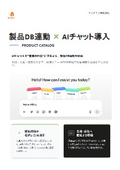
102. Introduction of AI chat linked to product database
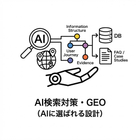
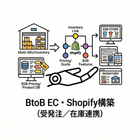
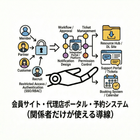

If you want to make AI chat a "substitute for sales," linking it to a product database is essential. By referencing the database for specifications, compatibility, and selection criteria, we can improve the accuracy of responses.
The main reason why AI chat fails to meet expectations is that product information is scattered in "text." Questions in the B2B manufacturing industry cannot be answered accurately unless they are structured data, such as applications, conditions, specifications, dimensions, materials, compatibility, and delivery times. Referring only to the text on the page leads to ambiguous answers and increases the risk of incorrect responses. This service will implement an AI chat that is linked to a product database (product master/specification database/compatibility tables/stock and delivery information, etc.). The chat will listen to the user's conditions, present relevant candidates from the database, and provide the basis (specification values and compatibility conditions), smoothly connecting to quotes, document downloads, and inquiries. ■ Provided Content (3 Points) 1. Product DB design/maintenance (items that can withstand AI reference/normalization) 2. AI chat implementation (database reference answers, candidate presentation, basis display) 3. Sales flow integration (quote condition collection, form/CRM integration, operational design) *First, please tell us the "number of products" and the "frequently asked questions from users (compatibility/selection/quotes)." We will design based on the optimal DB items.
basic information
■Concerns like these - There are too many products, and users cannot choose the suitable ones. - Technical questions are complex, and sales cannot handle the initial responses. - An AI chat was implemented, but the answers are vague and not used. - Compatibility and selection criteria are exchanged back and forth via email every time. - Necessary information for quotes is not gathered, leading to delays in negotiations. ■Provided Content (Details) - 1) Information design for the product database (to enable AI "search and comparison") - 2) Design for chat "selection support" (flow from questions to candidate suggestions) - 3) Guardrails (to prevent incorrect answers and accidents) - 4) Operation and update design (accuracy increases as the database grows) ■Deliverables - Product database item definitions (data dictionary: items, types, units, required/optional) - Database structure (categories, attributes, compatibility, related documents) - Chat design (entry point, question flow, candidate suggestions, rationale display) - Integration of pathways (quote forms, document downloads, inquiries, CRM/ledgers) - Management screen requirements (updates, approvals, history, search) *as needed - Operational rules (update procedures, guardrails, log improvements) - KPI design (self-resolution rate, candidate suggestion reach rate, quote conversion, negotiation conversion)
Price information
■4 million yen to 20 million yen (varies based on DB scale and integration scope) - Light (small-scale DB + basic selection chat): 4 to 7 million yen - Standard (compatibility/comparison, flow branching, operational design included): 7 to 12 million yen - Expanded (large-scale with multiple SKUs, CRM/inventory/ERP integration, including management screen): 12 to 20 million yen *Estimation required
Delivery Time
Applications/Examples of results
■Purpose - Self-resolution of compatible products (support for selection before inquiries) - Standard collection of necessary information for estimates (accelerating negotiations) - Automation of first response to technical questions (reducing labor) - Resolution of "unfindable issues" for companies with many products - Stabilization of AI response accuracy (answering based on database evidence) ■Examples of Achievements - Multi-SKU manufacturing → Realized candidate suggestions through condition hearing-type chat - High volume of compatibility inquiries → Reduced back-and-forth by database conversion of compatibility tables - Organization of conditions prior to estimates → Advanced negotiations by collecting necessary information ■Approach 1. Current situation analysis: number of products, categories, existing databases/Excel, inquiry content 2. Database design: determine essential items and normalization for AI reference 3. Chat design: finalize the flow for selection/compatibility/estimates 4. Implementation: database maintenance, chat introduction, measurement settings 5. Testing: accuracy verification with representative questions (identifying incorrect answers/missing conditions) 6. Operation: monthly improvement of database and responses (support available)
catalog(20)
Download All Catalogs
Recommended products




















Distributors

A site that is just cheap ultimately increases costs and risks." We propose web development that maximizes business results while thoroughly addressing essential requirements. Are you creating a website like this? - It seems that the websites of competitors look better, but you don't know why. - Every update incurs additional costs, and before you know it, expenses have ballooned beyond expectations. - While the appearance is nice, it ignores laws and industry-specific rules, leading to complaint risks... - You want to attract customers and inquiries, but the production company only talks about design. - As a result of choosing a production that is simply cheap, you are overwhelmed with trouble handling and can't focus on your core business. Point 1. Avoid troubles with a design that has no "gaps or omissions." 2. Minimize operational costs with a design that assumes in-house updates. 3. Planning power that pursues business results. "Is the initial cost a bit high?" But in the long run, it's safe and cost-effective. We have prepared a plan to truly deliver results "correctly.