
117. AI Implementation PoC Design (Web)

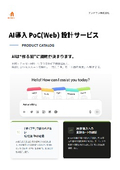
The outcome of AI is determined "before it is created." We validate the purpose, data, KPIs, and risks through a Proof of Concept (PoC) and design a deployment route that avoids failure.
The patterns of failure in AI implementation are common. The objectives are vague, there is insufficient data, KPIs are not established, there is no risk inventory, and there is no operational framework. In this situation, the PoC ends up being just a "working demo" and cannot transition to production. In this service, we design the PoC (Proof of Concept) for AI implementation in the web domain (AI chat, RAG, inquiry automation, content generation, etc.) in a way that connects to "production." We clarify **"what needs to be validated to determine GO/NO-GO"**, and by detailing the necessary data, evaluation metrics, guardrails, and operational assumptions, we facilitate the shortest route to production implementation. ■ Provided Content (3 points) 1. PoC Design (Objectives, Hypotheses, Validation Scope, KPIs, Success Conditions) 2. Data/UX Design (Target Content, User Flow, Evidence Presentation, Evaluation) 3. Risk/Operational Design (Guardrails, Auditing, Improvement, Structure) *First, please decide on one theme you want to solve with AI (e.g., reducing inquiries, pre-estimate hearings). A focused PoC is the fastest approach.*
basic information
■For such concerns - Considering the introduction of AI but unsure where to start - Vendor proposals are "demo-focused," making it difficult to assess results - Need a verification plan and success criteria to get internal approval - Fear of incorrect answers and data leaks prevents taking action - Unable to transition from PoC to production (operations are stuck) ■Provided content (details) - 1) PoC design (defining success criteria numerically) - 2) Data design (PoC fails due to lack of data) - 3) UX/flow design (directly linked to results) - 4) Guardrails (aiming for "zero incidents" at the PoC stage) - 5) Evaluation design (creating reports that can be assessed) - 6) Production transition design (making PoC a "scaled-down version of production") ■Deliverables - PoC requirement definition (objectives, hypotheses, scope, target data) - Success criteria/KPI definition (GO/NO-GO standards) - Screen and flow requirements (response format, CTA branching) - Data preparation plan (sources, organization, version control, confidentiality classification) - Guardrail design (prohibited areas, thresholds, escalation) - Test scenarios (representative questions, risky questions, evaluation procedures) - PoC report template - Production transition roadmap
Price information
■2 million to 15 million yen (varies based on scope and verification depth) - Light (PoC design + KPI + test scenarios): 2 to 4 million yen - Standard (including design set with data/flow/guardrails): 4 to 8 million yen - Expanded (including approval documents, multiple theme comparisons, and accompanying verification): 8 to 15 million yen *Estimate required
Delivery Time
Applications/Examples of results
■Purpose - Avoiding failures in AI implementation (clarification of objectives/KPIs) - Forming internal consensus and approvals (presentation of success conditions) - Early detection of data shortages and operational deficiencies - Accident prevention (assuming guardrails) - Designing the shortest route to full implementation ■Examples of Achievements - PoC that ends with a demo → transformed into a format that can be judged by KPIs/success conditions - Fear of incorrect answers → zero-accident operation through prohibited areas/thresholds/audits - Inability to transition to full implementation → designing the system and operations from the PoC stage ■Approach - 1. Theme selection: Focused approach (inquiries/estimates/document searches, etc.) - 2. Current situation assessment: Confirm target data and current KPIs - 3. PoC design: Finalize success conditions, scope, and guardrails - 4. Verification: Testing with representative questions and risky questions - 5. Evaluation: Judgement based on KPI reports and field reviews - 6. Transition: To full requirements and an expansion roadmap
catalog(20)
Download All Catalogs


















Recommended products



















Distributors

A site that is just cheap ultimately increases costs and risks." We propose web development that maximizes business results while thoroughly addressing essential requirements. Are you creating a website like this? - It seems that the websites of competitors look better, but you don't know why. - Every update incurs additional costs, and before you know it, expenses have ballooned beyond expectations. - While the appearance is nice, it ignores laws and industry-specific rules, leading to complaint risks... - You want to attract customers and inquiries, but the production company only talks about design. - As a result of choosing a production that is simply cheap, you are overwhelmed with trouble handling and can't focus on your core business. Point 1. Avoid troubles with a design that has no "gaps or omissions." 2. Minimize operational costs with a design that assumes in-house updates. 3. Planning power that pursues business results. "Is the initial cost a bit high?" But in the long run, it's safe and cost-effective. We have prepared a plan to truly deliver results "correctly.