
Three conditions for preventing poor curing that causes stickiness in paint.
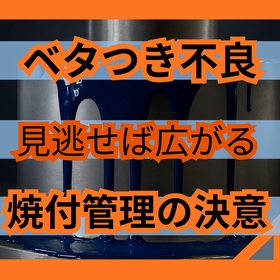
Stickiness is not a minor discomfort; it is a serious quality defect caused by insufficient curing or excessive film thickness.
■Cause of Occurrence: Poor curing that leaves stickiness on the surface is a defect that is difficult to judge visually. If a few pieces are mixed in one lot, it can lead to rubbing during assembly, sticking of packaging materials, scratches during transportation, and re-inspection. The three conditions to check are curing temperature, curing time, and film thickness. Even if the set temperature is reached, if the parts do not rise to the required temperature, they will not cure. ■Truth: At the time of shipment, they may appear slightly soft, but they can quickly deteriorate in the subsequent processes. If the film thickness is too thick, heat will not penetrate to the inside, and if the drying oven is unstable, curing will vary. This cannot be prevented by intuition alone. ■Improvement Measures: Confirm curing conditions based on part temperature, record film thickness with measured values, and check the temperature differences at the entrance, center, and exit of the drying oven. By including these three points as management items, the risk of recurrence will decrease. Please utilize materials that allow you to confirm curing conditions, film thickness, and drying management.
basic information
Confirmation of 3 conditions: Baking temperature, baking time, film thickness / Component temperature: Actual measurement management using thermocouples / Drying oven: Check temperature difference between entrance, center, and exit / Film thickness: Measurement value recording / Hardness stable supply of 4H or higher.
Price range
Delivery Time
Applications/Examples of results
Automotive parts, assembly parts, thick-walled parts, industrial machinery parts.
Related Videos
catalog(3)
Download All Catalogs
Distributors

We are not just a "subcontracted painting factory." Established in 1958, our company has a foundation of painting technology and also specializes in chemical treatment, stripping, and cleaning, functioning as the "external surface treatment department" in your organizational chart. Based on our philosophy of "preparation is eight-tenths of the work," we emphasize participation from the "upstream process" before the drawings are finalized. We conduct test painting on a wide range of metals and difficult materials, and we produce the entire process from assembly, packaging, to delivery, thereby reducing your management workload. Additionally, by being able to perform zinc phosphate treatment in-house, we achieve stable painting quality. Furthermore, our micro-heating stripping technology, which does not use chemicals, maintains the electrical state of the "jigs (hangers)" that influence painting quality. Our approach of "pre-treatment determines painting quality" ensures the stability of the paint film during mass production. Rather than simply "applying specified standards," we work backwards to achieve optimal painting specifications and prevent scratches during transportation, sparing no effort in thorough discussions from the outset. This diligent preparation is the shortest path to preventing rework and minimizing total costs. From the development stage, please utilize the expertise of our specialists as part of your production line.