
[Information] What is a secure smart factory through factory IoT?

Examples of successful outcomes from implementing smart factories, including the inheritance of technology, resolution of labor shortages, and cost reduction.
This document discusses the secure smart factory transformation through factory IoT. It introduces topics such as "Implementing AI and IoT in factories to lead to the automation and autonomy of production systems" and "Security measures cannot be ignored for the realization of smart factories." It also includes illustrations, making it an easy reference. We encourage you to read it. 【Contents (partial)】 ■ Implementing AI and IoT in factories to lead to the automation and autonomy of production systems ■ Reducing waste and human errors with factory IoT, successful due to the one-stop service of NSW ■ Security measures cannot be ignored for the realization of smart factories ■ NSW realizes smart factories in appropriate ways according to the concerns of our customers *For more details, please refer to the PDF document or feel free to contact us.
basic information
【Other Listings】 ■High-security IoT platform combining Toami and Azure, Azure Sphere Toami on Azure Sphere ■Choosing a vendor with a one-stop solution and additional security knowledge ■Microsoft's Azure Sphere supporting the field with advanced security *For more details, please refer to the PDF document or feel free to contact us.
Price range
Delivery Time
Applications/Examples of results
For more details, please refer to the PDF document or feel free to contact us.
catalog(1)
Download All Catalogs
News about this product(2)
-
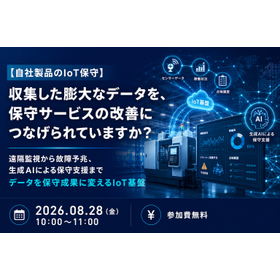
[Online Seminar] [IoT Maintenance of Our Products] Are you able to leverage the vast amount of collected data to improve maintenance services?
In machinery and equipment manufacturing, the IoT integration of their products and equipment has progressed, allowing for the daily collection of vast amounts of data that were previously unattainable, such as operational status, sensor data, and inspection and maintenance history. On the other hand, there are many companies that, while they have "collected data for the time being," have not been able to sufficiently connect it to maintenance operations or service improvements. This seminar will introduce methods for real-time monitoring of equipment status through remote monitoring, data analysis using AI to predict potential failures, and a maintenance support system where AI presents potential causes and response options by cross-referencing past maintenance history, manuals, and operational data. Additionally, we will clearly explain how to transform IoT data into valuable information, along with key points for implementation, to achieve the advancement of maintenance operations and improvement of service quality, using specific case studies. This seminar is recommended for those who wish to utilize their own product's IoT data and generative AI to advance maintenance operations and service improvements. We look forward to your participation.
-
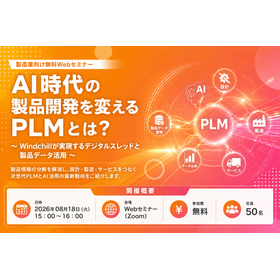
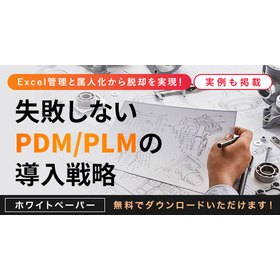
What is PLM that changes product development in the AI era? - The digital thread and product data utilization realized by Windchill.
The environment surrounding the manufacturing industry is rapidly changing, with advancements in products, software integration, shorter delivery times, and increasing quality demands. In this context, the "Digital Thread," which centralizes product data management from design to manufacturing to service and enables AI-driven decision-making, is gaining attention. This seminar will introduce the latest trends in PLM utilizing AI, based on the concept of "Intelligent Product Lifecycle (IPL)" proposed by PTC. We will also clearly explain the latest features of Windchill AI, such as information retrieval, design support, and business automation, along with demonstrations of the role of PLM required in the AI era. This seminar is recommended for those considering PLM renewal or looking to leverage product information and promote design and development digital transformation (DX). We look forward to your participation.
Recommended products




Distributors

Since our founding in 1966, we have expanded our business areas in response to the demands of the times, transitioning from software development to device development, then to system integration, and further to cloud services centered around data center operations. What has remained consistent since our inception is our customer-oriented approach, which emphasizes that "the center of business is always the customer, and we work in unity with our customers," along with our belief in valuing human resources, which focuses on "maximizing the potential of each employee." We also consider our commitment to CSR aimed at realizing a prosperous society to be an important mission, and we are dedicated to social contribution activities such as resource and environmental conservation, community beautification efforts, blood donation, and support for disaster victims. Our corporate philosophy, "Humanware By Systemware," embodies our desire to "enrich society through excellent systems." Moving forward, we will continue to leverage our technology, knowledge, and creativity to create "valuable systemware" that meets the needs of the new era and earns the trust of our customers, shareholders, and society.