Why is continuous processing highly reproducible? An explanation of the mechanism that stabilizes distributed quality.

澁谷工業 メカトロ統轄本部
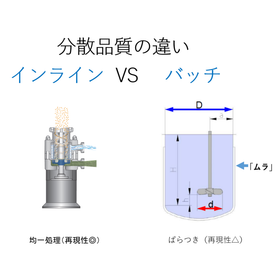
In dispersion processes, the variation in quality is one of the significant challenges. Even when processing under the same equipment and conditions, it is not uncommon for the dispersion state to differ from batch to batch. The main factor behind this is the variability in the dispersion history experienced by the particles. In batch processing, the shear and residence time experienced by each particle differ depending on their position and flow state within the tank. As a result, there is a mixture of sufficiently dispersed particles and undispersed particles, leading to variations in quality. This tendency becomes particularly pronounced under high viscosity or high solid content conditions. On the other hand, in continuous processing, particles pass through a consistent processing area, receiving nearly the same dispersion conditions. Because shear energy and residence time can be controlled consistently, the variability in dispersion history is minimized, resulting in a uniform and highly reproducible dispersion state. Moreover, continuous processing is advantageous during scale-up. By adjusting the flow rate, it becomes easier to replicate similar dispersion quality from the lab to mass production. This helps reduce the risk of quality fluctuations during the transition from development to mass production. What is crucial in dispersion processes is to provide the same processing history to all particles. Continuous processing easily meets this condition and is an effective method for stabilizing quality and ensuring reproducibility.