
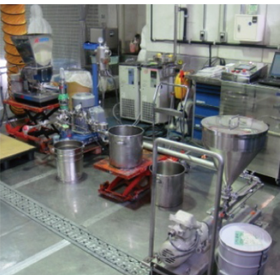
Dispersion machine (solid-liquid mixing dispersion system) slurry dispersion line


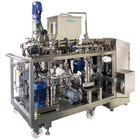


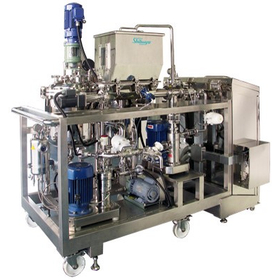
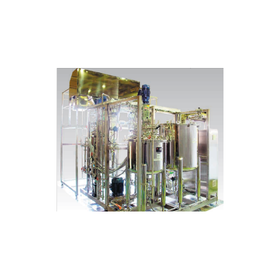
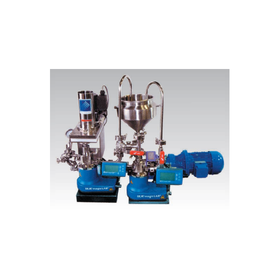
Dispersion is not determined by the equipment. It is determined by the process design of the solid-liquid mixing dispersion system.
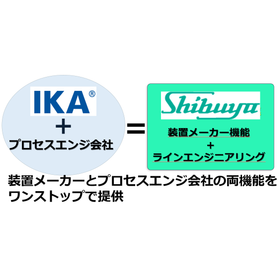
The occurrence of "agglomeration," "cohesion," and "viscosity increase" in dispersion processes is caused not by the equipment but by the design of the process. Poor wetting during powder input and unsuitable dispersion conditions lead to quality variations and poor redispersion, significantly compromising stability during mass production. Additionally, during scale-up, it is often impossible to reproduce the same conditions, resulting in unexpected troubles. Furthermore, every time there is a change in materials or formulations, new conditions must be established, increasing the burden of development and mass production. Shibuya Kogyo's solid-liquid mixing and dispersion system is designed to provide a consistent process from powder supply to dispersion, formulation, and CIP cleaning. By optimizing the entire process, including material properties, input conditions, and fluid design, we stabilize dispersion quality and reproducibility. Moreover, optimization across the entire line contributes to reducing losses between processes and lowering equipment load. It is not just a dispersion machine but a dispersion system that governs the entire process. By building quality from the design stage, we achieve shorter startup times and improved yields. We also provide consistent support from equipment selection to startup, reducing the burden on the site. We propose the optimal dispersion process tailored to your materials and process conditions. Please consult us about your current challenges. We support you from initial considerations to mass production startup.
basic information
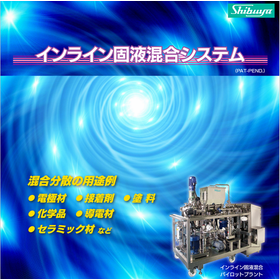
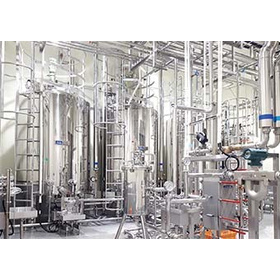
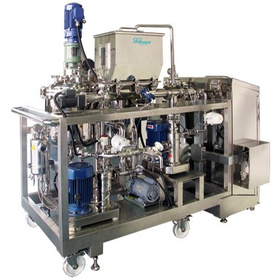
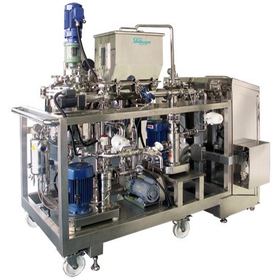
This system is an inline solid-liquid mixing and dispersion system that can be consistently designed from powder supply to solid-liquid mixing, dispersion, formulation, and CIP cleaning. By controlling wettability during powder input and achieving high shear dispersion, it suppresses the occurrence of lumps and the aggregation of nanoparticles, realizing a uniform dispersion state in a short time. Continuous processing enables the reduction of dispersion time and improvement of processing capacity, contributing to reproducibility during scale-up. Furthermore, process design tailored to material characteristics (particle size distribution, viscosity, temperature characteristics) helps to suppress particle size variation and poor redispersion. The design philosophy optimizes not just the equipment itself but the entire process, achieving both quality stability and energy efficiency. Data logging and recipe management functions can also be incorporated. It is particularly effective for applications requiring high viscosity and nanoparticle dispersion, such as battery material slurries and high-performance materials. It can accommodate everything from the establishment of new factories to the modification of existing lines.
Price information
It varies depending on the specifications.
Delivery Time
Model number/Brand name
Cyclic solid-liquid mixing and dispersion system (CMX)
Applications/Examples of results
【Improvement of Particle Size Variation and Poor Re-dispersion】 Battery material slurry, electronic material slurry, conductive paste 【Enhancement of Nanoparticle Aggregation and Dispersion Stability】 CNT dispersion, CNF (Cellulose Nanofiber), Perovskite materials 【Optimization of Dispersion and Mixing of High Viscosity Slurries】 Adhesive filler dispersion, resin, ink dispersion 【Quality Reproduction and Mass Production Stabilization during Scale-Up】 New factory startup, existing line modification
Related Videos
Line up(1)
| Model number | overview |
|---|---|
| Inline solid-liquid mixing and dispersion system |
catalog(9)
Download All Catalogs


News about this product(10)
-
【June 2, 2026 (Tuesday) - June 5, 2026 (Friday)】 Announcement of participation in 'FOOMA JAPAN 2026'
Shibuya Kogyo Co., Ltd. will exhibit at FOOMA JAPAN 2026, which will be held at Tokyo Big Sight from June 2 (Tuesday) to June 5 (Friday), 2026. We will introduce various devices that contribute to "quality improvement," "labor saving," and "cleaning efficiency" in food and beverage manufacturing. [Exhibition Details] ■ Two-stage superheated steam circulation baking machine (JESTOS Jr.) *Panel display and tasting available - Achieves fluffy, high-quality baking in a short time using superheated steam - Capable of low-temperature to high-temperature cooking (with a firm browning) with just one machine - Prevents oxidation by blocking outside air with a shielding nozzle (patented) ■ 3D nozzle type container cleaning machine (TSW4000 model) *Actual machine display - Achieves high cleaning power with low water usage and short time - Contributes to reduced cleaning time and utility costs ■ Continuous and batch continuous solid-liquid mixing system *Panel display - Stable inline processing of mixing and dispersing powders and liquids - Accommodates high-viscosity materials and high solid content such as proteins, achieving uniformity and reproducibility in quality - Capable of engineering proposals including process design On the day, you can experience solutions to on-site challenges through actual machines, panels, and tastings. Please be sure to stop by our booth.
-
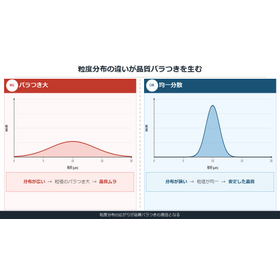
What are the causes and countermeasures for quality variation in dispersed engineering? An explanation of design points to prevent instability in particle size distribution and reduced reproducibility.
In dispersion processes, issues such as unstable particle size distribution and quality variation between batches occur in many settings. These quality variations are caused not only by equipment performance but also by variations in dispersion conditions, flow states, and process design. For example, when shear energy is uneven, differences arise in the disintegration state of particles, leading to a wider particle size distribution and residual agglomeration. Additionally, in batch processing, variations in mixing uniformity and residence time can cause fluctuations in dispersion state between batches, making it difficult to ensure reproducibility. Particularly in high-viscosity systems or high solid content slurries, even slight variations in conditions can significantly impact quality. To suppress quality variations, it is crucial to design processes that maintain consistent dispersion energy and flow conditions. By stabilizing conditions, as in inline continuous processing, it becomes possible to reduce inter-batch differences and achieve stable dispersion quality. Furthermore, in dispersion processes, not only the performance of the equipment itself but also operating conditions such as input order, residence time, and flow control greatly affect quality. Inline continuous processing makes it easier to maintain these conditions consistently, ensuring stable dispersion even in high-viscosity slurries. By designing the entire process, it is possible to fundamentally suppress quality variations.
-

What causes clumping when adding powder? Design points for preventing and addressing poor dispersion.
In dispersion processes, the occurrence of agglomerates (clumps) during powder addition, which cannot be resolved in subsequent dispersion stages, is a common issue in many settings. The cause of this is that the powder does not wet uniformly in the liquid, leading to the formation of localized high-concentration areas. These agglomerates are also referred to as "fisheyes," and due to their internal unwetted structure, they are difficult to break apart. Once an agglomerate forms during powder addition, liquid has difficulty penetrating its interior, resulting in only the outer layer being wetted, which makes it hard for the internal particles to be disintegrated. Additionally, depending on the addition position and speed, the powder may float on the liquid surface or remain stagnant without following the flow within the equipment, promoting the formation of agglomerates. Particularly under conditions of high viscosity or high solid content, the low fluidity makes it challenging to achieve uniformity in the initial dispersion stage, leading to a higher likelihood of agglomerates remaining. Such agglomerates may not be completely resolved even with strong shear in subsequent processes, causing variations in the quality of the final product and introducing foreign substances. To prevent the formation of agglomerates, it is crucial to improve wettability during powder addition, ensure appropriate addition positions and flow design, and optimize the initial dispersion. By performing shear and mixing simultaneously right after addition, as in inline powder addition and simultaneous dispersion, it is possible to suppress the formation of agglomerates and achieve stable dispersion quality.
-
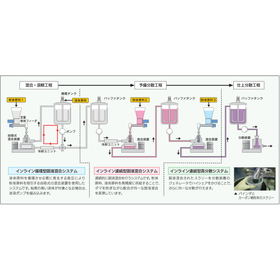
What is decentralized process design? Key points for stabilizing quality.
In dispersion engineering, stable quality cannot be achieved solely based on the performance of the equipment. What is important is the overall design of the process, taking into account material properties and process conditions. This is referred to as dispersion process design. Dispersion quality is determined not only by the strength of shear but also by multiple factors such as flow state, residence time, and method of input. If these conditions are not properly designed, localized agglomeration or variation can occur, making it difficult to maintain stable quality. For example, poor wetting during powder input or the occurrence of stagnant areas due to flow bias can lead to clumping or dispersion issues. Additionally, even if the shear energy is sufficient, if it does not act uniformly on all particles, differences in dispersion state will arise. Therefore, in dispersion processes, it is crucial to design "flow," "shear," and "processing time" as an integrated system. This allows for all particles to receive the same dispersion history, achieving uniform and highly reproducible dispersion quality. In particular, inline continuous processing has the advantage of maintaining consistent conditions within the flow, making it easier to ensure reproducibility in process design. Dispersion process design is a key concept for stabilizing quality and successfully scaling up.
-
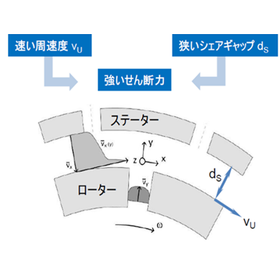
What is the relationship between viscosity and dispersion efficiency? The reason why dispersion becomes difficult under high viscosity conditions.
In dispersion processes, viscosity is an important factor that significantly affects dispersion efficiency. Generally, as viscosity increases, fluidity decreases, making it more difficult for dispersion energy to be transmitted to the particles. When viscosity is low, liquids flow easily, and shear energy is widely transmitted throughout the system, making it relatively easy to break apart particle agglomerates. On the other hand, as viscosity increases, flow becomes localized, and shear tends to be concentrated near the equipment. As a result, there is a mixture of particles that receive sufficient energy and those that do not, leading to variability in the dispersion state. Additionally, under high viscosity conditions, the movement of particles is also restricted, making collisions and breakdowns between agglomerates less likely. Consequently, even if the mixture appears homogeneous, there may be undispersed regions remaining internally. To enhance dispersion efficiency, it is crucial to implement appropriate shear conditions and flow designs according to viscosity. Particularly in inline continuous processing, it is possible to provide uniform shear to the particles within the flow, allowing for efficient transmission of dispersion energy even under high viscosity conditions. In dispersion processes, optimizing flow, shear, and processing time while considering the effects of viscosity is key to achieving stable dispersion quality.
Recommended products






Distributors

Our company is headquartered in Kanazawa City, Ishikawa Prefecture, and has sales offices and factories both within and outside the prefecture. We focus on the bottling business, which involves filling beverages and other products, and we are expanding into various fields such as solid-liquid mixing and dispersion systems, laser processing machines (including fiber lasers and CO2 lasers), and semiconductor assembly equipment (such as taping machines, multifunctional test handlers, ball mount machines, and bonders). Please feel free to contact us if you have any inquiries.