What is distributed energy? A clear explanation of the important indicators that influence distributed quality.

澁谷工業 メカトロ統轄本部
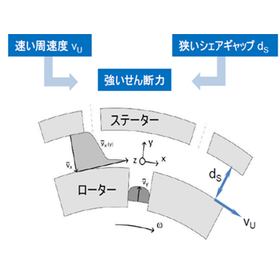
In the dispersion process, it is not "how much to mix" but "how much energy to provide" that determines the quality of dispersion. The key factor here is dispersion energy. Dispersion energy refers to the amount of energy applied to break down the agglomeration of particles and achieve a uniform state. When dispersion is insufficient, it is often due to a lack of energy. Even if it appears to be mixed, the agglomeration between particles may not be resolved, leading to variations in quality and performance degradation. Dispersion energy is determined not only by the strength of the shear force but also by the duration of its application. In other words, it is important to consider it as "strength × time." In batch processing, this energy can vary for each particle, making it easier for differences in dispersion states to occur. On the other hand, in inline continuous processing, particles are subjected to the same shear conditions within a consistent flow, allowing for uniform application of dispersion energy. This results in a consistent dispersion state for each particle, achieving stable quality. In the dispersion process, it is crucial to provide the necessary dispersion energy to all particles without excess or deficiency. Therefore, process design that includes flow, shear, and processing time is essential.