
news list
1~3 item / All 3 items
-
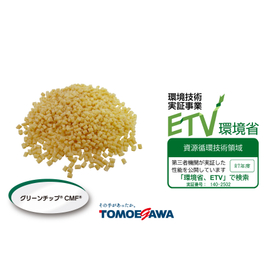
TOMOEGAWA's high-content cellulose fiber resin "Green Chip CMF" has demonstrated various physical properties and the effectiveness of resource recycling in the Ministry of the Environment's ETV project.
Bakagawa Corporation is pleased to announce that the various physical properties and effectiveness of resource circulation of our cellulose fiber high-content resin "Green Chip CMF" have been validated in the Environmental Technology Verification (ETV) program conducted by the Ministry of the Environment. The results of this verification are published in the database of the Ministry of the Environment's ETV program. This product is a composite resin that incorporates a high content of cellulose fiber derived from wood into polypropylene (PP) resin, and it is expected to achieve a reduction in the use of petroleum-derived resins while promoting resource circulation. To objectively confirm the performance (physical properties) as a plastic resin and its material recyclability, it was adopted as a verification target technology in the Ministry of the Environment's ETV program (Resource Circulation Technology Domain), and verification was conducted by a third-party organization. The verification confirmed that, compared to standard PP resin, it demonstrated high performance in key physical properties and met the verification criteria. It was also confirmed that the rate of change in physical properties during material recycling remained within a certain range, demonstrating its effectiveness from the perspective of resource circulation.
-
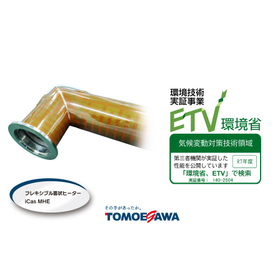
TOMOEGAWA's "Flexible Surface Heater iCas MHE" has demonstrated over 20% energy-saving effects in the Ministry of the Environment's ETV project - Approximately 42% reduction confirmed in the technology verification test.
We are pleased to announce that the "Flexible Surface Heater iCas MHE" from Hakawa Corporation has been demonstrated to have over 20% energy-saving performance compared to conventional mantle heaters in the Environmental Technology Verification (ETV) project conducted by the Ministry of the Environment. In the technical verification tests, a reduction of approximately 42% has been confirmed*. This product takes advantage of its ability to heat in close contact with the heated object, enabling efficient heat transfer compared to conventional heaters, and is expected to contribute to reducing environmental impact. To objectively evaluate this feature, the product was selected as a verification target technology under the Ministry of the Environment's ETV project, and verification was conducted by a third-party organization. During the verification, measurements of power consumption and other factors were taken under conditions simulating actual operation, confirming that the characteristic of heating in close contact with the heated object allows for efficient transmission of heating energy. Additionally, it was demonstrated that the entire surface generates heat uniformly, enabling stable heating with minimal temperature differences throughout the piping. *Refer to the Ministry of the Environment ETV project website for the list of verified technologies, verification reports, and summaries.
-
TOMOEGAWA's breathable heater adopted in Nikon's semiconductor exposure equipment - Achieving precise temperature control -
The breathable heater component "iCas MCT," developed by Hakusen Corporation, has been adopted in Nikon Corporation's semiconductor exposure equipment. This equipment is scheduled to be sold starting in December 2026. Semiconductor exposure equipment requires technology that can form complex and fine electronic circuit patterns on silicon wafers with high precision while also contributing to improvements in productivity and energy efficiency. Even slight temperature fluctuations can affect pattern accuracy, making high-precision and rapid temperature control in the exposure equipment essential, measured in mK (milliKelvin) units. The breathable heater component "iCas MCT" has been adopted for the first time in semiconductor exposure equipment. The "iCas MCT" is a heater component that uses a paper-like, porous structure made of "stainless steel fiber sheet" as the heating element. By incorporating breathability into the heater component and allowing air to pass vertically through the heating surface, it effectively heats while minimizing thermal capacity, achieving high temperature responsiveness and heating performance. Additionally, it contributes to the miniaturization and lightweight design of components, as well as the high performance of semiconductor exposure equipment.