
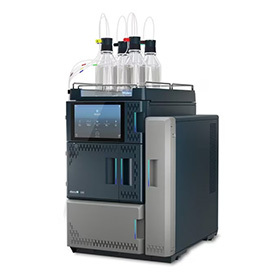
Ultra High-Speed High-Resolution LC [ACQUITY UPLC PLUS]


Demonstrates excellent analytical skills. LC improves lab productivity, efficiency, and throughput simultaneously.
UltraPerformance LC (UPLC) is the result of a total system innovation that has redesigned all aspects of traditional HPLC, including packing material technology, column design, injectors, fluid delivery systems, and detectors. UPLC technology was developed to simultaneously enhance laboratory productivity, efficiency, and throughput for scientists seeking reliable technology. Its success has already been demonstrated through thousands of peer-reviewed papers, application notes, and significant process improvements, making UPLC a standard technology that delivers important scientific and business benefits in leading companies and research institutions around the world. We offer a diverse lineup that allows for effective use of this technology not only in research settings but also in production management. Since the launch of ACQUITY UPLC in 2004, Waters has continued to pursue further innovations, and the new ACQUITY UPLC PLUS series has been introduced, achieving even greater flexibility, performance, and ease of use.
basic information
[ACQUITY UPLC I-Class PLUS System] - Achieves high-efficiency and rapid separation with industry-leading ultra-low dispersion and low delay volume. - Demonstrates excellent analytical capability even for very complex and low-concentration samples, making it suitable as an MS inlet. [ACQUITY UPLC H-Class PLUS System] - A hybrid LC that can be used as both HPLC and UPLC. - A system that balances the performance of UPLC with the operability of HPLC. - Transforms existing standard analytical conditions into top-class performance. [UPLC 2D System] - A 2D chromatography system in UPLC mode. - Achieves separations that cannot be accomplished in standard HPLC/UPLC modes.
Price information
Please contact us.
Delivery Time
Applications/Examples of results
For more details, please contact us or download the catalog.
catalog(4)
Download All Catalogs


News about this product(3)
-
"One Rank Higher LC Application Seminar" to Help Improve Analysis Accuracy - A Total of 6 Sessions Held [Live Webinar]
[Viewer Benefits Available] Explaining Tips for LC in a Short Seminar Do you have concerns such as "I'm unsure about column selection," "I'm struggling to optimize analysis conditions," or "I have challenges analyzing compounds with weak retention" in LC analysis? Waters will hold a seminar titled "Must-Listen! Advanced LC Application Seminar" where you can learn practical LC analysis know-how in just 30 minutes. In this seminar, we will cover useful topics in a total of six sessions, including tips for choosing detectors, how to utilize reverse phase columns, scaling up to preparative LC, approaches for analyzing hydrophilic and highly polar compounds, case studies of low-adsorption HPLC, and improving purity through solid-phase extraction. Each session is scheduled to start at 15:00. Event Themes: • October 6 (Tuesday) - Session 1: Tips for Choosing Detectors • October 13 (Tuesday) - Session 2: Tips for Choosing Columns • October 21 (Wednesday) - Session 3: Tips for Preparative LC • October 27 (Tuesday) - Session 4: Approaches for Analyzing Hydrophilic and Highly Polar Compounds • November 5 (Tuesday) - Session 5: Case Studies of Low-Adsorption HPLC • November 10 (Tuesday) - Session 6: Tips for Solid-Phase Extraction
-

[On-Demand Webinar] Pharmaceutical Analysis User Presentation 1: Kaigen Pharmaceutical Co., Ltd. "Development of Testing Methods Using the Analytical Method and Method Development Software Fusion"
In this seminar, we will introduce case studies of analytical method development using QbD software: Fusion, and present solutions that are helpful for developing robust analytical methods. ◆ Development of testing methods using the analytical method and method development software Fusion Dr. Taiki Kamiya, Kaken Pharmaceutical Co., Ltd. The analysis department of the CMC Center, to which the speaker belongs, has been developing testing methods using HPLC and introduced Fusion four years ago to improve operational efficiency. This time, we will explain the introduction environment, background, and overview of Fusion, and introduce the operational methods used in the department. Additionally, we will share impressions of using Fusion (advantages and challenges) as well as examples of testing method development (successes and failures). ◆ Waters Analytical Development Solutions, Waters Japan We will introduce mass spectrometers that can be used in conjunction with QbD software, LC systems that enable smooth development and transfer of analytical methods, and the quality of analytical columns, which is crucial for conducting robust analyses over the long term.
-

[On-Demand Webinar] Chemical Analysis Course: From HALS/Lubricant Quantitative Analysis to Structural Analysis of Synthetic Resins
In recent years, with the advancement and enhancement of polymer materials, various additives for synthetic polymers with different functions have been used in optimized formulations. Among them, there are types of additives, such as hindered amine light stabilizers (HALS) and lubricants, that present challenges in solubility and detection methods, making analysis difficult. Additionally, when conducting structural analysis of multi-component polymers or terminal group analysis using pyrolysis gas chromatography-mass spectrometry (PyGC/MS), there are many pyrolysis products not registered in the EI method database, making analysis not straightforward. In this webinar, we will introduce two solutions to the challenges in the characterization of synthetic resins, along with practical examples. ■ Overview of additives for synthetic polymers ■ Actual quantitative analysis of HALS/lubricants ■ Examples of structural analysis of synthetic resins using PyGC/Q-Tof MS Target audience: Individuals handling organic compounds for the development and quality control of materials and industrial products.
Recommended products





Distributors

Waters Corporation, headquartered in Milford, Massachusetts, USA, has played a pioneering role as a specialized manufacturer of liquid chromatography since its establishment in 1958. Actively engaged in the development of new products and technologies, it has grown into an international group company that supplies not only high-performance liquid chromatography but also mass spectrometers (MS) and thermal analysis instruments. Waters Japan started operations in 1973 (Showa 48) as the Japanese base of Waters Corporation. Inheriting the corporate ethos of the U.S. headquarters, we have made "Customer Success" our mission and continue to provide innovative technologies and lab solutions.