
GPU product lineup supporting generative AI and HPC.


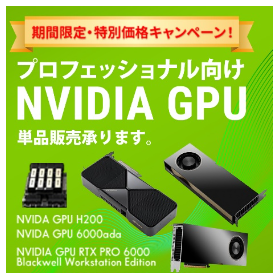
From generative AI, LLM, CAE to 3DCG production. GPU solutions supporting next-generation research and development.
This lineup features NVIDIA GPU solutions that support a wide range of research and development as well as creative applications, from generative AI, LLM, CAE, to 3DCG production. It includes a broad selection from the "RTX PRO series" for workstations, "H200 NVL" for AI/HPC, the compact AI supercomputer "DGX Spark," to the high cost-performance "GeForce RTX 50 series." We propose the optimal GPU environment for research institutions, universities, manufacturing, and design development departments. ■ Example of featured products - NVIDIA RTX PRO Blackwell series - NVIDIA H200 NVL - NVIDIA DGX Spark - GeForce RTX 5090 / 5080 / 5070Ti, among others ■ Main applications - Generative AI / Local LLM development - CAE / CFD / Structural analysis - 3DCG / CAD / Video production - AI image analysis / Data science - Scientific and technical computing (HPC)
basic information
We offer a lineup of NVIDIA GPUs optimized for generative AI, LLM, CAE, video production, and scientific computing. The "RTX PRO Blackwell series" for workstations accelerates large-scale AI inference, 3DCG, CAD, and simulation processing with up to 96GB GDDR7 VRAM and PCIe 5.0 support. The "H200 NVL" for servers features 141GB HBM3e memory and an ultra-fast bandwidth of 4.8TB/s, catering to large-scale LLM and HPC applications. Additionally, we also feature the compact AI supercomputer "DGX Spark" and the cost-effective "GeForce RTX 50 series." ■ Key Specifications - Up to 141GB HBM3e / 96GB GDDR7 VRAM - PCIe 5.0 support - Equipped with CUDA / Tensor / RT cores - High bandwidth design for AI inference, CAE, and 3DCG - Models available for both workstations and servers
Price range
Delivery Time
Applications/Examples of results
GPU solutions are utilized in a wide range of fields that require high computational performance, such as generative AI, CAE, 3DCG, video production, and scientific and technical computing. In recent years, there has been an expansion in the adoption of these solutions for local LLM environment construction, AI image analysis, digital twins, and simulation acceleration. We can propose configurations that are active in diverse settings such as research institutions, universities, manufacturing, architectural design, and video production companies. ■ Main Applications - Generative AI / Local LLM Development - CAE / CFD / Electromagnetic Field Analysis - AI Image Analysis / Appearance Inspection - 3DCG / CAD / Video Editing - Scientific and Technical Computing (HPC) - Digital Twin / Simulation ■ Implementation and Utilization Image - AI research and large-scale analysis in university laboratories - Design development and quality inspection in manufacturing - 3D design and rendering in architecture and manufacturing - Establishing a secure local AI environment within companies
catalog(8)
Download All Catalogs

News about this product(16)
-
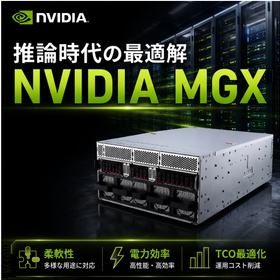
[Blog] <Optimal Solutions in the Era of Inference> Best Fit Proposal by Applied × MSI using NVIDIA MGX
As the practical application of LLMs (large language models) like ChatGPT rapidly advances, the requirements for AI infrastructure are also undergoing significant changes. In the past, during the AI development phase, particularly in the "training" phase, the mainstream approach was to gather the highest-performing GPUs and invest heavily in data centers to pursue the speed and capacity of GPU memory. However, as models are completed and we transition to the "inference" phase, where they are utilized in actual business operations and services, new challenges are emerging. One such challenge is the issue that "using the top-tier systems for training (like DGX or HGX) for inference is often over-specification, leading to excessive initial investments and running costs." What is now required from inference infrastructure is not just "maximum performance," but rather "flexibility" and "power efficiency" tailored to specific applications. This time, we will explain the "NVIDIA MGX" architecture, which optimizes the TCO (total cost of ownership) of data centers and enables a streamlined inference foundation, along with the best-fit server configurations proposed by Applied.
-

[Blog] "The Possibilities of Automotive Development Expanding with LS-DYNA × AI" HPC Supporting Next-Generation CAE
In automotive development, CAE (Computer Aided Engineering) is widely used to enhance safety and performance. Among these, "crash analysis," which predicts the deformation, stress, and strain of the vehicle body during a collision, is crucial in the field of crash safety. The representative CAE software LS-DYNA allows for the setting of conditions such as body shape, materials, thickness, and collision speed to analyze the behavior during a crash. On the other hand, automotive development requires not just a single design proposal but also the comparison of numerous candidates, including materials, thickness, component shapes, and reinforcement positions. This is where the focus shifts to utilizing the analysis data accumulated in LS-DYNA to train AI, which can be used for predicting analysis results and screening design candidates. Rather than replacing CAE, combining CAE with AI has the potential to make the design review process more efficient. Furthermore, HPC (High Performance Computing) becomes essential as a foundation supporting CAE analysis, AI learning, and large-scale data processing.
-
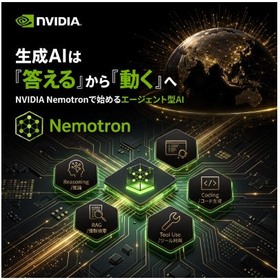
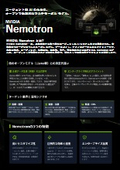
[Blog] Generative AI is moving from "answering" to "acting." Starting with agent-type AI using NVIDIA Nemotron.
With the spread of generative AI, including ChatGPT, AI has begun to be utilized in various scenarios such as text generation, summarization, translation, and programming assistance. On the other hand, in corporate and research and development settings, there is an increasing expectation for more advanced AI applications, not just to answer questions, but to: - Automatically search for necessary information from internal technical documents - Compare multiple pieces of information to determine the next course of action - Operate external tools and business systems - Progress through a series of tasks including research, analysis, code generation, and report creation This system, which infers based on objectives and utilizes necessary information and tools to advance tasks, is referred to as "Agentic AI." Supporting this Agentic AI is NVIDIA's open model family, known as NVIDIA Nemotron. In this article, we will introduce what NVIDIA Nemotron is, how it differs from traditional generative AI, and what applications can be considered in manufacturing and research and development.
-
[Blog] An Explanation of Changes in Data Centers and New Options
In recent years, have you noticed the changes in data centers? The needs for data centers are currently fluctuating significantly due to the explosive spread of AI. This time, we will introduce the changes in data centers in the IT industry, which can be seen as a reflection of the trends of the times.
-

[Blog] "Revisiting the Question: What is 'Generative AI'?" As corporate utilization advances, the fundamentals and possibilities you should know.
The term "generative AI" has become something we hear in our daily lives. Generative AI, including ChatGPT and Gemini, is being utilized in various situations such as writing and summarizing text, information retrieval, image generation, and program creation. In companies, expectations for generative AI are rising for purposes like improving operational efficiency, utilizing information, and creating new services. On the other hand, because generative AI has become more accessible, many people may want to clarify the basics: "What exactly is generative AI?" "What is different from previous AI?" "How can it be specifically utilized in companies?" "What kind of environment is necessary to fully leverage generative AI?" This time, as the use of generative AI in businesses is progressing, we will revisit and organize our understanding of generative AI, its potential, and the computing environment that supports it.
Recommended products
Distributors

Applied Corporation is a computer manufacturing company based in Hakata-ku, Fukuoka City, Fukuoka Prefecture, with 65 locations nationwide. We provide the latest business proposals, from cutting-edge computers to the implementation of DX and solutions, for corporate clients across the country.