
What are the types of flow meters? How to choose in water treatment [Basic Knowledge]
Principles and strengths and weaknesses of flow meters such as electromagnetic, ultrasonic, vortex, and positive displacement types will be explained. We will also discuss important points to consider when measuring in drainage channels and chemical injection.
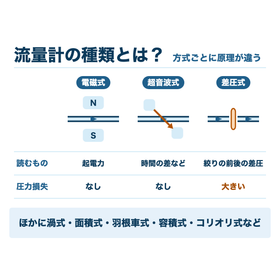
A flow meter is an instrument used to measure the amount of liquid flowing through pipes or channels. In industrial water treatment, it is used to monitor the volume of wastewater and the amount of chemical injection. The principles vary by type, and the liquids that can be measured and the installation conditions also change. ■ What are the methods for measuring inside a pipe? 1. Electromagnetic: Determines flow velocity from the electromotive force generated when a conductive liquid crosses a magnetic field. 2. Ultrasonic: Determines flow velocity from the time difference of ultrasonic waves or the frequency shift due to the Doppler effect. 3. Vortex: Determines flow velocity from the frequency of the Kármán vortex formed behind a vortex generator. 4. Differential pressure: Determines flow rate from the differential pressure generated before and after a constriction. 5. Area: Reads flow rate from the position of a float that rises within a tapered pipe. 6. Turbine: Determines flow rate from the rotation of a turbine. All of these methods are used as flow meters for wastewater, and there are installation considerations based on each principle. ■ Volumetric method using a measuring bucket The volumetric method uses the space between a rotor and a case like a measuring bucket, counting the volume based on the number of times liquid is dispensed. It is suitable for high-viscosity liquids and does not require straight pipe sections before and after. Please feel free to consult us first.
basic information
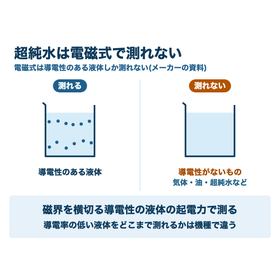
■What liquids cannot be measured with electromagnetic methods?! Electromagnetic methods can only measure conductive liquids due to their principle. They cannot measure non-conductive substances such as gases, oils, or ultra-pure water. The extent to which liquids with low conductivity can be measured varies depending on the detection method and model. ■What happens if the pipe is not full? Electromagnetic methods are designed for fully filled pipelines, and if the detector is not full or if there are air bubbles, it can cause unstable readings. If there are bends or valves upstream, a straight pipe section of at least 5 to 10 times the pipe's diameter (D) is required. It is important to choose a position where the pipe is always full during installation. ■Differences in pressure loss Pressure loss does not occur with electromagnetic and ultrasonic methods, but it can be significant with differential pressure methods like orifices. However, in the case of time-difference ultrasonic methods, measurements may not be possible if there are air bubbles or debris in the ultrasonic path. ■Is there a method that measures by mass? The Coriolis method measures mass rather than volume. It determines mass flow rate from the twisting that occurs in the pipe and can simultaneously measure density. On the downside, it is expensive and has a significant pressure loss.
Price range
Delivery Time
Applications/Examples of results
■How to Measure in Drainage Channels? In channels that do not reach full capacity, methods such as triangular weirs or partial flumes can be established to determine flow rates from the water level upstream. This is because if the shape and dimensions of the weir or flume are fixed, a consistent relationship between water level and flow rate is established. ■Measuring Drainage Volume under Total Quantity Regulation In facilities where total quantity regulation applies, the pollution load of discharged water is measured and recorded. The Enforcement Regulations of the Water Pollution Control Act stipulate that the volume of discharged water, along with the pollution status, should be measured to determine the daily pollution load. ■Are Drainage Flow Meters Subject to Calibration?! The Enforcement Order of the Measurement Act designates drainage flow meters, drainage totalizers, and water meters with a diameter of 350mm or less as specific measuring instruments. When using specific measuring instruments for transactions or certifications, it is necessary to use those that have calibration certification marks. ■Be Cautious of Pulsation in Chemical Injection! Reciprocating positive displacement pumps generate pulsation, which can lead to inaccurate measurements with certain flow meters. There are flow meters designed to accommodate pulsation for chemical injection. Our company offers consultations on chemical injection equipment and water quality measurement devices. Please feel free to reach out to us.
catalog(3)
Download All Catalogs
Recommended products


Distributors

Since our founding, we have continued to provide flexible services with the motto of accurately supplying a diverse range of products that respond to changes in the times and the diversification of consumer needs, tailored to various applications and requirements. With the corporate slogan "Chemical Engineering Partner," we, as a group of experts in chemical technology, actively discover ideas to solve our customers' problems from advanced technologies both domestically and internationally, and propose them.