




![[Free Offer] Coating Sample! Experience Kit Here](https://image.mono.ipros.com/public/premium/image_category/c19/1260/IPROS86266474934566858653.jpeg?w=140&h=140)


All products and services
1~30 item / All 620 items
-
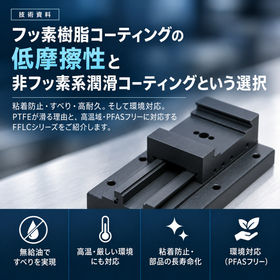
Friction countermeasures for non-lubricated sliding parts | Provision of technical materials on solid lubrication
Cannot be refueled, oil spillage is not allowed, exposed to high temperatures. Explanation of options for sliding parts where liquid lubrication cannot be used in technical documentation.
last updated
-
【Coating Q&A】The Difference Between PFOA-Free and PFAS-Free
PFOA is a type of PFAS. The absence of PFOA alone cannot be considered PFAS-free (non-use).
last updated
-
Coating Q&A: Food Contact Coatings and the PL System
Synthetic resin coatings that come into contact with food must be confirmed for compliance with the PL system.
last updated
-
Coating Q&A: Partial Repair of Coating
We will check the type of membrane and its damage condition, and consider partial repair or reprocessing.
last updated
-
Coating Q&A: Substrates that can be coated with fluororesin
We will consider metals such as stainless steel, aluminum, and iron, depending on the substrate and application.
last updated
-
Coating Q&A: Processing Temperature of Fluororesin Coating
PTFE and PFA are generally heated to about 400°C. The thermal deformation and dimensional changes of the substrate are checked.
last updated
-
Coating Q&A: Prevention of Adhesion of Sticky Substances and Improvement of Cleanability
We will consider the application of non-stick coatings based on the contaminants, cleaning methods, and wear conditions.
last updated
-
Coating Q&A: Industrial Non-Stick Coating
We offer non-stick treatments such as PTFE, PFA, FEP, and silicone, tailored to your needs.
last updated
-
Coating Q&A: Consultation on Coating Delivery Times
Confirm the processing, quantity, inspection, and the time of custody, and provide the delivery date including the necessary processes.
last updated
-
Coating Q&A: Comparison Points for Coating Companies
We will confirm the proposal details, evaluation methods, inspections, and post-use responses, and compare them under the same conditions.
last updated
-
Coating Q&A: Necessary Information for Coating Estimates
We will consider the estimate based on the material, dimensions, quantity, processing range, and usage conditions.
last updated
-
Coating Q&A: Hearing Items for Coating Consultation
We will organize the necessary usage conditions for selection, such as material, temperature, counterpart material, and cleaning method.
last updated
-
Types of Antistatic Coatings and How to Choose Them | Safron
Prevent static electricity problems by discharging to the substrate or ground. Explanation of leakage resistance value guidelines and grade selection.
last updated
-
Contract Processing of Surface Treatment | How to Choose Treatment Methods and Classification Map
A classification map of surface treatments derived from the desired functions, including an explanation of the distinctions between coatings and plating.
last updated
-
Contract coating of medical device and pharmaceutical manufacturing equipment parts.
To the production sites of pharmaceuticals and medical devices where cleanliness is required. Proven track record from tablet press to transport equipment in sterile rooms.
last updated
-
Teflon Coating Request Guide | How to Choose a Contractor, Costs, and Process
An explanation by a Kema's certified licensed processing manufacturer regarding the process of requests, cost considerations, and quality inspection.
last updated
-
Differentiation and comparison between fluororesin and silicone coatings.
Comparison of heat resistance, release properties, and cleanability. Yoshida SKT, which processes both methods in-house, will explain the criteria for choosing between them.
last updated
-
Coating processing of food machinery | Compliance with the Food Sanitation Act PL system
A fluororesin coating that complies with the revised Food Sanitation Act positive list system, solving sticking and burning issues.
last updated
-
Corrosion protection coatings and fluororesin linings for chemical plants.
Corrosion protection for tanks, piping, and valves. Also, permeation-resistant PFA MY lining and on-site applied corrosion-resistant coatings.
last updated
-
Contract processing of functional coatings | From consultation to testing and mass production
Break down the issues into 11 functions and propose the optimal surface treatment. You can quantify the selection through performance measurement services.
last updated
-
Prototype 1 piece; contract for fluororesin coating from small lots.
We support not only mass-produced items but also individual parts of machines that exist only in one factory. From prototypes to mass production, we have a system of three factories nationwide.
last updated
-
Differences and Selection of PTFE, PFA, FEP, and ETFE | Comparison by Application
Heat-resistant, corrosion-resistant, non-stick... A comparison of four types of fluoropolymer explained with data. Yoshida SKT supports selection for all types.
last updated
-
For those troubled by wear on the conveyor guide of the packaging machine.
Reduce friction and guide wear during high-speed transport, minimizing product clogging and damage.
last updated
-
For those struggling with sticking in vacuum forming molds.
Improvement of sheet adhesion and air release issues from surface shape.
last updated
-
For those troubled by cutter residue on packaging film.
Reduction of cutting defects and misalignment due to adhesive adhesion, and reduction of release agent application work.
last updated
-
For those troubled by seal adhesion issues with pillow packaging machines.
Reduce film and scorch adhesion, decreasing cleaning frequency and packaging line downtime.
last updated
-
For those struggling with achieving both corrosion resistance and static electricity prevention.
Protecting the substrate from the liquid medication while also suppressing adhesion and discharge caused by static electricity.
last updated
-
For those troubled by undercoating corrosion and blistering.
Suppresses the penetration of moisture and chemical solutions, reducing film swelling and substrate corrosion.
last updated
-
For those troubled by internal corrosion of pharmaceutical piping.
Isolate the inner surface of the piping from the chemical solution to suppress corrosion thinning and metal leaching.
last updated
-
For those troubled by chemical corrosion of stirring blades.
While utilizing the strength of the metal, long-term protection of the stirring blades from chemical solutions.
last updated
