
What is hydrochloric acid? The dangers and handling of industrial hydrochloric acid [Basic Knowledge]
What is the difference between hydrochloric acid and hydrogen chloride? This will explain the uses and dangers of industrial hydrochloric acid, regulations to check with SDS, and how to respond to storage and leaks.
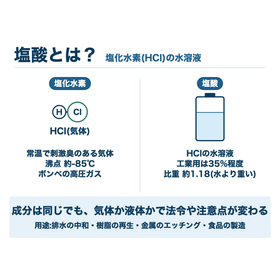
Hydrochloric acid is an aqueous solution of hydrogen chloride (HCl) dissolved in water. It has strong acidity and is used in a wide range of fields, including neutralizing wastewater (pH adjustment), regenerating ion exchange resins used in pure water systems, metal etching, and food production. ■ Industrial grade is about 35% liquid For industrial use, hydrochloric acid containing about 35% hydrogen chloride is used. Its specific gravity is approximately 1.18, making it a liquid heavier than water. ■ What is the difference between hydrochloric acid and hydrogen chloride? Hydrogen chloride is a gas at room temperature with a pungent odor and is also referred to as anhydrous hydrochloric acid. Its boiling point is about -85°C, and it is handled as a high-pressure gas packed in cylinders. In contrast, hydrochloric acid is its aqueous solution. Although the components are the same, the regulations and handling precautions differ depending on whether it is a gas or a liquid. ■ Does hydrochloric acid burn? Hydrochloric acid itself does not burn or explode. However, it can corrode many metals and generate hydrogen gas, which can ignite and explode when mixed with air. To prevent rusting, it is essential to choose suitable materials and implement anti-corrosion measures for equipment handling hydrochloric acid. Please feel free to consult us first.
basic information
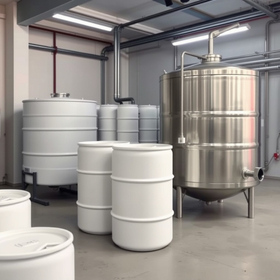
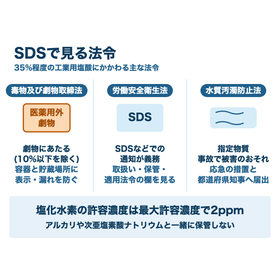
■What dangers are there? Approximately 35% hydrochloric acid is classified as corrosive to metals, corrosive to skin, and causes serious eye damage, all categorized as Class 1 under GHS. If it comes into contact with skin, it can cause severe chemical burns, and if it gets into the eyes, there is a risk of blindness. It easily vaporizes, and inhaling vapors or mists can damage the respiratory system, with repeated exposure potentially affecting the teeth. ■What is the permissible concentration of 2ppm? The Japan Society for Occupational Health recommends a maximum permissible concentration of 2ppm for hydrogen chloride. This maximum permissible concentration is a level below which no adverse health effects are expected for almost all workers during any time of exposure. It is required to maintain this level consistently, rather than just as an 8-hour average. ■What to first check in the SDS Hydrogen chloride is a substance for which notification via an SDS (Safety Data Sheet) is mandated under the Industrial Safety and Health Act when transferring or providing it. In the received SDS, check the summary of hazards, handling and storage precautions, exposure prevention and protective measures, and applicable regulations. ■Storage in corrosion-resistant containers Containers should be made of materials such as rubber-lined steel tanks, FRP tanks, or polyethylene containers.
Price range
Delivery Time
Applications/Examples of results
■ Where does it fall under hazardous substances? According to the Poisonous and Deleterious Substances Control Law, preparations containing hydrochloric acid are considered hazardous substances, except for those with a concentration of 10% or less. Industrial-grade hydrochloric acid at around 35% is classified as a hazardous substance, and businesses handling it must adhere to the following: 1. Labeling: Indicate "Pharmaceutical Deleterious Substance" on containers and storage locations. 2. Management: Prevent theft, loss, and leaks. 3. In case of an accident: Report to the health department if there is a risk of harm. ■ What if it leaks from the tank? Hydrochloric acid is designated as a specified substance under the Water Pollution Prevention Law. If an accident at a designated facility leads to discharge into public water areas or underground infiltration, posing a risk to human health or the living environment, immediate emergency measures must be taken, and notification to the prefectural governor is required. Small leaks should be absorbed with dry sand and collected in corrosion-resistant containers, while large leaks should be contained with earthworks to prevent outflow, and then gradually diluted with water and neutralized with calcium hydroxide or similar substances. ■ Can it be stored in the same place as sodium hypochlorite? Hydrochloric acid reacts violently with alkalis, so it should not be stored together. If oxidizing agents (such as sodium hypochlorite) are mixed in, toxic chlorine gas will be released. The delivery of chemicals such as hydrochloric acid for the maintenance of pure water systems is also accepted at Torii. Please feel free to consult us first.
catalog(3)
Download All Catalogs

Recommended products


Distributors

Since our founding, we have continued to provide flexible services with the motto of accurately supplying a diverse range of products that respond to changes in the times and the diversification of consumer needs, tailored to various applications and requirements. With the corporate slogan "Chemical Engineering Partner," we, as a group of experts in chemical technology, actively discover ideas to solve our customers' problems from advanced technologies both domestically and internationally, and propose them.