
What is factory wastewater treatment? In-house processing vs. outsourcing, how to choose a contractor [Basic Knowledge]
Does handing it over to a contractor end the responsibility? Does the handling change for waste acid with a pH of 2.0 or lower? This explains the rules for treating factory wastewater as industrial waste.
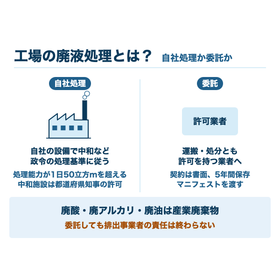
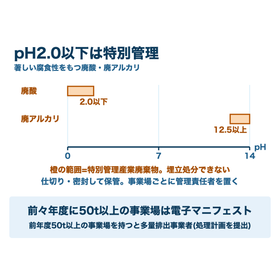
In the production process of factories, various types of waste liquids, such as used acids and alkalis, are generated. There are two methods for treating waste liquids: processing them with in-house equipment or outsourcing to a licensed contractor. Regardless of the choice, it is necessary to handle them in accordance with the regulations of the Waste Management Law. ■ Are waste liquids considered industrial waste? Waste acids and waste alkalis generated from business activities are classified as industrial waste under the Waste Management Law. Waste oil is also classified as industrial waste. Article 3 of the law stipulates that businesses must properly manage the waste generated from their activities under their own responsibility. ■ Is a pH of 2.0 or lower subject to special management? Waste acids and waste alkalis with significant corrosiveness are classified as specially managed industrial waste. The criteria are that waste acids have a pH of 2.0 or lower, and waste alkalis have a pH of 12.5 or higher. When storing these substances, measures must be taken to prevent corrosion, such as using partitions to avoid mixing with other materials and sealing them in containers. These waste acids and waste alkalis cannot be disposed of in landfills. ■ There are two methods of treatment 1. In-house treatment: Neutralization and other disposal methods using in-house equipment. 2. Outsourcing: Entrusting transportation and disposal to a licensed contractor. Please feel free to consult with us first.
basic information
■What are the rules for neutralization within the company? Businesses that transport or dispose of waste themselves must comply with the processing standards established by government ordinance. There are specific processing standards for specially controlled industrial waste. Additionally, among the neutralization facilities for waste acids and waste alkalis, those with a daily processing capacity exceeding 50 cubic meters are classified as industrial waste processing facilities. To establish such a facility, permission from the prefectural governor is required. ■Is it necessary to appoint a responsible person? Businesses that generate specially controlled industrial waste must appoint a special management industrial waste management officer for each site. One qualification is that the individual must have graduated from a university program in science, pharmacy, engineering, or agriculture, having completed courses in sanitary engineering or chemical engineering, and must have at least two years of practical experience in waste processing technology. ■Electronic manifest becomes mandatory For businesses that generated 50 tons or more of specially controlled industrial waste (excluding PCB waste) in the fiscal year before last, electronic manifests must be used when outsourcing processing. Businesses that had 50 tons or more of specially controlled industrial waste in the previous fiscal year are classified as large waste generators and must create a processing plan to submit to the prefectural governor.
Price range
Delivery Time
Applications/Examples of results
■ How to choose a contractor? For transportation, you should entrust it to a company that has a collection and transportation business license, and for disposal, to a company with a disposal business license. If the waste liquid falls under special management industrial waste, the contractor must have a special management industrial waste collection and transportation license or a disposal license. You can confirm whether the waste liquid falls within the scope of the licensed business by checking the license. ■ Contents to include in the contract The contract for outsourcing should be in writing and include the type and quantity of waste liquid, the method of disposal, fees, and the validity period of the contract. It should also include information such as the characteristics and packaging, changes in characteristics during storage, and issues that may arise when mixed with other waste. The contract should be kept for five years after its termination. When handing over the waste, a manifest (industrial waste management slip) should be provided to the contractor, and a copy will be returned within ten days after the completion of transportation and disposal. ■ Does outsourcing end your responsibility?! Even if you outsource, the responsibility of the waste generator does not end. You are required to make efforts to ensure that the processing is carried out properly until final disposal. It is also important not to completely delegate the selection of contractors and verification of fees to third parties that are not subject to regulation. At Torii, we deliver neutralizing agents such as caustic soda to our own neutralization factory. Please feel free to consult us, including considerations of whether to process in-house or outsource.
catalog(2)
Download All Catalogs
Recommended products

Distributors

Since our founding, we have continued to provide flexible services with the motto of accurately supplying a diverse range of products that respond to changes in the times and the diversification of consumer needs, tailored to various applications and requirements. With the corporate slogan "Chemical Engineering Partner," we, as a group of experts in chemical technology, actively discover ideas to solve our customers' problems from advanced technologies both domestically and internationally, and propose them.