
news list

1~30 item / All 110 items
-
Excellent high-release and non-stick properties! Newly added silicone coatings 'MRS-019' and 'MRS-020BK' compliant with the Food Sanitation Act PL system.
Our company has added new products "MRS-019" and "MRS-020BK" to the "MRS Coating" series, which exhibits excellent release properties for adhesives, resins, and adhesive tapes, intended for use in food contact applications. We propose these as a new option for environments where compliance with regulations and high release performance are both required for equipment and components that come into contact with food. The MRS Coating series offers a range of surface treatments that not only provide excellent non-stick properties but also feature solvent resistance and high hardness, which are not found in traditional silicone treatments. In food manufacturing processes that handle materials prone to sticking, such as rice, dough, and seasonings, it contributes to reducing adhesion issues, lowering cleaning burdens, and improving work efficiency. You can utilize this coating on metal components that come into contact with food, such as conveyor parts, hoppers, chutes, guides, plates, and components of filling and molding equipment.
-
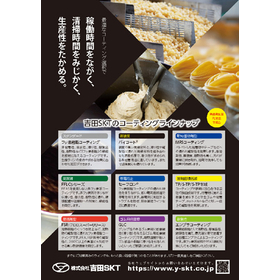
[New Product Information] Expanded high-performance coatings compliant with the Food Sanitation Act positive list.
We are pleased to announce that our company has expanded its high-performance coating series compliant with the Food Sanitation Act (Positive List System). This surface treatment technology, which is suitable for applications that come into direct contact with food, combines multiple functions such as slip resistance, non-stick properties, release properties, heat resistance, and static prevention, thereby supporting the efficiency of food manufacturing and processing equipment. In particular, this product is ideal for companies facing the following challenges: - Reducing line stoppages caused by food sticking or adhering - Improving productivity by re-evaluating frequent cleaning tasks - Ensuring compliance with the Food Sanitation Act (Positive List) for equipment Additionally, we offer the "FFLC Series," which is free of PFAS, making it a suitable option for those seeking environmentally friendly products. Today, we have also started the download of our catalog. We will propose the optimal specifications tailored to your manufacturing processes and usage conditions, so please feel free to contact us.
-

◆Yoshida SKT Co., Ltd.◆ Introducing the newly developed "CAS Coating" that balances release properties and durability.
We have developed a new coating technology called "CAS (Ceramic Alloy Coating)" to solve issues frequently occurring in manufacturing sites, such as "adhesion of sticky substances" and "poor mold release." CAS achieves overwhelming release performance and durability by combining a unique convex surface formed from ceramic-based materials with high-release materials. It enables smooth mold release, which was difficult to achieve with conventional thermal spraying techniques or sandblasting for roughening surfaces. For more details, please check the related links.
-

◆Yoshida SKT Co., Ltd.◆ NEW "PFAS-free non-fluorinated high-performance lubrication coating 'FFLC Series'" has been released.
The newly developed "FFLC series" is a high-performance lubrication coating that is non-fluorinated. This coating provides excellent lubrication performance comparable to fluoropolymer coatings without using PFAS. One of its major features is the improved friction and wear durability, especially in high-temperature environments (200°C - 250°C). For more details, please download the materials or visit the product site and related sites.
-

◆Yoshida SKT Co., Ltd.◆ NEW "Polyurea Coating 'CD8900' Release Information" has been published.
Wear-resistant and noise-reducing! Can be processed at room temperature. It is a room temperature curing type of polyurea coating. With a hardness of about 70° and high flexibility, it excels in wear resistance. The "Polyurea Coating CD8900" is a room temperature curing type of coating that excels in wear resistance and soundproofing, and can be applied to any material except for liquids and gases. For more details, please check the product site.
-

◆Yoshida SKT Co., Ltd.◆ NEW "Released a static electricity prevention fluororesin coating that reduces distortion in semiconductor device components."
Electrostatic discharge prevention coating for thin aluminum parts used in semiconductor devices! Electrostatic discharge prevention fluororesin coating that can reduce distortion caused by firing. Here are some examples. Coating adopted [Features of Safron LF+] ■ Can be processed at low temperatures (below 100°C) ■ Applicable to metals and resins ■ Color variation ■ High friction coefficient and mechanical strength ■ Electrostatic discharge prevention performance is equivalent to conventional Safron For more details, please check the product site.
-

◆Yoshida SKT Co., Ltd.◆ NEW "Both static electricity prevention and friction coefficient! Meeting diverse needs with 'Safron LF+' has been released."
【Features of Safron LF+】 ■Low-Temperature Processing Conventional fluoropolymer coatings required firing at nearly 400°C, but Safron LF+ can be processed at temperatures below 100°C. ■Applicable to Metals and Resins Applicable not only to metals but also to resins, expanding the range of applications. For more details, please check the product site.
-

◆Yoshida SKT Co., Ltd.◆ NEW "We have released a coating that does not exceed the heat resistance temperature of rubber and follows the elasticity of rubber."
The GLC series coatings offer coatings suitable for the heat resistance and characteristics of various rubbers. The coating processing temperatures are listed to not exceed the heat resistance temperatures of the rubber materials. Therefore, it is possible to apply the coatings without compromising the physical properties of the rubber. *For more details, please download the materials and check.
-

◆Yoshida SKT Co., Ltd.◆ NEW "A coating that excels in non-stick and low friction properties for rubber products is now available!" has been released.
The GLC series is a "low-friction coating for rubber" that imparts grip to rubber materials. Depending on the model number, it also excels in non-stick and water-repellent properties, allowing for the selection of the optimal coating based on the application of rubber products. The GLC series enhances the functionality of rubber products and contributes to extending their lifespan. *For more details, please download the materials and check.*
-

◆Yoshida SKT Co., Ltd.◆ NEW "A coating that significantly reduces the friction coefficient of rubber and improves slip resistance" has been released.
The GLC series is a "low-friction coating for rubber" that imparts low friction (slipperiness) to rubber materials with grip. By applying the coating, the friction coefficient of the rubber is significantly reduced. This is because it forms a slippery film on the surface of the rubber, which reduces the friction between the rubber and other objects. The reduction in friction coefficient improves slipperiness, allowing rubber products to move smoothly and function as expected. *For more details, please download the materials and check.
-

◆Yoshida SKT Co., Ltd.◆ NEW "Low Friction Coating GLC Series for Rubber" has been released.
Yoshida SKT has announced the "Low Friction Coating for Rubber" GLC series, which imparts low friction (slipperiness) to rubber materials with grip properties. 【Features of the GLC Series】 - The surface of the rubber material is treated with fluorine, silicone, and inorganic coatings. - It reduces friction on the rubber surface. Depending on the product number, water repellency and non-stick properties can also be expected. - It is a low-temperature coating that can be applied to rubber with low heat resistance. - It has a high degree of adherence that makes it difficult to peel off, even on flexible rubber. *For more details, please download the materials and check.
-

◆Yoshida SKT Co., Ltd.◆ NEW "What is the difference between PTFE and PFA? Technical documentation" has been released.
At Yoshida SKT, we are currently offering a reference document titled "What are the Differences Between PTFE and PFA?" which allows you to compare the characteristics of PFA, which has a continuous use temperature equivalent to that of PTFE, the most widely produced fluoropolymer. The document includes fundamental knowledge such as molecular structure and thermal properties, as well as guidance on how to differentiate their uses in coatings. Additionally, it provides explanations about the features of FEP and ETFE. This technical document allows you to learn in detail about the differences among four types of fluoropolymers in one book. We encourage you to download it and check it out during this opportunity.
-

◆Yoshida SKT Co., Ltd.◆ NEW "What is corrosion protection? An explanation of methods to enhance corrosion resistance" has been released.
Corrosion prevention is a method to prevent corrosion. Metal corrosion refers to a state in which the appearance and function of an object are compromised due to chemical and biological actions. Iron is generally cited as a metal material that is prone to corrosion. These metals can undergo rust and corrosion due to factors that cause corrosion, such as oxygen, sulfur, nitrogen, and water vapor in the atmosphere, along with the inherent properties of the metal, impurities, and electrochemical reactions. *Please check the product page for coatings and linings suitable for corrosion prevention.*
-

◆Yoshida SKT Co., Ltd.◆ NEW "Surface treatment technology that can be processed on plastic surfaces" has been released.
Plastic is lightweight and easy to mold, making it suitable for various equipment parts. On the other hand, unlike metals, it is weak against heat, and the methods for processing involving heating are limited. Surface treatment of plastic helps improve surface characteristics. For more details, please check the product page.
-

◆Yoshida SKT Co., Ltd.◆ NEW "Surface Treatment Technology: 'Surface Treatment to Improve the Low Friction and Wear Resistance of Aluminum'" has been released.
Aluminum is used in many applications as packaging machines and transport components because it is lightweight and easy to process. We would like to introduce a surface treatment that addresses challenges that could not be resolved even with anodizing or fluororesin processing. Please check the product page for details on the surface treatment.
-

◆Yoshida SKT Co., Ltd.◆ NEW "Surface treatment technology that can be processed on the surface of CFRP" has been released.
CFRP is a material that significantly contributes to labor-saving in production equipment due to its lightweight and high strength. By changing the conveyor rollers from metal to CFRP, labor-saving can be achieved; however, there may be issues with surface treatments that were applied to the metal not being applicable. Please check the product page for surface treatment products that can reduce waste and unevenness in parts made from CFRP and can be processed at room and low temperatures.
-

◆Yoshida SKT Co., Ltd.◆ NEW "Released a non-PFAS regulatory proposal, excellent wear-resistant release and slip coating."
A wear-resistant release and slip coating that does not use substances subject to PFAS regulations! "Bycoat Exceed HR↑" enhances non-stick properties, slip characteristics, and heat resistance without being affected by PFAS regulations. It provides reliable release and durability even with molds that use strongly adhesive resins. Please check the product page for more details. For inquiries about coatings considering PFAS regulations, please contact us.
-

◆Yoshida SKT Co., Ltd.◆ NEW "Corrosion-resistant coating 'Cerashield' not subject to PFAS regulation proposal" has been released.
A corrosion-resistant coating that does not use substances subject to PFAS regulations! The organic-inorganic oxyalkylene oligomer coating system "Cerashield" is a corrosion-resistant coating material that reduces the frequency of updates for industrial equipment such as tanks by preventing corrosion and permeation. Please check the product page for more details. For inquiries about coatings considering PFAS regulations, please contact us.
-

◆Yoshida SKT Co., Ltd.◆ NEW "Non-stick Coating 'MRS Coating' Exempt from PFAS Regulation Proposal" has been released.
"MRS Coating" is an innovative surface treatment that is not affected by the PFAS regulatory proposals and has features not found in traditional silicone coatings. Please check the product page for more details. *Features may vary depending on the product type. For more information, please download the PDF or contact us. For inquiries regarding the use of PFAS due to differences in series, please be sure to contact us.
-

◆Yoshida SKT Co., Ltd.◆ NEW "Regarding the PFAS regulation proposal for fluoropolymer coatings" has been released.
Currently, a regulatory proposal is being considered to minimize PFAS emissions within the EU. ■Regulated Items Fluorinated surface treatment agents: water-repellent and oil-repellent agents, release agents, fluoropolymer-containing coatings, etc. Coatings: PTFE, PFA, FEP, ETFE, and other fluoropolymers (for applications such as corrosion-resistant linings, non-stick surfaces, lubrication, etc.) Molded and processed products: PTFE, PFA, FEP, ETFE, and other fluoropolymers (lining sheets, fabric sheets, etc.) Fluorinated surfactants, fluorinated oils, low molecular weight PTFE, fluorinated molding aids, etc. For more details, please check the linked source.
-

◆Yoshida SKT Co., Ltd.◆ NEW "Surface treatment that can be applied to the surface of rubber" has been released.
Rubber is an essential material in our lives. It is used in various situations, not only in household goods but also in automotive parts, PC components, the chemical industry, and the medical field. Surface treatment of rubber requires confirmation of various conditions. For more details, please check the product page.
-

◆Yoshida SKT Co., Ltd.◆ NEW "The Advantages and Disadvantages of Fluoropolymer Coating/Recoating for Frying Pans" has been published.
If you use a household frying pan for a long time, the fluoropolymer coating may peel off or wear down, leading to sticking issues. The fluoropolymer coating can be removed and reprocessed. However, household frying pans are not designed with reprocessing in mind, which can lead to both advantages and disadvantages. For more details, please check the product page.
-

◆Yoshida SKT Co., Ltd.◆ NEW "Fluororesin Coating 'Reprocessing Method'" has been released.
Fluororesin coatings can experience wear and peeling depending on the application, environment, and conditions. In such cases, it is possible to strip the coating and reprocess it. Reprocessing places a greater burden on the substrate compared to the initial processing, so consultation is necessary depending on the application. Please check it out.
-

◆Yoshida SKT Co., Ltd.◆ NEW "What is the method to reduce the release resistance of ejector pins? Countermeasures through surface treatment" has been published.
In mold forming, measures for ejector pins are also important to stabilize product quality. This content introduces methods to reduce the release resistance of ejector pins and surface treatments to improve release properties. Please take a look.
-

◆Yoshida SKT Co., Ltd.◆ NEW "List of Mold Coatings - Surface Treatments Excellent in Release Properties and Preventing Eye Goo" has been released.
In mold forming, to stabilize product quality, it is important to improve release properties and prevent mold contamination. Measures such as PVD coating, DLC coating, and chrome plating have been implemented, but depending on the molding conditions, issues can arise where parts of the product stick, or resin residue can cause product defects. We would like to introduce coatings that have a proven track record of improving mold release properties. Please take a look.
-

◆Yoshida SKT Co., Ltd.◆ NEW "What are the methods to prevent mold eye discharge? We also introduce improvement cases through surface treatment." has been published.
Mold release residue refers to foreign substances that adhere to the surface of molded products when thermoplastic materials such as resin or rubber are molded. To prevent residue, it is necessary to prevent material retention in the mold. When appropriate material selection and molding conditions do not resolve the issue of residue, adopting surface treatments with excellent release properties is effective. We will introduce examples of residue improvement through surface treatment. Please take a look.
-

◆Yoshida SKT Co., Ltd.◆ NEW "What is productivity improvement? An explanation of benefits, initiatives, and methods" has been published.
This article aims to deepen the understanding of productivity improvement for business professionals. It explains the definition of productivity improvement, its objectives, benefits, and methods to enhance productivity. It also clarifies the differences from operational efficiency, so please use it as a reference. 【Table of Contents】 What is productivity improvement? Reasons why productivity improvement is necessary Types of productivity Four benefits of improving productivity 1. Addressing labor shortages 2. Enhancing international competitiveness 3. Improving work-life balance 4. Cost reduction Four initiatives for productivity improvement 1. Input reduction type 2. Significant input reduction type 3. Output expansion type 4. Significant output expansion type Methods to improve productivity Points to consider when aiming for productivity improvement Differences between productivity improvement and operational efficiency Will grants and subsidies increase if productivity is improved? Examples of productivity improvement initiatives in the manufacturing industry Conclusion If you are interested, please check the official Yoshida SKT website.
-

◆Yoshida SKT Co., Ltd.◆ NEW "What is productivity improvement? An explanation of benefits, initiatives, and methods" has been published.
This article aims to deepen the understanding of productivity improvement for business professionals. It explains the definition of productivity improvement, its purposes, benefits, and methods to enhance productivity. It also clarifies the differences from operational efficiency, so please use it as a reference. 【Table of Contents】 What is productivity improvement? Reasons why productivity improvement is necessary Types of productivity Four benefits of improving productivity 1. Addressing labor shortages 2. Enhancing international competitiveness 3. Improving work-life balance 4. Cost reduction Four initiatives for productivity improvement 1. Input reduction type 2. Significant input reduction type 3. Output expansion type 4. Significant output expansion type Methods to improve productivity Points to consider when aiming for productivity improvement Differences between productivity improvement and operational efficiency Will subsidies and grants increase if productivity is improved? Examples of productivity improvement initiatives in the manufacturing industry Conclusion If you are interested, please check the official Yoshida SKT website.
-
◆Yoshida SKT Co., Ltd.◆ NEW "What is a motor? A clear explanation of types, mechanisms, roles, and characteristics" has been published.
A motor is a device that converts electrical energy into mechanical energy. This article aims to provide a clear explanation of the structure, history, and types of motors for those who want to organize their basic knowledge about motors. Please make use of it. 【Table of Contents】 What is a motor The role of a motor History of motors Characteristics of motors How motors work There are mainly two types of motors Summary If you are interested, please check the official Yoshida SKT website.
-

◆Yoshida SKT Co., Ltd.◆ NEW "What are the methods for improving productivity in the manufacturing industry? We have published an explanation of the reasons and benefits for taking action, the steps involved, and the factors that can lead to a decline."
Improving productivity is important for companies, but many are struggling with how to achieve it. Yoshida SKT has a proven track record in improving production equipment in manufacturing sites through surface treatment technology, helping to resolve these concerns. This article explains the benefits of improving productivity in the manufacturing industry, the causes of productivity decline, procedures, and key points. Those who want to enhance their company's productivity should find this information useful. [Table of Contents] - What is productivity improvement in manufacturing? - Why should the manufacturing industry aim for productivity improvement? - Benefits of aiming for productivity improvement in manufacturing - Causes of productivity decline in manufacturing - Steps to improve productivity in manufacturing - Key points for improving productivity in manufacturing - Conclusion If you are interested, please check the official Yoshida SKT website.