
news list
1~5 item / All 5 items
-
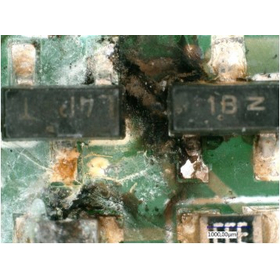
Added a page on the causes and countermeasures of substrate corrosion: an explanation from the occurrence mechanism to analysis methods.
The circuit board, often referred to as the heart of electronic devices, plays a crucial role in determining the overall quality of the product. However, corrosion of the circuit board directly leads to issues such as circuit shorts and disconnections, which can reduce the reliability of electronic devices. In this article, we will explain how corrosion of the circuit board occurs, its mechanisms, preventive measures, and methods for identifying the causes in the event that corrosion does occur.
-
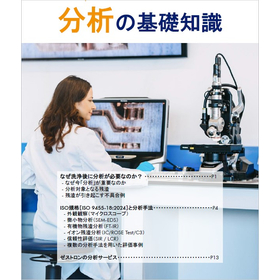
A page on "Basic Knowledge of Analysis" has been added.
In recent years, electronic devices have been miniaturized, made more densely packed, and designed for higher voltages, especially in the automotive and power device sectors, where long-term use under harsh conditions is assumed. Under such conditions, even trace residues on devices can lead to corrosion, ion migration, and insulation degradation, ultimately resulting in market failures. Furthermore, changes in flux composition and the diversification of materials have made the nature of residues more complex than before. Against this backdrop, the importance of post-cleaning analysis is increasing. Cleaning is the process of removing flux residues and contamination, but to objectively demonstrate whether removal has been successful, verification through analysis is essential. While cleaning is a process of removal, analysis can be seen as a process that substantiates the results.
-
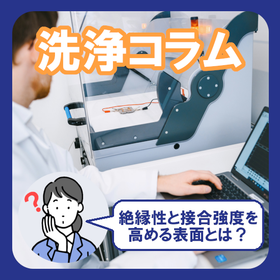
Before the resin encapsulation of semiconductors." "A page has been added on 'Why did the 'Quiet Evolution' occur?'
"Before the resin encapsulation of semiconductors." We have added a page to the technical document titled "Why Did the 'Silent Evolution' Occur?" The article provides a detailed explanation of the basic concepts of semiconductor resin encapsulation, as well as specific approaches to surface treatment that are key to maximizing quality. Additionally, the technical document systematically organizes the mechanisms behind the deterioration of insulation and the instability of resin bonding strength, and explains advanced insights into surface design and cleaning technologies that are essential for high-reliability devices. We encourage you to read it.
-
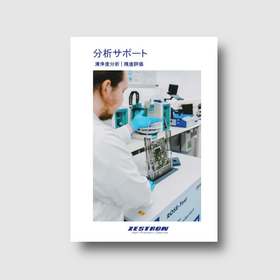
A page for "Analysis Support" has been added.
Flux residues require the selection of analytical methods based on their type. By conducting chemical analysis, it is possible to analyze the causes of defects and improve processes. You can download a free document summarizing our analysis service overview. If you are struggling with cleaning processes or defect analysis, please take a look. Zestron offers cleanliness analysis technology that can comply with ISO 9455-18:2024.
-

Added a page for "Basic Knowledge of Flux Cleaning ver.2 [Document]."
This is the updated version (ver.2) of the popular document "Fundamentals of Flux Cleaning." In this revision, in addition to the existing content (how to choose cleaning agents and cleaning methods), we have added the basics of "Residue Evaluation (Analysis)." This document is recommended for those who are just starting with flux cleaning and for those who want to understand the entire process from cleaning to analysis. In addition to the purpose of cleaning and the fields where cleaning is necessary, we also explain the necessity and methods of chemical analysis, so please take a moment to read it.