
What is a water quality test for drinking water? Required tests by water source [Basic Knowledge]
Whether it is directly connected to the water supply, a water storage tank, or a well. The inspection of drinking water at the business location varies in frequency and regulations depending on the water source and the building.
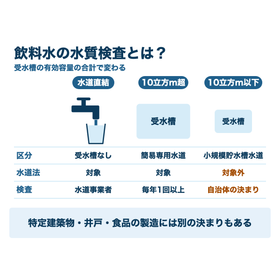
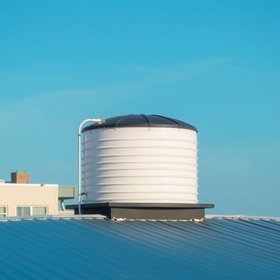
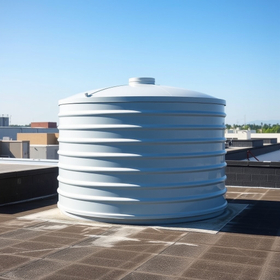
When inspecting drinking water at a business facility, the first thing to confirm is "where the water comes from and what equipment it passes through to reach the faucet." Even for the same tap water, the inspection rules set by the installer vary depending on the size of the water tank and the purpose of the building. ■ Who inspects if it's directly connected to the water supply? In cases where the water supply is directly connected from the water pipe to the faucet without passing through a water tank, the water supply operator conducts regular inspections to comply with water quality standards based on the Water Supply Act. ■ Is there a capacity threshold for water tanks? 1. If the effective capacity of the tank exceeds a total of 10 cubic meters: classified as a simple dedicated water supply, requiring inspections at least once a year by a registered organization. 2. If it's 10 cubic meters or less: referred to as a small-scale water storage supply and is not subject to the Water Supply Act. ■ Regulations for 10 cubic meters or less are set by local governments. Even if it is not subject to the Water Supply Act, there are cases where local governments have established their own regulations. Some municipalities require annual inspections of the tank cleaning and the water's color, odor, taste, turbidity, and residual chlorine. There are also municipalities that mandate sanitary measures for tanks exceeding an effective capacity of 5 cubic meters through local ordinances. Please feel free to consult us first.
basic information
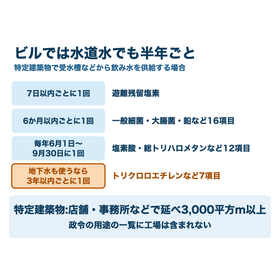
■In buildings, tap water is tested every six months! For specific buildings under the Building Sanitation Act, when drinking water is supplied from water supply facilities such as water storage tanks, management inspections continue even if the only water source is tap water. 1. Once every 6 months: 16 items including general bacteria, E. coli, lead, TOC, pH value, turbidity, etc. 2. Once a year from June 1 to September 30: 12 items 3. Once every 7 days: free residual chlorine ■What are the 12 items measured in summer? They include cyanide ions and cyanogen chloride, chlorate, chloroform, bromate, total trihalomethanes, and formaldehyde. The timing for measurement is specified by the enforcement regulations. ■Mixing well water increases the number of items tested For specific buildings that use groundwater as all or part of their water source, all items specified in the water quality standards are examined before the start of water supply. In addition to the above tests, 7 items such as trichloroethylene and benzene are tested once every three years. ■Are factory buildings included? Specific buildings are those with a total floor area of 3,000 square meters or more used for purposes such as stores, offices, or inns. Buildings used exclusively for schools must be 8,000 square meters or more. Factories are not included in the list of purposes specified by the government ordinance.
Price range
Delivery Time
Applications/Examples of results
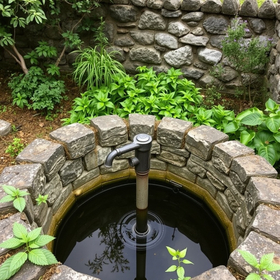
■Is well water in food factories tested at least once a year? According to the Food Sanitation Act Enforcement Regulations, when using "water suitable for drinking" other than tap water for food production, annual water quality testing is required, along with the retention of the test results for one year. A copy of the test results must also be attached when applying for a business license. Water used in processes that do not affect food safety, such as cooling, is exempt. If the test reveals that the conditions are not met, use must be immediately discontinued. If sterilization or purification devices are installed, their proper functioning must be regularly checked and recorded. ■Commercial wells are subject to national guidelines For drinking wells at business establishments that do not fall under the above categories, regular inspections must be conducted at least once a year according to the Hygiene Measures Guidelines for Drinking Wells (national guidelines). ■Organizing your own water source in four points! 1. Water source: Is it tap water, well water, or both? 2. Water storage tank: Is there one, and does it have an effective capacity exceeding 10 cubic meters? 3. Building: What is its purpose and total floor area? 4. Use: Is it used for food production? Our company accepts requests for water quality testing for drinking water, in addition to cleaning and inspecting water storage tanks. Please feel free to consult with us.
catalog(2)
Download All Catalogs

Recommended products
Distributors

Since our founding, we have continued to provide flexible services with the motto of accurately supplying a diverse range of products that respond to changes in the times and the diversification of consumer needs, tailored to various applications and requirements. With the corporate slogan "Chemical Engineering Partner," we, as a group of experts in chemical technology, actively discover ideas to solve our customers' problems from advanced technologies both domestically and internationally, and propose them.