
What is the water quality inspection under the Food Sanitation Act? Business permits and items [Basic knowledge]
Water quality testing for facilities that produce food using well water and other sources. It organizes the differences between "water suitable for drinking" and "water for food production," along with 26 items and regular inspections.
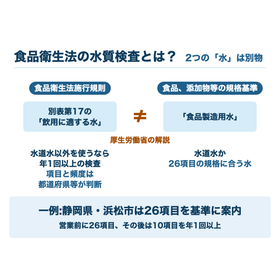
The water quality inspection under the Food Sanitation Act is a test conducted by businesses that use water other than tap water for food production or cooking to verify the quality of that water. ■ Basis is Appendix Table 17 of the Enforcement Regulations The basis is Appendix Table 17 of the Food Sanitation Act Enforcement Regulations, which includes "management of water used, etc." as part of the general hygiene management standards that businesses must adhere to. Restaurants and food factories that use well water or spring water are the main targets. ■ Is it exempt if using tap water? According to Appendix Table 17, the water that can be used is that supplied from water supply businesses, dedicated water supply systems, or simple dedicated water supply systems, as well as other "water suitable for drinking." Inspections are required at least once a year when using the latter. If only tap water is used, this inspection is not required. ■ The two types of water do not mean the same thing! The national "standards for food, additives, etc." also includes the term "water for food manufacturing," which refers to either tap water or water that meets 26 specified criteria. This water for food manufacturing is different from the "water suitable for drinking" in Appendix Table 17. Furthermore, the inspection items and frequency for water suitable for drinking are determined by prefectures based on local water quality conditions. Please feel free to consult with us first.
basic information
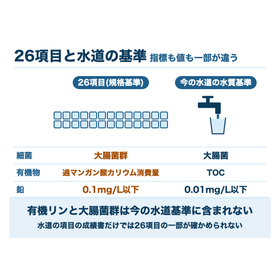
■What are the 26 items? 1. Bacteria: General bacteria, coliform group 2. Metals, etc.: Cadmium, mercury, lead, arsenic, hexavalent chromium, cyanide, zinc, iron, copper, manganese 3. Nitrogen and fluorine, etc.: Nitrate nitrogen and nitrite nitrogen, fluorine, organic phosphorus 4. Dissolved components: Chloride ions, hardness, evaporative residue, anionic surfactants, phenols, organic matter, etc. (potassium permanganate consumption) 5. Properties: pH value, taste, odor, color, turbidity ■Is it the same standard as the water supply? The 26 items differ in some indicators and values from the current water quality standards for tap water. Bacteria are measured as coliform group instead of E. coli, and organic matter is assessed by potassium permanganate consumption instead of TOC. The lead standard for the 26 items is below 0.1 mg/L, while for tap water it is below 0.01 mg/L. ■Flow of inspections set by local governments Some local governments guide the 26 items as standards for water suitable for drinking. In such cases, the 26 items are checked before starting operations, and thereafter, 10 items including general bacteria, coliform group, nitrate nitrogen, and nitrite nitrogen are checked at least once a year. The content may be revised.
Price range
Delivery Time
Applications/Examples of results
■ What should be submitted for the business permit? When using water other than tap water, the application for permission must include a copy of the water quality test results along with the facility's blueprints. The tests must be conducted by a local public agency based on the Water Supply Act or by a nationally registered testing agency. ■ Test results must be within one year Some municipalities require test results that have been conducted within the last year when applying for permission. ■ Is testing for tap water sufficient? The current water quality standards for tap water do not include organic phosphorus and coliform bacteria among the 26 items. A report only covering the tap water items will not confirm some of the 26 items. ■ Emergency testing after a disaster! According to Appendix Table 17, if there is a risk that a water source has been contaminated due to an unforeseen disaster, testing will be conducted each time. Unforeseen disasters include earthquakes, landslides, floods, and other events that could contaminate water sources such as well water. ■ Is a disinfection device absolutely necessary? The installation of disinfection or purification devices is not mandatory, and there are methods to verify that the water is suitable for drinking through regular testing. Torii offers handling of chlorine disinfection agents (sodium hypochlorite) and water quality measurement devices, and we are also available for consultations regarding water quality testing. Please feel free to contact us first.
catalog(3)
Download All Catalogs


Recommended products
Distributors

Since our founding, we have continued to provide flexible services with the motto of accurately supplying a diverse range of products that respond to changes in the times and the diversification of consumer needs, tailored to various applications and requirements. With the corporate slogan "Chemical Engineering Partner," we, as a group of experts in chemical technology, actively discover ideas to solve our customers' problems from advanced technologies both domestically and internationally, and propose them.