
What is water quality management for school pools? Daily procedures [Basic knowledge]
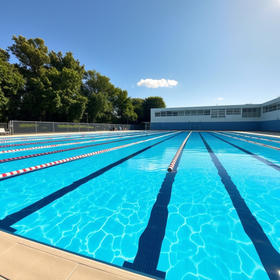
What should be checked before use, when to retest during class, and what to leave behind after it's finished? We will follow the water quality management of the school pool for one day according to the standards.
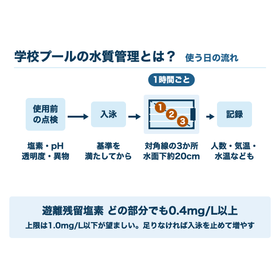
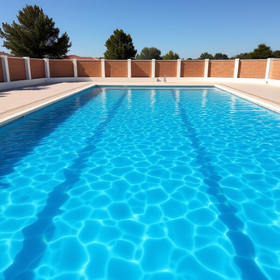
The water in the school's swimming pool is managed in accordance with the school environmental health standards established by the government based on the School Health and Safety Act. In addition to regular water quality tests, daily inspections for the days of use are also specified by the standards. Here, we will organize the checks according to the daily flow of the person in charge. ■ Four items to check before use 1. In the water: Ensure there are no hazardous substances or abnormalities. 2. Free residual chlorine: At least 0.4 mg/L in any part. 3. pH value: Maintained at the standard level. 4. Clarity: The wall should be clearly visible from a distance of 3 meters underwater. Before swimming, also check that the covers of the drainage and circulation water intake are secured with screws or bolts. This is an important check related to the safety of swimmers. ■ What if there is not enough chlorine? If it is below the standard, stop swimming and increase the amount of chlorine agent injected. Allow swimming only after confirming it has returned to above 0.4 mg/L. ■ What if the wall is hard to see? If the wall 3 meters ahead is not clearly visible underwater, operate the circulation filtration system sufficiently until it becomes visible, or replace the water. Please feel free to consult us first.
basic information
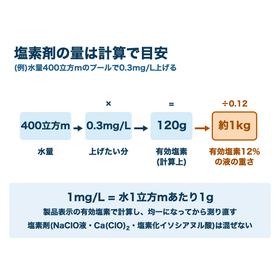
■Why measure every hour during class? Even if the standards are met before use, it is necessary to check every hour on the day of use because many students enter at once. Free residual chlorine should be measured at least once every hour during use, with a desirable upper limit of below 1.0 mg/L. The measurement points should be three locations that are almost evenly spaced along the diagonal, about 20 cm below the water surface. ■Estimate the dosage through calculation 1 mg/L corresponds to 1 g per cubic meter of water. For example, to raise the chlorine level by 0.3 mg/L in a pool with a water volume of 400 cubic meters, you would need 120 g of effective chlorine, which is about 1 kg if using a liquid with 12% effective chlorine. Calculate based on the effective chlorine indicated on the product, and measure again after the concentration has become uniform. Continuous injection of chlorine is the preferred method. Even if not using continuous injection, it is necessary to maintain a uniform concentration of free residual chlorine. ■What should be recorded together? Record the results of free residual chlorine, pH value, and clarity along with the number of swimmers, usage time, air temperature, water temperature, and the status of disinfectant use. Records of regular inspections should be kept for five years, and daily inspection records should be maintained for three years.
Price range
Delivery Time
Applications/Examples of results
■Do not mix chlorine agents! The chlorine agents that can be used according to standards are sodium hypochlorite solution, calcium hypochlorite, or chlorinated isocyanuric acid. Mixing different types can cause a rapid reaction and may lead to an explosion, so caution is necessary when handling them. Ensure that the dedicated chemical storage is structured so that swimmers cannot easily access it. ■Is the air in indoor pools monitored? In indoor pools, the desirable level of chlorine gas in the air is below 0.5 ppm. If it exceeds this level, ventilation should be performed, and checks should be made to ensure that chlorine agents are not in contact with other chemicals. ■What to do on water drainage days? Even at normal residual chlorine concentrations, there can be toxicity to aquatic life. Therefore, before discharging directly into public water bodies, neutralize with sodium thiosulfate or leave it in a drainage tank for more than a day, and confirm that the residual chlorine has decreased using methods like the DPD method. Similarly, after using a large amount of chlorine agents for pool cleaning, the drainage should be treated in the same way before being released. ■Consultation on pool chemicals At Torii, we offer consultations on chemicals used for managing school pools, such as lightweight solid chlorine agents. Please feel free to reach out to us for inquiries.
catalog(3)
Download All Catalogs


Recommended products
Distributors

Since our founding, we have continued to provide flexible services with the motto of accurately supplying a diverse range of products that respond to changes in the times and the diversification of consumer needs, tailored to various applications and requirements. With the corporate slogan "Chemical Engineering Partner," we, as a group of experts in chemical technology, actively discover ideas to solve our customers' problems from advanced technologies both domestically and internationally, and propose them.