
What is daily inspection? How to check color, turbidity, and residual chlorine [Basic Knowledge]

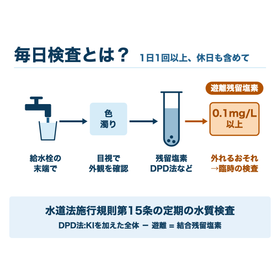
Daily inspections are mandated by the Water Supply Act to be conducted at least once a day. This explains who measures, at which faucet, using what method, and how to respond if the standards are exceeded.
Daily inspection refers to the inspections specified in Article 15 of the Water Supply Act Enforcement Regulations, which are required to be conducted "at least once a day." The focus is on the color and turbidity of the water, as well as the residual effect of disinfection (residual chlorine). ■ Can inspections be skipped on weekends and holidays? Since the frequency is set to "at least once a day," inspections are conducted every day, including holidays. In fact, inspections are carried out daily, including on weekends and holidays. Additionally, some municipalities conduct sensory tests to check taste and odor, which are performed daily alongside the legally mandated items. ■ Who conducts the measurements? It is not limited to the staff of water supply operators. Some municipalities conduct daily inspections at various water supply points throughout the city with the cooperation of citizens or by outsourcing the inspections. ■ Is it acceptable to use automatic equipment for measurements? Using continuous automatic measuring devices is one of the methods specified by national notifications. These devices must have a performance capability of measuring below a quantifiable lower limit of 0.05 mg/L, and regular cleaning, maintenance, and calibration are required to maintain accuracy within ±0.05 mg/L during operation. Please feel free to consult us first.
basic information
■Where do you measure from the faucet? The residual effect of disinfection is confirmed at the end of the water supply faucet. This is to check whether chlorine remains not only at the outlet of the water purification plant but also at the end of the distribution. ■Do you check color and turbidity visually? Color and turbidity are checked through visual inspection. The enforcement regulations state that on the days when color and turbidity tests are conducted, the daily inspections of color and turbidity can be omitted. ■There are six methods for measurement! The national notification specifies the DPD method, current method, spectrophotometric method, continuous automatic measurement device spectrophotometric method, polarographic method, and portable residual chlorine measurement method. ■Procedure for the DPD method Samples are taken in glass bottles and tested immediately. A buffer solution and DPD reagent are added to the water sample to make a total of 50 mL, and the free residual chlorine is determined by comparing the color with a standard colorimetric series. Adding potassium iodide reveals the total residual chlorine, and the difference gives the combined residual chlorine. ■Does any portable measuring device suffice? The notification specifies that the lower limit of quantification must be 0.1 mg/L or less, and it should be able to display up to two decimal places. Regular cleaning and maintenance according to the instruction manual are also required.
Price range
Delivery Time
Applications/Examples of results
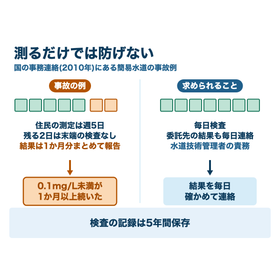
What if it falls below 0.1 mg/L? The free residual chlorine that should be maintained in the water from the water supply faucet is above 0.1 mg/L. If there is a possibility of not meeting the standard, a temporary inspection must be conducted, and when there is a risk of harming health, there is an obligation to immediately stop the water supply and inform the relevant parties. Can't just measuring prevent it?! In 2010, there was an incident at a certain simple water supply where the residual chlorine at the end of the water supply remained below 0.1 mg/L for over a month. The measurements entrusted to residents were conducted five days a week, with no inspections at the end on the remaining two days, and the results were reported in a lump sum for the month without verification. Results should be connected daily Daily communication of inspection results to the contractor is also part of the responsibilities of the water supply technical manager. By verifying the measured results every day, abnormalities can be detected quickly. Inspection records must be kept for five years. Confirmation of chlorine agents and injection equipment Sodium hypochlorite and others must ensure effective chlorine concentration while considering storage temperature and duration. Additionally, the injection equipment should be inspected, and the actual injection amount should be confirmed. We also offer consultations on how to select chlorine agents and inspect injection equipment. Please feel free to consult with us first.
catalog(3)
Download All Catalogs


Recommended products







Distributors

Since our founding, we have continued to provide flexible services with the motto of accurately supplying a diverse range of products that respond to changes in the times and the diversification of consumer needs, tailored to various applications and requirements. With the corporate slogan "Chemical Engineering Partner," we, as a group of experts in chemical technology, actively discover ideas to solve our customers' problems from advanced technologies both domestically and internationally, and propose them.