
What is water quality testing for bathtubs? Standards and frequency for public baths [Basic Knowledge]
How many times a year for the four items: turbidity, organic matter, E. coli, and Legionella bacteria? We will explain the frequency of tests that varies depending on how the bathtub is used, as well as guidelines for daily chlorine management.
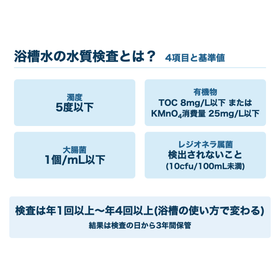
Bathwater refers to the water in the bathtub. Public baths and ryokans conduct water quality tests on their bathwater a specified number of times each year and keep the results on record. ■ Standards are set by prefectures According to the Public Bathhouse Law, operators must take necessary measures for the hygiene of bathers, and these standards are established by prefectural ordinances. The national government provides guidelines on water quality standards and testing methods for public baths, urging local governments to use them as a reference for their guidance. ■ What are the four items and standard values for bathwater? 1. Turbidity: 5 degrees or less 2. Organic matter: Total Organic Carbon (TOC) 8 mg/L or less, or potassium permanganate consumption of 25 mg/L or less 3. E. coli: 1 colony-forming unit/mL or less 4. Legionella bacteria: Not detectable (less than 10 cfu/100 mL) ■ Are the standards the same for the water before entering the bathtub? The water poured into the bathtub, such as the source water or shower water, has different standards, including six items that cover color and pH values. Turbidity must be 2 degrees or less, and E. coli must not be detectable, which are stricter than the standards for bathwater. Please feel free to consult us first.
basic information
■ Has it stopped being "coliform bacteria"? At the time of the revision in the first year of Reiwa, the guideline for bathing water referred to coliform bacteria. The current guideline has changed to Escherichia coli, and the testing method for coliform bacteria in the sewage quality standards examines samples without dilution. Be careful not to use the names of items from old materials as they are. ■ Are there two ways to measure organic matter? Organic matter is assessed either by TOC or by potassium permanganate consumption. However, in cases where it is inappropriate to apply TOC values, such as when disinfected with chlorinated isocyanuric acid, it is stipulated to use the potassium permanganate consumption value. ■ Items that can be excluded for hot spring water When using hot spring water or well water, if it is difficult to meet the standards and there is no risk of health hazards, the standards for turbidity and organic matter may not be applied. Coliform bacteria and Legionella species are not included in this treatment. ■ How many times a year should inspections be conducted? 1. Bathtubs that do not use filters and are completely drained daily: at least once a year 2. Bathtubs used continuously: at least twice a year 3. Bathtubs used continuously and not disinfected with chlorine: at least four times a year Results must be kept for three years from the date of inspection.
Price range
Delivery Time
Applications/Examples of results
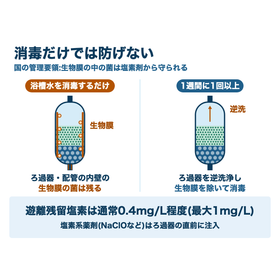
■What are the daily chlorine management guidelines? The free residual chlorine concentration should be measured frequently, typically maintained at around 0.4 mg/L, and efforts should be made not to exceed a maximum of 1 mg/L. When disinfecting with combined chlorine monochloramine, it should be around 3 mg/L. The measurement results should be kept for three years. ■Is disinfection alone not enough?! Microorganisms that contaminate bathwater grow from organic matter from bathers and form biofilms on filters, bathtubs, and the inner walls of pipes. The bacteria within the biofilm are protected from chlorine agents, so simply disinfecting the bathwater will not eliminate them. Therefore, the filter should be backwashed at least once a week to remove and disinfect the biofilm in the filter and circulation pipes. ■Where to add chlorine agents and daily inspections In circulation-type bathtubs, chlorine-based agents are added just before the filter. In addition to checking the remaining amount in the chemical tank, it is necessary to verify daily that the dosing pump is functioning properly and that the chemical is being injected. This is because the injection may stop due to clogging of the nozzle or air entrapment in the injection valve. The injection valve should also be cleaned regularly. We also offer consultations regarding sodium hypochlorite for bathwater and dosing pumps at Torii. Please feel free to reach out to us first.
catalog(2)
Download All Catalogs
Recommended products







Distributors

Since our founding, we have continued to provide flexible services with the motto of accurately supplying a diverse range of products that respond to changes in the times and the diversification of consumer needs, tailored to various applications and requirements. With the corporate slogan "Chemical Engineering Partner," we, as a group of experts in chemical technology, actively discover ideas to solve our customers' problems from advanced technologies both domestically and internationally, and propose them.