
What is a water quality survey? Differences from water quality testing and how to proceed [Basic Knowledge]
Just taking a sample once and measuring it won't give you a grasp of the water's condition? This explains how to conduct water quality surveys by assembling data from locations, times, frequencies, and on-site records.
When you want to know the condition of the river flowing near the site, or the water in the ponds and waterways on the premises, taking a single water sample for analysis will only provide you with the values at that moment. In this article, we will refer to each instance of taking and analyzing water as "inspection," while the overall effort to determine the condition by deciding when, where, and how many times to sample will be called "survey." ■ What does the "principle method" indicated by the government mean? The Environmental Agency (now the Ministry of the Environment) provided a notification in 1971 titled "Water Quality Survey Methods," which outlines the fundamental methods that prefectures should adhere to for the continuous monitoring of public water areas and the investigation of wastewater from factories and businesses. It is stipulated that while this method serves as a principle, effective surveys should be conducted considering the specific conditions of the water area in question. The targets include rivers, lakes, coastal areas, and wastewater from factories and businesses, with guidelines for timing and sampling locations specified for each. ■ Surveys are categorized by purpose This notification categorizes surveys into monitoring measurement surveys to grasp the status of environmental standards, standard-setting surveys to obtain data for establishing criteria, and sediment surveys to examine the mud at the bottom. If the purposes differ, the items to be measured will also change. Please feel free to consult with us first.
basic information
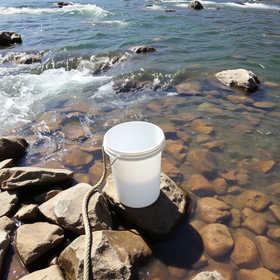
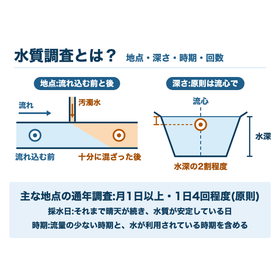
■Is the location "before and after the inflow"? The water sampling points in the river are selected considering not only the water use points but also locations where the main polluted water has sufficiently mixed after inflow and points before the inflow, as well as locations before and after the confluence of tributaries. By comparing the values before and after, it becomes easier to identify where the water quality changes. ■Sampling at 20% of the water depth in the middle of the river? As a principle, sampling is conducted at the river's center, at a depth of about 20% of the water depth from the surface. If polluted water is flowing unevenly or if the river is wide, the right bank and left bank may be treated as separate points, and the samples from each should not be mixed. ■Sampling after a period of clear weather?! The days for river water sampling are chosen when relatively clear weather has continued, ensuring stable water quality. The survey period includes times of low flow and times when water is being utilized. ■Why sample four times a day? For year-round surveys at key points such as reference points, the principle is to conduct sampling and analysis about four times a day, at least once a month. In areas with less variability, such as upstream sections, the frequency can be reduced. In locations with significant daily fluctuations, surveys may involve sampling approximately 13 times every two hours over two days a year. The timing of sampling is determined considering human activities, factory operations, and the time it takes for pollutants to arrive.
Price range
Delivery Time
Applications/Examples of results
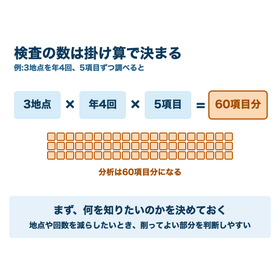
■Should water samples be taken at different depths in ponds and lakes? In lakes and ponds, water quality varies significantly between stagnant and circulation periods, so it is advisable to measure during both periods. During the stagnant period, water samples should be taken at different depths, with standard intervals of 5 to 10 meters. ■What should be recorded on-site? It is essential to record the date and time of sampling, flow rate, rainfall conditions, and major pollution sources nearby. Water temperature, color, turbidity, and odor should be measured on-site as a rule. Samples that cannot be analyzed immediately should be preserved according to the method specified in JIS K0102. The analysis method for each item should also be noted in the results. ■The number of tests is determined by multiplication For example, if three locations are tested four times a year for five items each, that results in 60 items for analysis. When wanting to reduce the number of locations or tests, it is helpful to first determine what information is needed, making it easier to identify areas that can be cut. ■If results are to be presented externally If you plan to submit results, check whether the requesting party is registered under the Measurement Law. In addition to water quality testing requests, our company also offers consultations on rental equipment for measuring total nitrogen, total phosphorus, and COD. Please feel free to contact us for more information.
catalog(2)
Download All Catalogs

Recommended products

Distributors

Since our founding, we have continued to provide flexible services with the motto of accurately supplying a diverse range of products that respond to changes in the times and the diversification of consumer needs, tailored to various applications and requirements. With the corporate slogan "Chemical Engineering Partner," we, as a group of experts in chemical technology, actively discover ideas to solve our customers' problems from advanced technologies both domestically and internationally, and propose them.