
What is groundwater quality testing? Environmental standards and monitoring research [Basic Knowledge]
Is the measurement the same as that for drinking water? We will summarize the 28 environmental standards for groundwater, the monitoring surveys conducted by the national and local governments, and the key points to consider in factories and businesses.
The purpose of investigating groundwater can be broadly divided into two categories: testing whether well water can be used as drinking water, and examining whether the groundwater itself is contaminated from an environmental perspective. The former is assessed based on water quality standards for tap water, while the latter is judged according to environmental standards for groundwater. The drinking water tests will be covered in a separate article, and this article will focus on the latter. ■ What are the environmental standards for groundwater? Based on the Basic Environmental Law, the government has established desirable standards for protecting human health through official notifications. There are 28 criteria values set for all groundwater. Measurements are conducted at locations that accurately capture the contamination situation, taking into account factors such as groundwater flow. ■ Main contents of the 28 items 1. Metals, etc.: Cadmium, lead, hexavalent chromium, arsenic, total mercury, etc. 2. Volatile organic compounds: Trichloroethylene, tetrachloroethylene, benzene, etc. 3. Others: Nitrate nitrogen and nitrite nitrogen, fluoride, boron, 1,4-dioxane, thiuram, etc. Please feel free to consult us first.
basic information
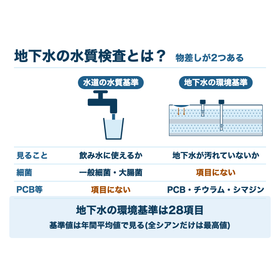
■Is it the same items as the drinking water standards?! The water quality standards for tap water include general bacteria and E. coli, but these are not included in the environmental standards for groundwater. Conversely, PCB, thiuram, and simazine are included in the environmental standards but not in the water quality standards. The items measured differ between determining whether water is drinkable and confirming contamination. ■Are the standard values viewed as annual averages? The standard values are based on annual averages, with total cyanide being the only maximum value. "Not detected" refers to results measured by a specified method that fall below the quantification limit. ■Who is monitoring groundwater? Under the Water Pollution Control Act, the governor of the prefecture continuously monitors the quality of groundwater and prepares a measurement plan each year. The heads of local public bodies can request cooperation from well owners for measurements. There may be cases where a company's well becomes the subject of measurement. ■Monitoring consists of three types of surveys 1. Overview survey: Grasping the overall situation of the region 2. Contaminated well surrounding area survey: Confirming the extent of identified contamination 3. Continuous monitoring survey: Ongoing monitoring of areas where contamination has been confirmed In the overview survey, many municipalities adopt a rolling method that divides the area and surveys the entire region over several years.
Price range
Delivery Time
Applications/Examples of results
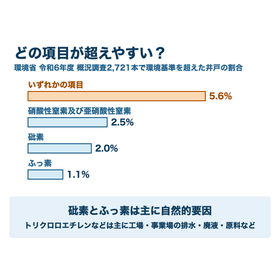
■ Which items are likely to exceed? In the national overview survey for fiscal year 2024, 5.6% of the 2,721 wells exceeded environmental standards for at least one item. By item, the order is as follows: nitrate and nitrite nitrogen 2.5%, arsenic 2.0%, and fluoride 1.1%. Arsenic and fluoride are primarily due to natural factors, while substances like trichloroethylene are mainly from factory and business wastewater, waste liquids, and raw materials. ■ If found, investigate the surroundings! In the investigation of areas around contaminated wells, the range is determined based on groundwater flow, and if it is difficult, an initial survey is conducted within a radius of about 500 meters from the contaminated well. ■ What if it seeps in? Under the Water Pollution Prevention Act, if health damage occurs or is likely to occur due to the infiltration of water containing harmful substances into the ground, the governor of the prefecture can order the facility operator to take measures for groundwater purification. ■ Measures to prevent seepage into the ground The Water Pollution Prevention Act requires operators of specified facilities that use harmful substances to comply with standards for structures that prevent the underground infiltration of water containing harmful substances and to conduct regular inspections and maintain records. We also accept inquiries regarding groundwater and well water testing. Please feel free to consult with us.
catalog(1)
Download All Catalogs
Recommended products








Distributors

Since our founding, we have continued to provide flexible services with the motto of accurately supplying a diverse range of products that respond to changes in the times and the diversification of consumer needs, tailored to various applications and requirements. With the corporate slogan "Chemical Engineering Partner," we, as a group of experts in chemical technology, actively discover ideas to solve our customers' problems from advanced technologies both domestically and internationally, and propose them.