
What is school water quality testing? Daily inspections and regular tests [Basic Knowledge]
Inspection of drinking water as determined by school environmental health standards. This explains who checks, at which faucet, and what is verified during inspections on every school day and regular inspections each academic year.
The management of drinking water in schools is established by the school environmental health standards announced by the Ministry of Education, Culture, Sports, Science and Technology based on the School Health and Safety Act. Water testing consists of two types: daily inspections conducted on every school day and periodic inspections carried out a set number of times each academic year. ■ What is the difference between daily inspections and periodic inspections? Daily inspections primarily use sensory methods, meaning they check for abnormalities using human sight, smell, and taste, and the results are utilized for periodic inspections and emergency checks. Periodic inspections are conducted to objectively and scientifically grasp the actual conditions of each item and to take follow-up measures based on the results. ■ Who conducts the daily inspections? It is necessary to clearly define the roles of faculty and staff through school duties and ensure that inspections are carried out reliably. ■ Who conducts the periodic inspections? Periodic inspections can be conducted by the school pharmacist themselves, by faculty and staff under the guidance and advice of the school pharmacist, or by consulting with the school pharmacist to request an external testing agency. Even when relying on a testing agency, it is important not to delegate everything; the school community should take the lead in planning the inspections, collecting samples, and evaluating the results. Please feel free to consult with us first.
basic information
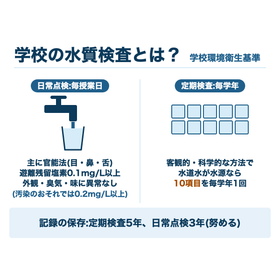
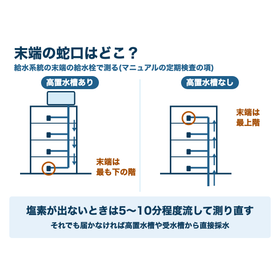
■Main points to check on each class day 1. Free residual chlorine: At least 0.1 mg/L from the tap water (if there is a significant risk of contamination from pathogenic microorganisms in the water source, at least 0.2 mg/L) 2. Appearance, odor, taste: No abnormalities 3. Water coolers, etc.: Water from storage water supply equipment should be managed in the same way as tap water ■Which faucet to measure? Measure at the tap at the end of the water supply system. In buildings with elevated water tanks, the lowest floor is the endpoint; in buildings without elevated water tanks, the top floor is the endpoint. If there are multiple elevated water tanks, check each system separately. ■What if chlorine is not detected? Run the water for about 5 to 10 minutes to flush out the water that has accumulated in the supply pipes, then measure again. ■Inspecting the water supply route If the standards are still not met, investigate by taking samples directly from the elevated water tank or receiving tank to determine where chlorine levels are decreasing or if contamination is occurring. ■What to do after long breaks?! After long periods of non-use, such as summer or winter vacations, especially run the water for a longer time before checking free residual chlorine, color, turbidity, odor, and taste.
Price range
Delivery Time
Applications/Examples of results
■10 Items for Regular Inspection For drinking water sourced from tap water, general bacteria, E. coli, chloride ions, organic matter (TOC), pH value, taste, odor, color, turbidity, and free residual chlorine are inspected once a year for each academic year. If there is a water storage tank, inspections will be conducted by system. ■Is Regular Inspection Required for Direct Water Supply? Direct water supply is exempt from regular inspections because the supplier conducts water quality tests and the school performs daily checks. ■Using Well Water or Rainwater Increases the Frequency! When using sources like well water, inspections will be conducted according to the items and frequency applicable to dedicated water supply, while rainwater and other utility water will be tested for 5 items, including pH value and E. coli, twice a year for each academic year. ■Does Water Quality Deteriorate with Fewer Students? If the amount of water used decreases, the daily turnover rate of the water in the storage tank may drop, leading to the disappearance of residual chlorine and a potential decline in water quality. In such cases, a review of the effective capacity of the storage tank or consideration of modifications to direct water supply will be undertaken. ■Records are Kept for 5 Years and 3 Years Records of regular inspections are kept for 5 years. Daily inspection records should be maintained, with efforts made to keep them for 3 years. We also offer consultations on the selection of chlorine agents. Please feel free to reach out to us for inquiries.
catalog(3)
Download All Catalogs

Recommended products
Distributors

Since our founding, we have continued to provide flexible services with the motto of accurately supplying a diverse range of products that respond to changes in the times and the diversification of consumer needs, tailored to various applications and requirements. With the corporate slogan "Chemical Engineering Partner," we, as a group of experts in chemical technology, actively discover ideas to solve our customers' problems from advanced technologies both domestically and internationally, and propose them.