
What is the method for treating plating wastewater? Precipitation of heavy metal hydroxides [Basic Knowledge]
Does plating wastewater contain not only zinc but also cyanide and hexavalent chromium? This explains the mechanism of hydroxide precipitation and points to consider regarding pH and chelating agents.
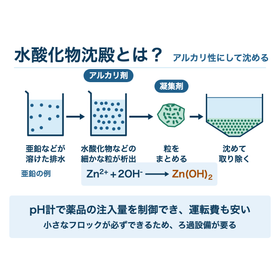
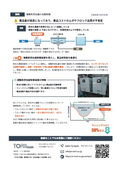
In the wastewater from the electroplating industry, cyanide, hexavalent chromium, boron, and fluoride often coexist alongside zinc. Cyanide compounds may be decomposed, while chromium compounds may be reduced, and pre-treatment can be carried out by separating these systems. The main treatment methods for heavy metals are as follows: 1. Coagulation and precipitation method: Changing them into forms that are difficult to dissolve in water and allowing them to settle. 2. Adsorption method: Allowing them to remain dissolved while adsorbing onto resins or similar materials. The coagulation and precipitation method, which has simple operations and equipment, is widely used. ■ What is hydroxide precipitation? When wastewater is made alkaline using alkalis such as caustic soda, slaked lime, or soda ash, many heavy metals precipitate in the form of hydroxides. This fine particulate matter is aggregated with a coagulant and settled out, which is known as hydroxide precipitation. ■ Why is it commonly used? Three main advantages are noted: 1. The amount of chemicals injected can be controlled using a pH meter. 2. Chemicals are readily available. 3. The operational costs are low. ■ Fine particles remain On the other hand, small flocs are inevitably formed during coagulation and precipitation, so filtration equipment is needed to capture the outflowing portion. Please feel free to consult us first.
basic information
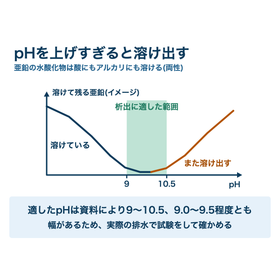
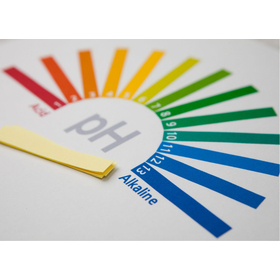
■If you raise it too much, it will dissolve! Zinc hydroxide has the property of being soluble in both acids and alkalis (amphoteric). Therefore, if the pH is raised too high, zinc that has once settled will dissolve again. ■What is the suitable pH for zinc? The suitable range for precipitation is said to be "9 to 10.5," but some say it is as narrow as "around 9.0 to 9.5," indicating a wide variation. Therefore, it is important to conduct tests with actual wastewater to confirm this. ■Theoretical minimum concentration? Based on the degree to which zinc hydroxide is difficult to dissolve (solubility product), the theoretical minimum concentration is about 0.033 mg/L. Compared to the uniform wastewater standard of 2 mg/L, this is about 1/60. ■It doesn't go according to theoretical values Since actual wastewater contains other metals and organic substances, the actual behavior differs from the theory. The calculated values should be considered as just one guideline, and actual wastewater should be tested for confirmation. ■It becomes easier to settle when mixed On the other hand, in wastewater containing two or more types of metals, due to co-precipitation and other effects, precipitation may occur at a lower pH than expected from calculations.
Price range
Delivery Time
Applications/Examples of results
■Do chelating agents interfere with precipitation?! Chelating agents that easily bind to metals are used in plating solutions and other applications. When zinc binds with a chelating agent (forming a complex), it may not precipitate even at the pH where it normally would, and can flow out while still dissolved. ■How to deal with complexes? 1. Replacement method: Add calcium or other elements to replace heavy metals and precipitate them as hydroxides. 2. Liquid chelation method: Can be used over a wide pH range of 4 to 10, allowing treatment near neutral conditions. 3. Sulfide method: Convert to sulfides, which are less soluble than hydroxides. However, the sulfide method is used less frequently due to the toxicity and odor of hydrogen sulfide. Additionally, liquid chelating agents are used as a supplement, not added from the beginning; they are introduced after sufficiently lowering the concentration with iron or other means. ■What to check first If the standard is exceeded, it is important to determine whether zinc is in a "dissolved state" or has flowed out as "suspended solids." You can distinguish between them by filtering through a membrane with a pore size of about 0.45 μm and comparing the concentrations before and after. If it is in the suspended solids state, review the conditions for sedimentation and filtration; if it is in the dissolved state, reassess the conditions for aggregation and precipitation after reducing the chelating agent. Please feel free to consult with us first.
catalog(2)
Download All Catalogs
Recommended products
Distributors

Since our founding, we have continued to provide flexible services with the motto of accurately supplying a diverse range of products that respond to changes in the times and the diversification of consumer needs, tailored to various applications and requirements. With the corporate slogan "Chemical Engineering Partner," we, as a group of experts in chemical technology, actively discover ideas to solve our customers' problems from advanced technologies both domestically and internationally, and propose them.