
What is a sedimentation tank? The mechanism of sedimentation treatment equipment [Basic Knowledge]
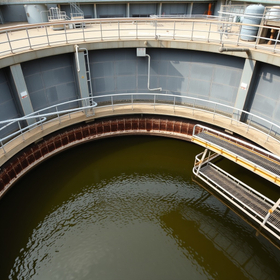
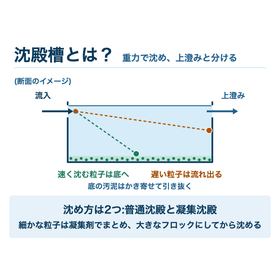
A sedimentation tank that sinks particles using gravity to separate clean supernatant. It will be explained based on the surprising reasoning that the surface area of the water is more effective than the depth.
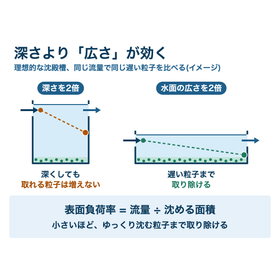
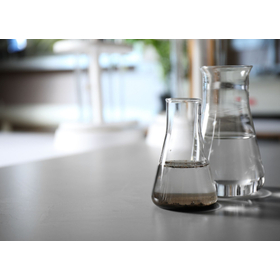
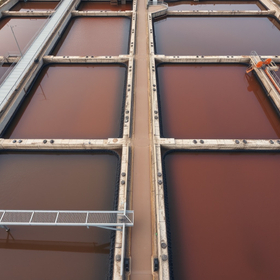
A sedimentation tank is a facility designed to settle heavier particles from water using gravity, separating them from the clear water above. It is one of the fundamental processes in water treatment, from water purification plants to industrial wastewater treatment. ■ Two methods of sedimentation 1. Ordinary sedimentation: Waiting for particles to settle naturally without using chemicals. 2. Coagulation sedimentation: Using coagulants to aggregate fine particles into larger flocs before settling them. When the particles causing turbidity are fine, they do not settle easily on their own. The aim of coagulation sedimentation is to make it easier for fine turbidity to settle. ■ Is "width" more effective than depth?! In an ideal sedimentation tank, whether particles can be removed is determined by the surface area of the water, not the depth of the tank. The smaller the value obtained by dividing the inflow of water by the settling area (surface loading rate), the more slowly settling particles can be removed. Under ideal conditions, simply deepening the tank does not increase the number of particles that can be removed. ■ Think of rivers and ponds In a fast-flowing river, sand is carried away, but when it enters a wide pond, it settles at the bottom. It is also important for a sedimentation tank to ensure a width that allows water to flow gently. Please feel free to consult with us first.
basic information
■Concept of Surface Load Rate The surface load rate is calculated by dividing the flow rate by the submerged area and is expressed in units of speed such as mm/min. 1. Particles that sink faster than this speed: Ideally, all can be removed. 2. Particles that sink slower: Can be removed in proportion to their sinking speed ratio. In other words, the surface load rate indicates how slow particles can be captured. In the design of water purification facilities, standard values are 15-30 mm/min (single layer) and 15-25 mm/min (multi-layer) for horizontal flow sedimentation tanks. ■How to Increase the Removal Force? 1. Expand the submerged area. 2. Grow larger flocs to increase sinking speed. 3. Reduce the amount of water flowing. All of these methods are derived from the concept of surface load rate. ■Increase Area with Inclined Plates! By arranging multiple inclined plates (or tubes) inside the tank, the submerged area can be significantly increased even in limited space. This is a clever application of the principle that area matters, utilized in a three-dimensional way. For the same treatment capacity, it becomes easier to compact the tank. In the design of water purification facilities, an inclined angle of 60° is standard.
Price range
Delivery Time
Applications/Examples of results
■Where is it used? 1. Water purification plants: Remove turbidity from river water and other sources. 2. Factory wastewater treatment: Separate flocs formed by coagulation treatment. 3. Activated sludge method: Separate microbial aggregates from treated water. The properties of the particles to be settled vary greatly depending on the location of use. If the particles are light and difficult to settle, innovations in coagulation become more important. ■Handling of settled sludge The sludge that accumulates at the bottom of the tank is typically collected and removed using a scraper. Creating a slope towards the sludge discharge outlet at the bottom is also a method to facilitate sludge collection. The removed sludge is sent to sludge treatment processes such as concentration and dewatering, and is generally dewatered and disposed of in a cake form. ■Common signs of malfunction? 1. The supernatant becomes turbid. 2. The settled sludge rises to the surface. 3. The settling of flocs worsens. In the sedimentation basin of a water purification plant, the amount of chemical injection is adjusted while observing the settling of flocs and the re-suspension of sludge. In the activated sludge method, changes in the amount of incoming organic matter and sludge can also be causes of issues. Be sure to check not only the conditions inside the tank but also the state of the incoming water. Please feel free to consult us first.
catalog(2)
Download All Catalogs
Recommended products

Distributors

Since our founding, we have continued to provide flexible services with the motto of accurately supplying a diverse range of products that respond to changes in the times and the diversification of consumer needs, tailored to various applications and requirements. With the corporate slogan "Chemical Engineering Partner," we, as a group of experts in chemical technology, actively discover ideas to solve our customers' problems from advanced technologies both domestically and internationally, and propose them.