
What is phosphorus removal in wastewater? Coagulation and biological treatment [Basic knowledge]
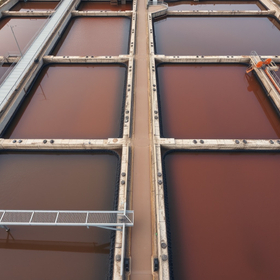
Remove the melted phosphorus by transferring it to the solid side? This explains the mechanisms of the method using coagulants and the method using microorganisms.
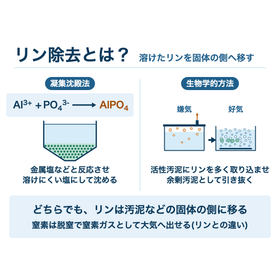
Phosphorus, along with nitrogen, is a nutrient that causes eutrophication. When nutrient salts increase in closed water bodies, phytoplankton proliferate, leading to red tides and blue-green algae blooms. There are standards for phosphorus content in the regulations that set wastewater discharge criteria, but these apply only to lakes and marine areas designated by the Minister of the Environment, as well as to the discharge water flowing into those public water bodies. ■ Where does phosphorus go? Nitrogen can be released into the atmosphere as nitrogen gas through denitrification. In contrast, phosphorus removal involves converting dissolved phosphorus into less soluble compounds and removing it through solid-liquid separation. Whether using coagulants or microorganisms, phosphorus transfers to the solid side, such as sludge. ■ What are the typical methods? 1. Coagulation and sedimentation method: Reacting with metal salts to form insoluble salts that settle. 2. Biological method: Allowing activated sludge to uptake a large amount of phosphorus and then extracting it as excess sludge. ■ There are also crystallization and adsorption methods. In addition, there are phosphorus removal methods using crystallization and adsorption. The choice of method varies depending on the target concentration and equipment conditions. Please feel free to consult us first.
basic information
■ How does the coagulant react with phosphorus? Coagulants such as sulfate bands and ferric chloride are widely used to convert phosphorus into insoluble aluminum phosphate or iron phosphate for sedimentation. For trivalent aluminum ions, the basic reaction can be expressed as follows: Al(3+) + PO4(3-) → AlPO4 However, in actual wastewater, multiple reactions occur simultaneously, such as the formation of hydroxides through reactions with bicarbonate ions. Therefore, the required amount of metal salts is 2 to 3 times the theoretical amount, which also increases the amount of sludge. Since the suitable pH differs depending on the type of coagulant, pH adjustment may be necessary. The injection amount and pH are determined while checking with the actual wastewater. ■ Can phosphorus be removed with lime? When lime is added to activated sludge treatment water with a pH of 9.5 to 10, insoluble hydroxyapatite is formed. 10Ca(2+) + 6PO4(3-) + 2OH(-) → Ca10(PO4)6(OH)2 One advantage of using lime is that anions do not accumulate like with sulfate bands, and the amount of salts does not increase. Polyphosphates can also be removed.
Price range
Delivery Time
Applications/Examples of results
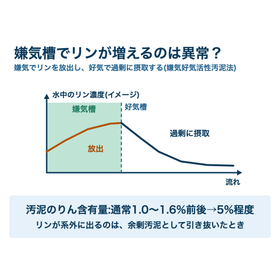
■Do microorganisms accumulate phosphorus?! In activated sludge, there are bacteria known as polyphosphate-accumulating organisms (PAOs). Activated sludge takes in organic matter while releasing phosphorus under anaerobic conditions, and then excessively absorbs phosphorus under subsequent aerobic conditions. The anaerobic-aerobic activated sludge method (AO method) utilizes this property by having the first half of the reaction tank as an anaerobic tank and the second half as an aerobic tank. The phosphorus content in sludge is usually around 1.0 to 1.6%, but in sludge that has excessively absorbed phosphorus, it can increase to about 5%. ■Is it abnormal for phosphorus to increase in the anaerobic tank? The rise in phosphorus concentration in the anaerobic tank is a phenomenon that occurs based on this mechanism. Phosphorus exits the system when sludge that has absorbed a lot of phosphorus is withdrawn as excess sludge. ■Where to add coagulants Coagulants can be added in several places, including the pretreatment sedimentation tank, direct addition to the aeration tank, coagulation sedimentation after biological treatment, and just before sand filtration. ■Rental of coagulants and measurement devices Our company also offers rental services for measurement devices for total nitrogen and total phosphorus, in addition to coagulants. Please feel free to consult with us first.
catalog(2)
Download All Catalogs
Recommended products

Distributors

Since our founding, we have continued to provide flexible services with the motto of accurately supplying a diverse range of products that respond to changes in the times and the diversification of consumer needs, tailored to various applications and requirements. With the corporate slogan "Chemical Engineering Partner," we, as a group of experts in chemical technology, actively discover ideas to solve our customers' problems from advanced technologies both domestically and internationally, and propose them.