
[Analysis Case] Transient Eddy Current Analysis in Conductors Due to Pulsed Current



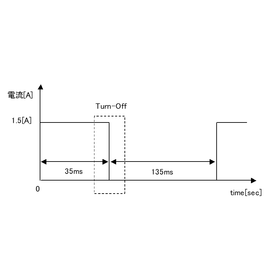
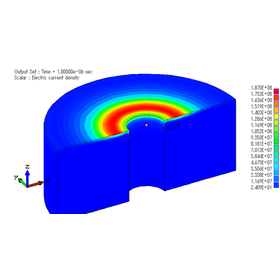
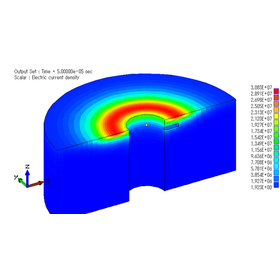
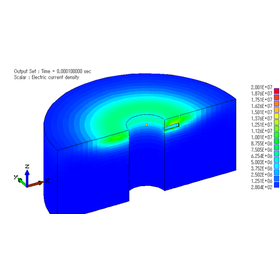
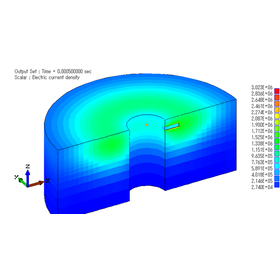
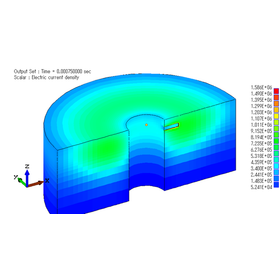
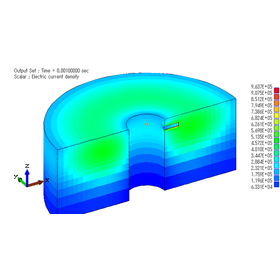
For the evaluation and visualization of pulsed eddy current testing (PEC)! High-precision simulation of transient eddy current changes after current off and behavior around defects.
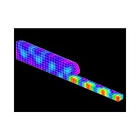
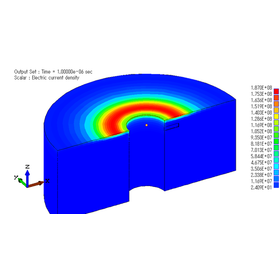
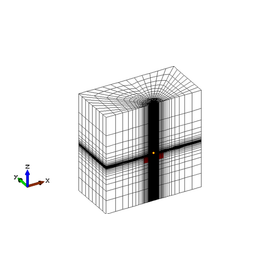
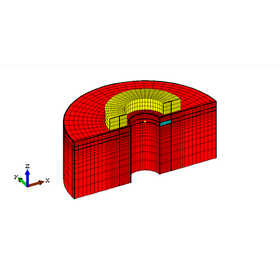
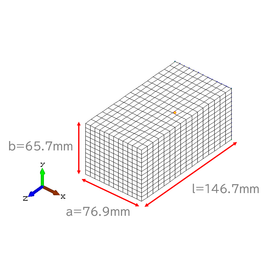
Defect detection in aluminum conductors and similar materials (Pulsed Eddy Current Testing: PEC) requires a thorough understanding of the transient eddy current time variation immediately after the current is turned off and the flow around defects. This time, we will introduce a visualization case using the dynamic magnetic field analysis software "PHOTO-EDDY." In this analysis, we reproduce the behavior of eddy current concentration (skin effect) on the surface of the conductor immediately after the rectangular pulse current is turned off, showing how it reaches the defect depth and spreads into the deeper layers over time. The local changes in current density at the defect site can also be visually evaluated by setting the skin layer mesh. 【Features and Benefits of Introduction】 - Time-series visualization of eddy currents: Clearly evaluate transient diffusion behavior and local concentration. - High-precision modeling: Analyze minute defects with mesh division that considers the skin effect. - Optimization of non-destructive testing: Contribute to the preliminary examination and efficiency of testing conditions (pulse width, etc.). 【Overview of Analysis Case】 - Analysis target: Aluminum conductor (with through holes and defects) & excitation coil (compliant with TEAM Problem 27). - Evaluation items: Time-series transition of transient eddy current density distribution (1.0e-6 to 1.0e-3 [sec]). - Software used: Dynamic magnetic field analysis software PHOTO-EDDY. *For detailed data and results, please feel free to download the PDF or contact us.
basic information
- Software Classification: 3D Magnetic Field Analysis Software - Analysis Method: Finite Element Method (FEM) - Target Phenomena: Transient Electromagnetic Field Analysis, Eddy Current Analysis, Magnetic Field Analysis - Supported Mesh Configuration: Skin layer mesh capable of reproducing the skin effect, compatible with air region mesh - Modeling Support: Periodic and symmetric boundary analysis considering symmetry, such as 1/2 models - Evaluation Features: Eddy current density (contour display), electric and magnetic field contours, time-series step evaluation (transient response for 1.0e-6 to 1.0e-3 sec, etc.) - Operating Environment: Compatible with Windows OS
Price range
Delivery Time
Model number/Brand name
PHOTO-EDDY
Applications/Examples of results
[Purpose] - Investigation of detection sensitivity and conditions for Pulsed Eddy Current (PEC) - Non-destructive testing simulation of internal defects, cracks, and fissures in aluminum and metal conductors - Optimization study of excitation pulse width and excitation current - Visualization and mechanism elucidation of skin effect and transient diffusion phenomena of eddy currents [Examples of Achievements] - Transient eddy current verification based on TEAM Workshop Problem 27 (through-hole and defected aluminum conductor with circular coil) - Evaluation results of eddy current reaching deep defects and local concentration over time after the pulse current is turned off
catalog(3)
Download All Catalogs


Recommended products











Distributors

At Photon, we are developing "electromagnetic field analysis software" that models and simulates products and components utilizing electromagnetic phenomena on a computer. In traditional design and development environments, the process has primarily revolved around trial and error through prototyping based on the experience of engineers and experiments with prototypes. However, conducting experiments using actual prototypes and analyzing the results requires significant time and cost. Moving forward, transitioning from an experimental and prototyping-based approach to an analysis-based design approach will be a crucial challenge for improving productivity, and establishing simulation technology as the core of analysis-based design techniques will be essential. In this context, Photon is developing and providing "analysis software" focusing on electromagnetic fields, as well as heat, vibration, and sound fields. By utilizing Photon's software, efficient development and design of various industrial products can be achieved. In this way, Photon aims to support users in reducing the number of prototypes, lowering development costs, and shortening development periods in their manufacturing environments, ultimately enhancing their competitiveness.