
Applied PC equipped with NVIDIA RTX Pro 6000


NVIDIA RTX PRO 6000 Blackwell Max-Q Workstation Edition equipped
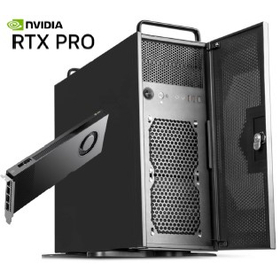
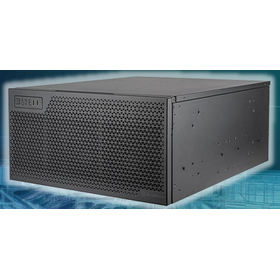
APPLEID Be-Clia Workstation Type-ZU2V2-9 High-Performance Workstation NVIDIA RTX PRO 6000 Blackwell Max-Q Workstation Edition model
basic information
NVIDIA RTX PRO 6000 Blackwell Max-Q Workstation Edition model Be-Clia Workstation Type-ZU2V2-9 ■ OS: Windows 11 Pro 64bit ■ CPU: Intel Core Ultra9 285K (Pcore: 3.7-5.5GHz / Ecore: 3.2-4.6GHz / 24C (P8+E16) / 24T) ■ Memory: 128GB (64GB ×2) DDR5-6400 ■ SSD: 2TB (M.2 NVMe) ■ GPU: NVIDIA RTX PRO 6000 Blackwell Max-Q Workstation Edition 96GB GDDR7 ECC ■ Power Supply: 1000W / 100V 80PLUS Gold certified (ATX3.1) ■ Warranty: 1-year send-back hardware warranty
Price range
Delivery Time
Model number/Brand name
Applied NVIDIA RTX Pro 6000 equipped workstation
Applications/Examples of results
NVIDIA's latest Blackwell architecture, a high-performance GPU designed for professionals! Equipped with 96GB of ultra-fast GDDR7 memory, it delivers exceptional performance in demanding workflows such as AI processing, large-scale simulations, and real-time rendering!
catalog(5)
Download All Catalogs
News about this product(5)
-
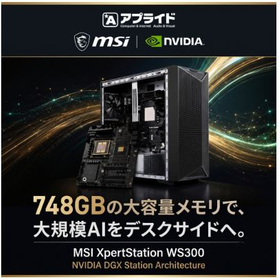
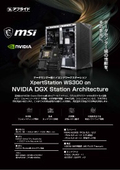
[Blog] Overcoming GPU Memory Shortage. Starting Local Large-Scale AI with the 748GB Equipped "MSI XpertStation WS300"
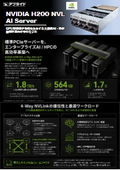
While the use of generative AI is expanding, manufacturing industries and research institutions are facing challenges such as: - Inability to upload confidential data and design information to the cloud - Desired AI models not fitting into GPU memory - Desire to reduce cloud usage costs and waiting times In particular, large-scale language models (LLMs) and vision-language models (VLMs), which process images and text together, are becoming larger. It is not uncommon for general 48GB or 96GB class GPUs to be unable to load the entire model. A new option to address these challenges is the "MSI XpertStation WS300," equipped with 748GB of coherent memory. This article will clearly explain the features of the WS300 and what types of AI development it is suitable for.
-
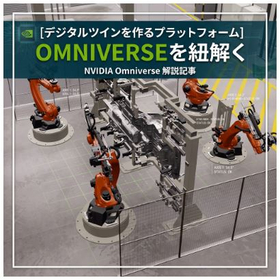
[Blog] Unraveling Omniverse: A Platform for Creating Digital Twins
One of the current demands for AI is "physical AI," and I believe there are increasing opportunities to hear related terms such as "Omniverse" and "Isaac Sim." This time, I would like to unravel the current role and position of "Omniverse."
-

[Exhibition Report] The Cutting Edge Where Physical Space and AI Intersect! The Evolution of Robotics Seen at the "Physical AI Exhibition"
On July 2, 2026, I visited the "Monozukuri World Physical AI Exhibition" being held at Tokyo Big Sight. The evolution of generative AI and reinforcement learning is breaking out of the digital world and exploring how to intelligently operate robots in the real world (physical). This exhibition was a very vibrant space that truly hinted at the next generation of manufacturing and the automation of R&D (research and development). I will report on the latest trends that particularly caught my eye on-site!
-
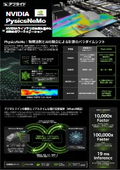
[Blog] [Thorough Explanation] The Full Picture of NVIDIA's Physical AI Platform
In the manufacturing industry and advanced research fields, the use of real machines for trial and error is already reaching its limits. NVIDIA's "Physical AI Platform" aims to completely eliminate the heavy constraints of "time, cost, and risk," elevating development speed to an entirely new dimension. This approach, known as "Sim2Real," allows for safe and instantaneous learning in virtual spaces, conducting tens of thousands to hundreds of millions of iterations, and seamlessly implementing the results into the real world. This is not just a concept; it is a powerful ecosystem that has already been put into practical use. In this article, we will elucidate the three phases that make up this platform and the roles of specific libraries that hold the key to its implementation.
-
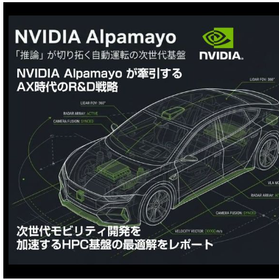
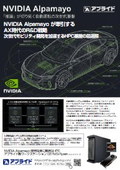
[Blog] <Next-Generation Mobility> R&D Strategy of the AX Era Led by NVIDIA Alpamayo
The development of autonomous driving systems is transitioning from traditional rule-based and modular approaches to an end-to-end "AX (AI Transformation)" environment where AI comprehensively understands situations and makes decisions. NVIDIA's offerings, "Alpamayo," "AlpaSim," and "NuRec," represent the latest ecosystem aimed at the societal implementation of level 4 autonomous driving, balancing safety and explainability. NVIDIA's autonomous driving AI platform "Alpamayo" moves away from reliance on traditional pattern recognition in autonomous driving by incorporating a mechanism where AI "infers (thinks and judges)" like a human, dramatically enhancing safety and reliability. The R&D departments of enterprises will report on the HPC requirements necessary to maximize the use of these technologies, integrating physics-based simulations (CAE) with AI models.
Recommended products












Distributors

Applied Corporation is a computer manufacturing company based in Hakata-ku, Fukuoka City, Fukuoka Prefecture, with 65 locations nationwide. We provide the latest business proposals, from cutting-edge computers to the implementation of DX and solutions, for corporate clients across the country.