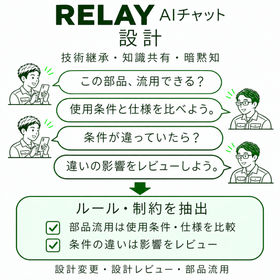
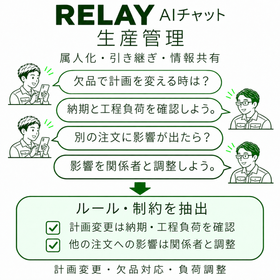
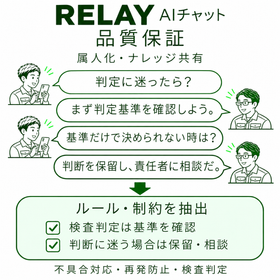
Transforming tacit knowledge of development into explicit knowledge: RELAY that retains evaluation focus.

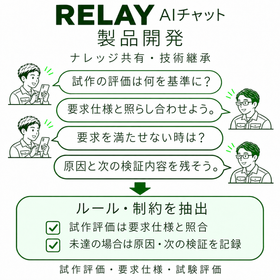
The veteran leaves a record in words of where they looked at the prototype.
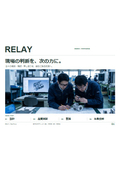
Even if a veteran notices something off about a prototype, what they observed to decide on the next test tends to get buried in the conversation at that moment. To formalize the tacit knowledge of development, it is essential to articulate the perspectives of experienced individuals and the conditions that led to their judgments. RELAY organizes points of concern, additional conditions for confirmation, and reasons for the chosen evaluation approach from chats between those in charge of development and evaluation using AI. The responsible parties can then review the original explanation and the state of the prototype, sharing it as knowledge to reference for the next test. This leaves concrete materials for younger staff to learn the thought processes that led to the results. [Check the usage image in the catalog] Download the related catalog "RELAY Manufacturing Industry Use Case Collection_Design" to see how RELAY can be utilized in the design department. This serves as a reference for other departments when considering its application in product development.
basic information
[Information handled through the formalization of tacit knowledge] The subject is a chat for discussing the status of prototypes and additional evaluations. The AI organizes the key points and reasoning, and the person in charge verifies the original explanations and testing conditions. The confirmed content is shared as formal knowledge, utilizing the tacit knowledge of development for the next evaluations and training of personnel.
Price range
Delivery Time
Model number/Brand name
RELAY
Applications/Examples of results
Utilization Image: Formalization of Tacit Knowledge A veteran pointed out that the operational sound of the prototype changes only during specific operations. They leave the conditions chosen for additional evaluation and the reasons for wanting to verify those conditions. Young members can reflect not only on the measurement results but also on how the tests were structured. This serves as material for considering whether the same perspective is necessary when evaluating the next prototype.